On eBird ↗
Chestnut Quail-thrush
Live sightings near you, the range map, bar charts of when it is seen, and Macaulay Library photos and recordings.
Chestnut Quailthrush
Cinclosoma castanotum
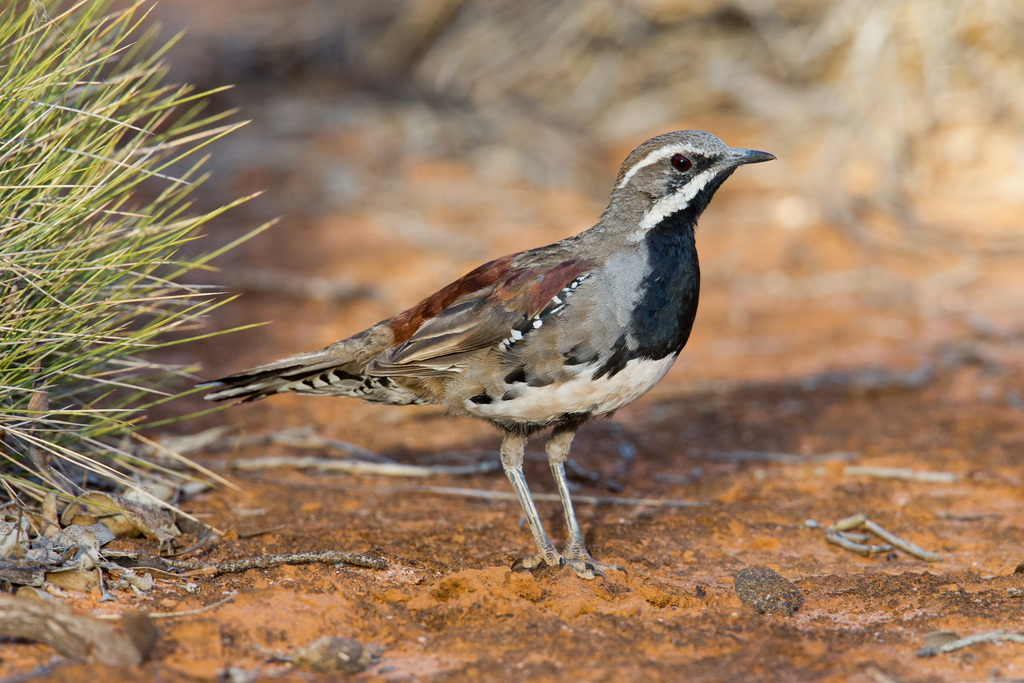
The chestnut quail-thrush (Cinclosoma castanotum) is a native Australian bird of the family Cinclosomatidae. These scrub birds are endemic to Australia and found in all states - barring Tasmania. They are relatively uncommon and are isolated to the semi-arid and arid fringes of the Australian interior.
From the article Chestnut quail-thrush on Wikipedia (CC BY-SA), quoted section by section
Description
Similar in physical appearance to other species such as Cinclosoma cinnamomeum and C.c. punctatum, the chestnut quail-thrush is a medium-sized bird that resides in the lower canopy and scrub of arid and semi-arid vegetation. The male is characterised by a black breast, grey flank, and chestnut to grey-brown upper parts with white eyebrow and throat-patch. The female differs with a grey throat and breast, rufous and light brown upper parts, and a yellow-buff eyebrow and mark on throat, presenting an overall duller hue than the male. Both sexes have a white belly. The difference in plumage and body size is attributed to the sexual dimorphism common amongst the Cinclosoma genus. They are known to collect in pairs and small family groups, using scrub and bushes for concealment and song perches, and running swiftly in rocketing bursts when disturbed or alarmed. The chestnut quail-thrush can be distinguished by its high-pitched call, heard as a wheit-wheit-wheit or an insect-like see-see see.
Range & habitat
The chestnut quail-thrush occurs in a relatively large area across the interior of Australia, covering both semi-arid and arid landscapes. It inhabits central Queensland, extending down through western New South Wales and continuing south as far as Cobar. The distribution and habitats of the chestnut quail-thrush are naturally fragmented due to natural landscape breaks, such as those that do not support mallee or heathland and thus a lack of suitable habitat. The traditional habitat of the chestnut quail-thrush is scrub and low-lying vegetation, such as mulga-eucalyptus and acacias that reside on stony ground, as well as grevilleas and tea trees on rocky hillocks. There is a variance between the habitat preferred by the chestnut quail-thrush in NSW and those in WA, with the former occurring exclusively in mallee woodlands that feature spinifex and acacia shrubs, while the latter occupies an understorey habitat characterised by sclerophyll woodlands, acacia shrubs and heathland. Their relationship to fire regimes varies with the highest densities occurring between two and fifteen years, while densities have been observed to drop when fire intervals fall below two years.
Wikipedia: “Distribution and habitat”
What it does
The chestnut quail-thrush is a largely ground-based bird that favours the understorey over the canopy in order to forage, nest and hide from predators. They are a locally nomadic bird that prefers to run than fly – with or without disturbance. They are a diurnal species that forages during the day and are often seen in pairs or small family groups when foraging, nesting or singing. It has been observed that, as with other quail-thrush, they can be easily confused with a babbler when running. Easily disturbed from external activity, the chestnut quail-thrush is difficult to follow and has a practiced skill in hiding in undergrowth and scrub when threatened. The Cinclosoma castanotum is an omnivore species that feeds on a combination of ground-laden insects and seeds. They are often observed foraging through clumps of spinifex chasing insects such as grasshoppers, beetles and caterpillars, both native and exotic seed, as well as the fruit of various native plants.
Wikipedia: “Behaviour and diet”
Listen
Looking for field recordings…
Where it lives
Recorded sightings
—
geo-referenced records in GBIF, from museums, herbaria and field observers.
Drag the globe to turn it. Dots are where records exist, not a range map; darker means more records.
In the stacks
Searching the stacks…
Every page naming Cinclosoma castanotum in the Biodiversity Heritage Library →
This page is assembled live from iNaturalist, GBIF, Wikipedia, the Source Library and the Internet Archive. It is not yet part of the hand-edited codex. iNaturalist taxon 512094.