- Animals
- ›Arthropods
- ›Hexapods
- ›Insects
- ›Winged and Once-winged Insects
- ›Mayflies
- ›Furcatergalia
- ›Scapphodonta
- ›Ephemeroidea
- ›Burrowing Mayflies
- ›Hexageniinae
- ›Hexagenia
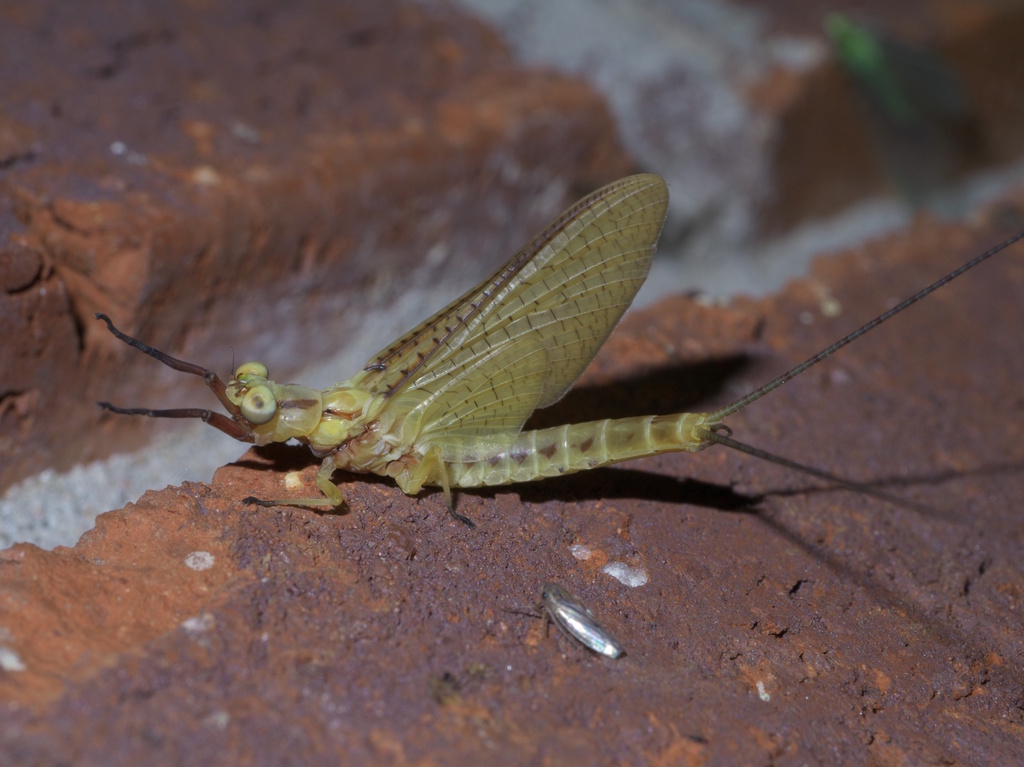
Giant Mayfly
Hexagenia limbata
Hexagenia limbata, the giant mayfly, is a species of mayfly in the family Ephemeridae. It is native to North America where it is distributed widely near lakes and slow-moving rivers. The larvae, known as nymphs, are aquatic and burrow in mud and the adult insects have brief lives. They are often referred to as fish flies around the Great Lakes as they tend to cause the areas around water to smell like rotten fish.
It's also called the golden mayfly, big Michigan mayfly and great leadwing drake.
From the article Hexagenia limbata on Wikipedia (CC BY-SA), quoted section by section
Description
The mature adult stage of Hexagenia limbata can be as much as 27 mm (1.1 in) long. The females tend to be slightly larger than the males but have smaller eyes. The forewings are long and membranous while the hind wings are much smaller and have dark margins. The tip of the abdomen bears two long cerci or tails. When the insect is at rest, the wings are folded vertically above the back. The color and body markings are somewhat variable but this insect is usually some shade of yellow, pale brown or white.
Range & habitat
Hexagenia limbata is the most widely distributed mayfly in North America. It is known from most of Canada and all the states in the United States except Alaska and Arizona. It is at its most common in the Great Lakes region. Its habitat is lakes and slow-moving rivers with muddy bottoms in which the nymphs can burrow. Adults can be found congregating in swarms near the water or resting in vegetation. Due to lake pollution, H. limbata was not observed on the U.S. side of Lake Erie between 1953 and the early 1990s.
Wikipedia: “Distribution and habitat”
What it does
The female lays eggs in the water which sink to the bottom. They may hatch fairly soon, but many overwinter as eggs and hatch in the spring. The newly hatched nymph is about 1 mm (0.04 in) long. It has a long, roughly cylindrical body and passes through up to thirty molts during its development. It has tusks on its mandibles with which it can dig, three pairs of legs, developing wingpads in later growth stages, and three elongated tails. It lives in a U-shaped burrow which it excavates in the mud, and has seven pairs of feathery gills on its abdomen with which it wafts water through its burrow to increase aeration. In cold northern lakes, it may take two years to develop, but in canals in the south of the United States, this may be reduced to as little as seventeen weeks. When the fully developed nymph rises to the surface to emerge as an adult, it first enters a subimago stage. This is similar in appearance to the adult, but has cloudy rather than clear wings and lacks functional genitalia. …
Wikipedia: “Ecology”
Listen
Looking for field recordings…
Where it lives
Recorded sightings
—
geo-referenced records in GBIF, from museums, herbaria and field observers.
Drag the globe to turn it. Dots are where records exist, not a range map; darker means more records.
In the stacks
Searching the stacks…
Every page naming Hexagenia limbata in the Biodiversity Heritage Library →
This page is assembled live from iNaturalist, GBIF, Wikipedia, the Source Library and the Internet Archive. It is not yet part of the hand-edited codex. iNaturalist taxon 51116.