- Plants
- ›Vascular Plants
- ›flowering plants
- ›Dicots
- ›Mints, Plantains, Olives, and Allies
- ›bignonia family
- ›Catalpeae
- ›Catalpa
- ›Catalpa
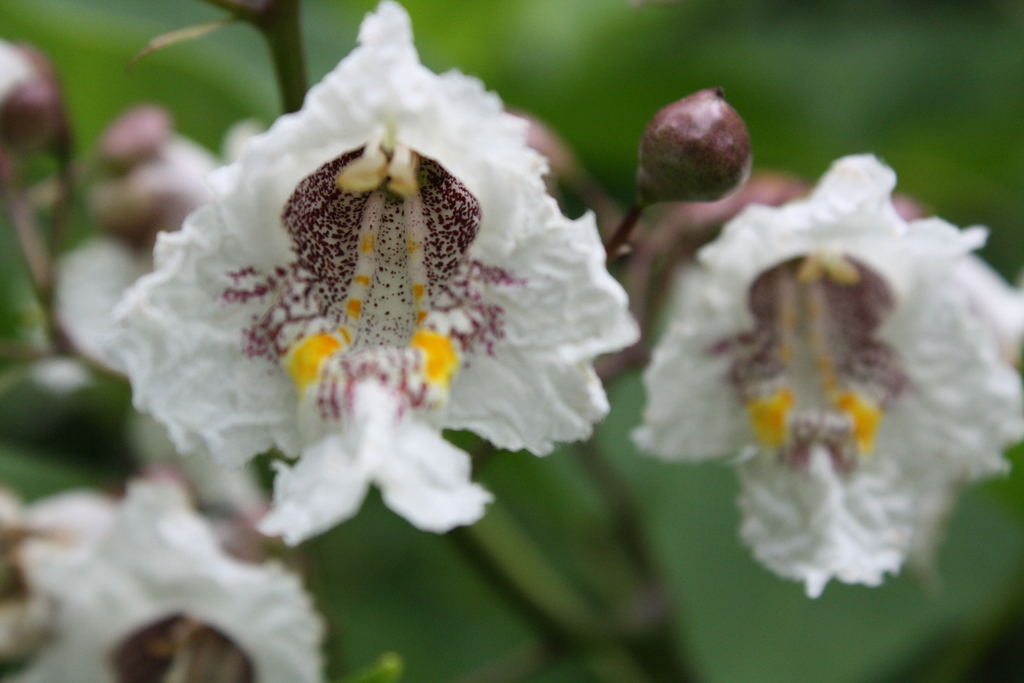
southern catalpa
Catalpa bignonioides
Catalpa bignonioides is a short-lived species of Catalpa that is native to the southeastern United States in Alabama, Florida, Georgia, Louisiana, and Mississippi. Common names include southern catalpa, cigartree, and Indian bean tree It is commonly used as a garden and street tree.
From the article Catalpa bignonioides on Wikipedia (CC BY-SA), quoted section by section
Description
Catalpa bignonioides is a deciduous tree growing to 25–40 feet (7.6–12.2 m) tall with an equal or greater spread, with a trunk up to 1 metre (3 ft 3 in) diameter, with brown to gray bark, maturing into hard plates or ridges. The short thick trunk supports long and straggling branches which form a broad and irregular head. The roots are fibrous and branches are brittle, its juices are watery and bitter tasting. The leaves are large, bright green and heart shaped, being 20–30 cm (8–12 in) long and 15–20 cm (6–8 in) broad. They appear late, and as they are full-grown before the flower clusters open, they add much to the beauty of the blossoming tree. They secrete nectar, a most unusual characteristic for leaves, by means of groups of tiny glands in the axils of the primary veins. The nectar secretion starts a week before the tree's flowers bloom and up to ten days after the blooming stops.
The flowers are 2.5–4 cm across, trumpet shaped, white with yellow spots inside; they grow in panicles of 20–40. In the northern states of the USA, it is a late bloomer, putting forth great panicles of white flowers in June or early in July when the flowers of other trees have mostly faded. These cover the tree so thickly as almost to conceal the full-grown leaves. …
Range & habitat
In the USA, Catalpa bignonioides is undoubtedly a Southern tree. Europeans first observed the tree growing in the fields of the Cherokee Native American tribes. However, it can flourish in the North as well, and accordingly its original range is somewhat in doubt. Despite its southern origins, it has been able to grow almost anywhere in the United States and southernmost Canada, and has become widely naturalized outside its restricted native range.
Wikipedia: “Distribution”
At the table
It is a fast-growing tree and widely grown as an ornamental tree. The catalpa has the distinction of bearing some of the showiest flowers of all the American native trees. Its value in this respect has long been recognized and it holds an assured place in the parks and gardens of all temperate countries. It has gained the Royal Horticultural Society's Award of Garden Merit, as has the gold-leafed cultivar C. bignonioides 'Aurea'. The purple-leaved hybrid Catalpa × erubescens 'Purpurea' syn. C. bignonioides 'Purpurea', has also achieved the award (confirmed 2017). It prefers moist soil and full sun. It is easily raised from seeds which germinate early in the first season. It also multiplies readily from cuttings. The tree is fairly free from fungal diseases and has few insect enemies. The wood is brittle and hard, but does not rot easily; it is used for fence posts and railroad ties. Catalpa bignonioides contains varying levels of iridoid glycosides that deter generalist herbivores, but which are tolerated by and concentrated in Ceratomia catalpae caterpillars. These caterpillars have a longstanding ecological relationship with the tree, and may defoliate a tree three or more times in a summer without killing it. …
Wikipedia: “Cultivation and uses”
In human culture
The genus was common in Europe during the Tertiary period. In North America its fossil remains have been discovered in the Miocene rocks of the Yellowstone River.
Wikipedia: “History”
Where it lives
Recorded sightings
—
geo-referenced records in GBIF, from museums, herbaria and field observers.
Drag the globe to turn it. Dots are where records exist, not a range map; darker means more records.
In the old herbals & bestiaries

In the stacks
Searching the stacks…
Every page naming Catalpa bignonioides in the Biodiversity Heritage Library →
This page is assembled live from iNaturalist, GBIF, Wikipedia, the Source Library and the Internet Archive. It is not yet part of the hand-edited codex. iNaturalist taxon 50859.