- Plants
- ›Vascular Plants
- ›flowering plants
- ›Dicots
- ›Roses, Elms, Figs, and Allies
- ›rose family
- ›brambles, roses, strawberries, and allies
- ›strawberries, cinquefoils, and allies
- ›strawberry subtribe
- ›Fragaria
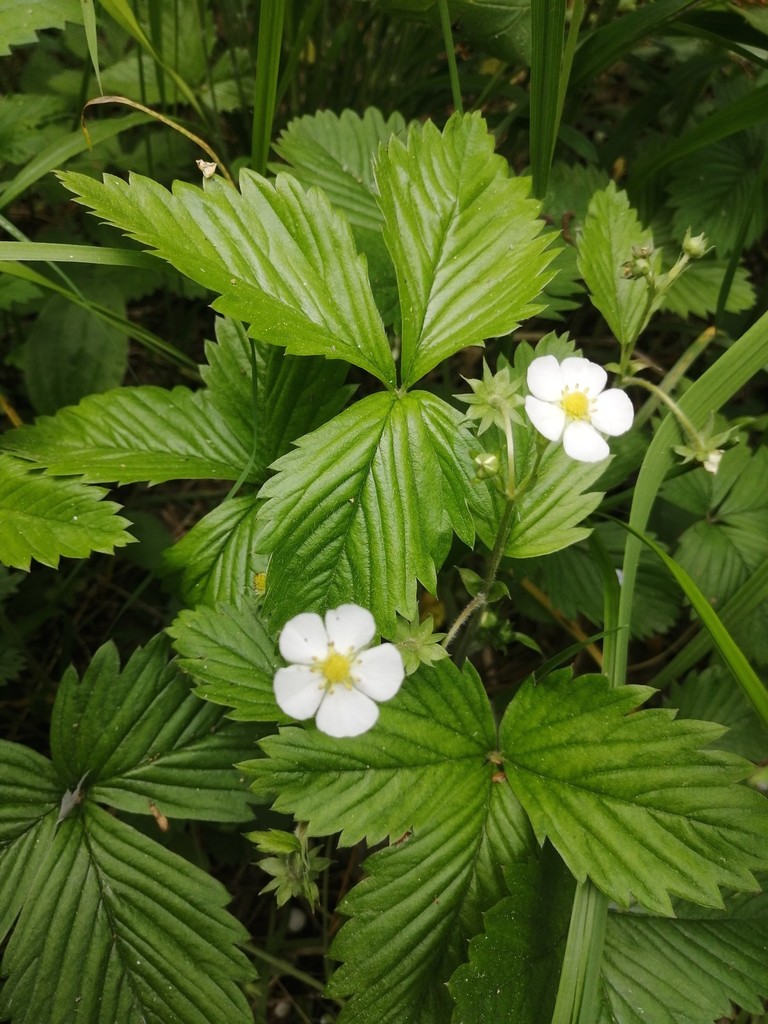
woodland strawberry
Fragaria vesca
Fragaria vesca, commonly called the woodland strawberry, Alpine strawberry, wild strawberry, Carpathian strawberry or European strawberry, is a perennial herbaceous plant in the rose family that grows naturally throughout much of the Northern Hemisphere, and that produces edible fruits.
The Latin specific epithet vesca literally means "thin" or "feeble", but likely carries the sense "edible" in this context (compare vescor, "to eat").
From the article Fragaria vesca on Wikipedia (CC BY-SA), quoted section by section
Description
Five to eleven soft, hairy white flowers are borne on a green, soft fresh-hairy 3–15 centimetres (1–6 in) stalk that usually lifts them above the leaves. The light-green leaves are trifoliate (in threes) with toothed margins. The plant spreads mostly by means of runners (stolons), but the seeds are viable and establish new populations. Its fruit persists for an average of 1.2 days, which is possibly the shortest persistence of any fleshy fruit in Europe. It bears an average of 46.8 seeds per fruit, which is possibly the highest per fruit of any in Europe. Fruits average 84.0% water, and their dry weight includes 21.0% carbohydrates and 5.5% lipids, one of the higher lipid values among European fleshy fruits.
What it does
Typical habitat is along trails and roadsides, embankments, hillsides, stone- and gravel-laid paths and roads, meadows, young woodlands, sparse forest, woodland edges, and clearings. Often plants can be found where they do not get sufficient light to form fruit. In the southern part of its range, it can grow only in shady areas; further north it tolerates more sun. It is tolerant of a variety of moisture levels (except very wet or dry conditions). It can survive mild fires and/or establish itself after fires. Although F. vesca primarily propagates via runners, viable seeds are also found in soil seed banks and seem to germinate when the soil is disturbed (away from existing populations of F. vesca). Its leaves serve as significant food source for a variety of ungulates, such as mule deer and elk, and the fruit are eaten by a variety of mammals and birds that also help to distribute the seeds in their droppings. It is a larval host to the two-banded checkered skipper.
Wikipedia: “Ecology”
At the table
Evidence from archaeological excavations suggests that Fragaria vesca has been consumed by humans since the Stone Age. Woodland strawberry fruit is strongly flavored, and is still collected and grown for domestic use and on a small scale commercially for the use of gourmets and as an ingredient for commercial jam, sauces, liqueurs, cosmetics and alternative medicine. In Turkey, hundreds of tons of wild fruit are harvested annually, mainly for export. Most of the cultivated varieties have a long flowering period (and have been considered by botanists as belonging to Fragaria vesca subsp. vesca 'Semperflorens'). They are usually called alpine strawberries. They either form runners or multiple crowns in a cluster, fruit over a very long period with larger fruit than the common wood strawberry, and are usually propagated by seeds or division of the plants. The type in cultivation is usually everbearing and produces few runners. Plants tend to lose vigour after a few years due to their abundant fruiting and flowering with final decline caused by viral diseases. Large-fruiting forms are known since the 18th century and were called "Fressant" in France. Some cultivars have fruit that are white or yellow when fully ripe, instead of the normal red. Cultivars that form stolons are often used as groundcover, while cultivars that do not may be used as border plants. …
Wikipedia: “History, cultivation and uses”
Where it lives
Recorded sightings
—
geo-referenced records in GBIF, from museums, herbaria and field observers.
Drag the globe to turn it. Dots are where records exist, not a range map; darker means more records.
In the old herbals & bestiaries

In the stacks
Searching the stacks…
Every page naming Fragaria vesca in the Biodiversity Heritage Library →
This page is assembled live from iNaturalist, GBIF, Wikipedia, the Source Library and the Internet Archive. It is not yet part of the hand-edited codex. iNaturalist taxon 50298.