On eBird ↗
White-naped Honeyeater
Live sightings near you, the range map, bar charts of when it is seen, and Macaulay Library photos and recordings.
White-naped Honeyeater
Melithreptus lunatus
The white-naped honeyeater (Melithreptus lunatus) is a passerine bird of the honeyeater family Meliphagidae native to eastern Australia. Birds from southwestern Australia have been shown to be a distinct species, Gilbert's honeyeater, and the eastern birds are more closely related to the black-headed honeyeater of Tasmania. One of several similar species of black-headed honeyeaters in the genus Melithreptus, it dwells in dry sclerophyll eucalypt woodland. Its diet consists of nectar from various flowers, and it also feeds on insects.
From the article White-naped honeyeater on Wikipedia (CC BY-SA), quoted section by section
Description
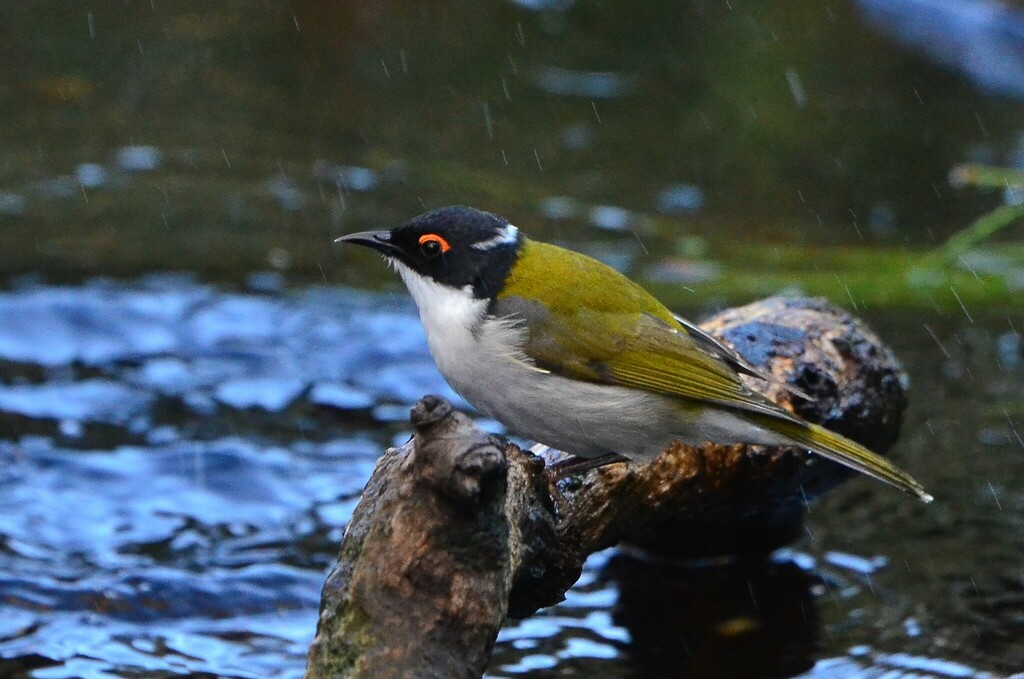
A mid-sized honeyeater at 13–15 cm (5–6 in) in length, it is olive-green above and white below, with a black head, nape and throat, a red patch over the eye, and a white crescent-shaped patch on the nape. It is thinner than other similar species. Juveniles have brownish crowns and an orange base of the bill. Its call is a mjerp mjerp.
What it does
It is found in eucalypt forest and woodlands. Its diet is principally nectar from a variety of flowers, supplemented by insects and various other invertebrates. White-naped honeyeaters may nest from July to December, breeding once or twice during this time. The nest is a thick-walled bowl of grasses and bits of bark in the fork of a tall tree, usually a eucalypt. Two or three eggs are laid, 18 mm × 14 mm (0.71 in × 0.55 in) in size, and shiny, buff-pink, sparsely spotted with red-brown.
Wikipedia: “Ecology”
Listen
Looking for field recordings…
Where it lives
Recorded sightings
—
geo-referenced records in GBIF, from museums, herbaria and field observers.
Drag the globe to turn it. Dots are where records exist, not a range map; darker means more records.
In the stacks
Searching the stacks…
Every page naming Melithreptus lunatus in the Biodiversity Heritage Library →
This page is assembled live from iNaturalist, GBIF, Wikipedia, the Source Library and the Internet Archive. It is not yet part of the hand-edited codex. iNaturalist taxon 501272.