- Plants
- ›Vascular Plants
- ›flowering plants
- ›Dicots
- ›beeches, oaks, walnuts, and allies
- ›beech family
- ›Quercus
- ›Quercus
- ›Lobatae
- ›Agrifoliae
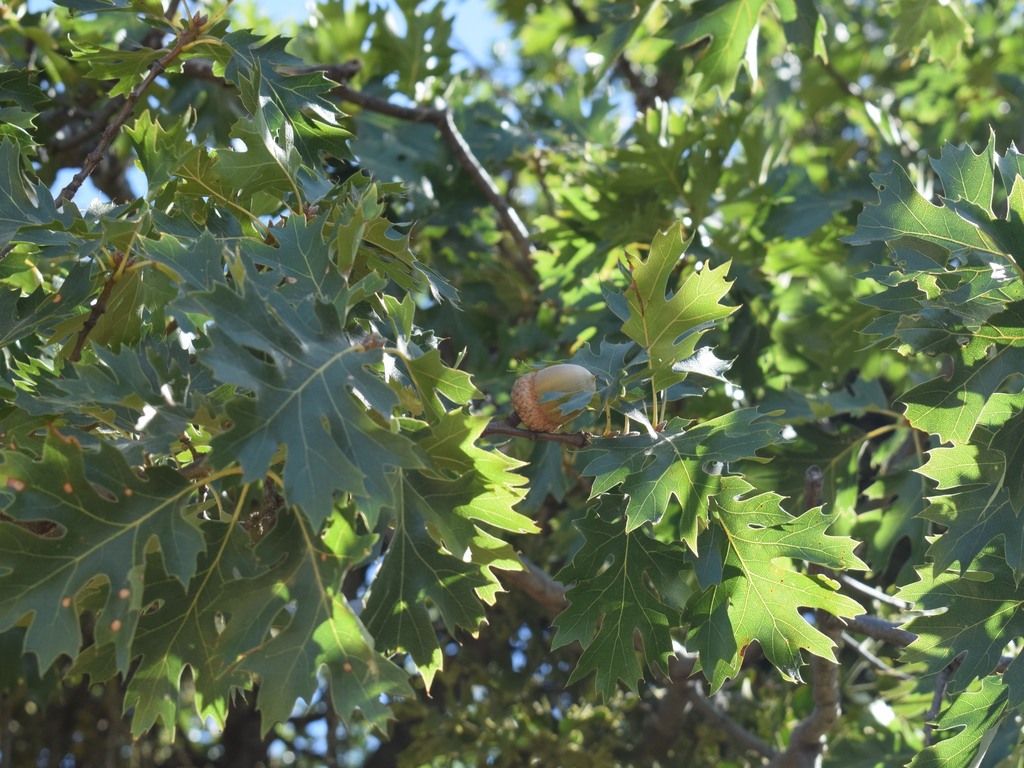
California black oak
Quercus kelloggii
Quercus kelloggii, the California black oak, also known as simply black oak, or Kellogg oak, is an oak in the red oak section (Quercus sect. Lobatae), native to western North America. It is a close relative of the black oak (Quercus velutina) found in eastern and central North America.
From the article Quercus kelloggii on Wikipedia (CC BY-SA), quoted section by section
Description
Quercus kelloggii grows from one to several vertical roots which penetrate to bedrock, with large, laterally spreading roots extending off from vertical ones. It also has a number of surface roots. It can reproduce vegetatively with new growth sprouting from the root crown after the tree is top-killed by wildfire, logging, frost, or other events. While individual trees generally have a lifespan between 100 and 200 years, California black oak can live up to 500 years. The tree typically grows from 9–25 meters (30–82 feet) in height and from 0.3–1.4 m (1–4+1⁄2 ft) in diameter. Large trees may exceed 36 m (118 ft) in height and 1.6 m (5 ft 3 in) diameter, with the record holder measuring 38 m (124 ft) tall and 2.7 m (9 ft) thick (in the Siskiyou National Forest in Oregon). The species also grows in shrubby scrub-oak form on poor sites. In open areas, the crown is broad and rounded, with lower branches nearly touching the ground or forming a browse line. In closed stands, the crown is narrow and slender in young trees and irregularly broad in old trees. Trunks are usually free of branches on the lower 6–12 m (20–39 ft) in closed stands. Trunks are often forked, and usually decayed and hollow in older trees. …
Range & habitat
California black oak is a deciduous tree growing in mixed evergreen forests, oak woodlands, and coniferous forests. California black oak is distributed along foothills and lower mountains of California and western Oregon. It can be found at elevations of up to 1,800 m (5,900 ft), for example near Mount Shasta. It is found from Lane County, Oregon, south through the Cascade Range, the Sierra Nevada, and the Coast, Transverse, and Peninsular Ranges to San Diego County, California. The tree occurs in pure or mixed stands. Pure stands usually indicate sites unfavorable to conifer growth or recurring disturbance such as fire or logging activities. The tree can grow in many types of soils, but they must be well-drained.
Wikipedia: “Distribution and habitat”
What it does
The California black oak is a critical species for wildlife. Oaks (Quercus spp.) may be the single most important genus used by wildlife for food and cover in California forests and rangelands, and California black oak occupies more total area in California than any other hardwood species. Livestock also make heavy use of this species for food and cover.
Older trees affected by heart rot have cavities which provide den or nest sites for owls, various woodpeckers, tree squirrels, and American black bears. Trees provide valuable shade for livestock and wildlife during the hot summer. California black oak forest types are heavily used for spring, summer, and fall cover by black bears. It is browsed by deer and livestock. Acorns are heavily used by livestock, mule deer, feral pigs, rodents, mountain quail, Steller's jays, and woodpeckers. Acorns constitute an average of 50% of the fall and winter diets of western gray squirrels and black-tailed deer during good mast years. Fawn survival rates increase or decrease with the size of the acorn crop. It is a preferred foraging substrate for many birds. All of 68 bird species observed in oak woodlands of the Tehachapi Mountains of California used California black oak for part of their foraging activities. Acorn woodpecker, Bullock's oriole, and Nashville warbler show strong preferences for California black oak. …
Wikipedia: “Ecology”
At the table
Some California Native Americans prefer California black oak acorns over those of other species for making acorn meal. Historically, this acorn was a staple food for many Native American groups, who usually leached out the bitter tannin. Native Americans recognized the importance of fire to this oak, and purposely lit fires in oak woodlands to promote its health and ensure their food source. The wood is used for making furniture, pallets, and construction timber. The tree is used as an ornamental.
Timber. California black oak comprises a total volume of 29% of California's hardwood timber resources, and is the major hardwood sawn into lumber there. The total estimated area of species occurrence is 361,800 hectares (3,618 square kilometers or 894,000 acres); 239,200 ha (2,392 km2 or 591,000 acres) of timberland and 122,600 ha (1,226 km2 or 303,000 acres) of woodland. Of this land 60% is privately owned, 31% is in National Forests, and 9% is on other public lands. It has greatly decreased from its historic abundance. This is due to a number of factors, including drought, disease, animal foraging, logging practices, fire suppression, and a variety of other human impacts. …
Wikipedia: “Uses”
Where it lives
Recorded sightings
—
geo-referenced records in GBIF, from museums, herbaria and field observers.
Drag the globe to turn it. Dots are where records exist, not a range map; darker means more records.
In the stacks
Searching the stacks…
Every page naming Quercus kelloggii in the Biodiversity Heritage Library →
This page is assembled live from iNaturalist, GBIF, Wikipedia, the Source Library and the Internet Archive. It is not yet part of the hand-edited codex. iNaturalist taxon 49919.