- Animals
- ›Chordates
- ›Vertebrates
- ›Mammals
- ›Therians
- ›Placental Mammals
- ›Primates, Rodents, and Allies
- ›Primates
- ›Monkeys, Apes, and Tarsiers
- ›Monkeys and Apes
- ›New World Monkeys
- ›Cebid Monkeys
- ›Capuchins
- ›Sapajus
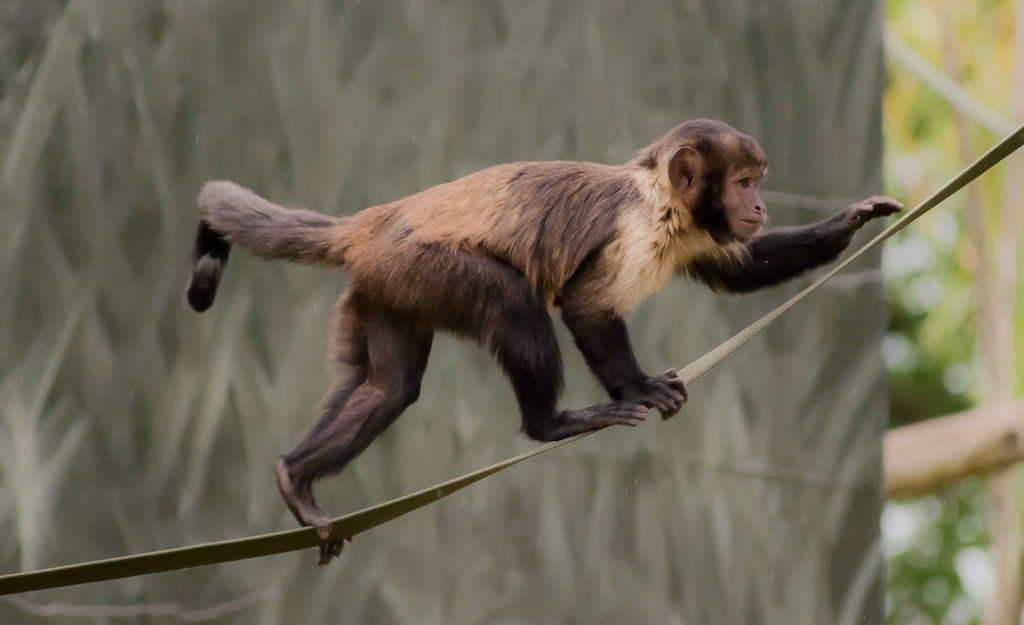
Buff-headed Capuchin
Sapajus xanthosternos
The golden-bellied capuchin (Sapajus xanthosternos), also known as the yellow-breasted or buff-headed capuchin, is a species of New World or neotropical monkey. It lives mainly in trees and are omnivorous, eating a wide variety of both plant and animals as food. Golden-bellied capuchin normal home range is in the Atlantic forest of Brazil and it is critically endangered due to forest fragmentation and habitat loss mainly due to agriculture, there are currently efforts to protect them by the local government.
From the article Golden-bellied capuchin on Wikipedia (CC BY-SA), quoted section by section
Description
Although there are differences between individuals as well as between the sexes and across age groups, S. xanthosternos is described as having a distinctive yellow to golden red chest, belly and upper arms. Its face is a light brown and its cap for which the capuchins were first named is a dark brown/black or light brown. Formerly thought to be a subspecies of tufted capuchin (S. apella), it was elevated to the status of species. Despite this previous classification, S. xanthosternos does not have very evident tufts, as they are oriented towards the rear of the skull and are hardly noticeable. A band of short hair around the upper part of the face with speckled colouring contrasts with the darker surrounding areas. The limbs and tail are also darkly coloured.
Size. Capuchins males stand around 40 cm (16 in) tall weighing an average of 4 kg (8.8 lb). Females are 37 cm (15 in) tall at round 2.5 kg (5.5 lb). Their prehensile tails are about the same length as their bodies and is helpful for swinging and climbing through the canopy. Capuchins have opposable big toes and long fingers assisting with climbing as well.
Life span. Capuchins life span is around 15–25 years when living in the wild. They can live much longer in captivity to about 50 years.
Origins. …
Wikipedia: “Characteristics”
Range & habitat
Populations of S. xanthosternos are restricted to the Atlantic forest of south-eastern Bahia, Brazil, due possibly to high degrees of interference from humans. Historically they probably would have inhabited the entire area east of, and north to, the Rio São Francisco.
The largest continuous area of forest in its known range, the Una Biological Reserve in Bahia, is estimated to contain a population of 185 individuals. As of 2004, there were 85 individuals in zoos and breeding facilities in Europe and Brazil.
Habitat fragmentation. The native biome of S. xanthosternos, the Atlantic forest of Brazil, is heavily fragmented with the majority of remaining forest fragment smaller than 50 hectares. Some of the remaining forests are maintained due to the presence of agroforests called cabrucas. The presence of these agroforests provide a habitat for local flora and fauna including S. xanthosternos. The remaining forest fragments tend to be surrounded by human activity such as farms, this is both beneficial and detrimental to the capuchins since they are able to raid crops to supplement their diet. This behavior, however, may lead to more confrontation and hunting by humans. The ideal size of a forest fragment in order to properly sustain a population of S. …
Wikipedia: “Distribution and habitat”
What it does
Golden-bellied capuchins feed on both plant and animal origins making them omnivores. They mostly feed on plants such as fruits, seeds, flowers, nuts, leaves and stems, and nectar. They also eat insects, bird eggs, frogs, small reptiles, birds, bats, or other small mammals. Capuchins residing near marine areas will feed on oysters, crabs or other shellfish. Sapajus xanthosternos has been known to hunt and eat various small lizards, sometimes ripping limbs off of the lizards before consuming them.
Wikipedia: “Diet”
Listen
Looking for field recordings…
Where it lives
Recorded sightings
—
geo-referenced records in GBIF, from museums, herbaria and field observers.
Drag the globe to turn it. Dots are where records exist, not a range map; darker means more records.
In the stacks
Searching the stacks…
Every page naming Sapajus xanthosternos in the Biodiversity Heritage Library →
This page is assembled live from iNaturalist, GBIF, Wikipedia, the Source Library and the Internet Archive. It is not yet part of the hand-edited codex. iNaturalist taxon 496704.