- Plants
- ›Vascular Plants
- ›flowering plants
- ›Dicots
- ›saxifrages, stonecrops, and allies
- ›sweetgum family
- ›Liquidambar
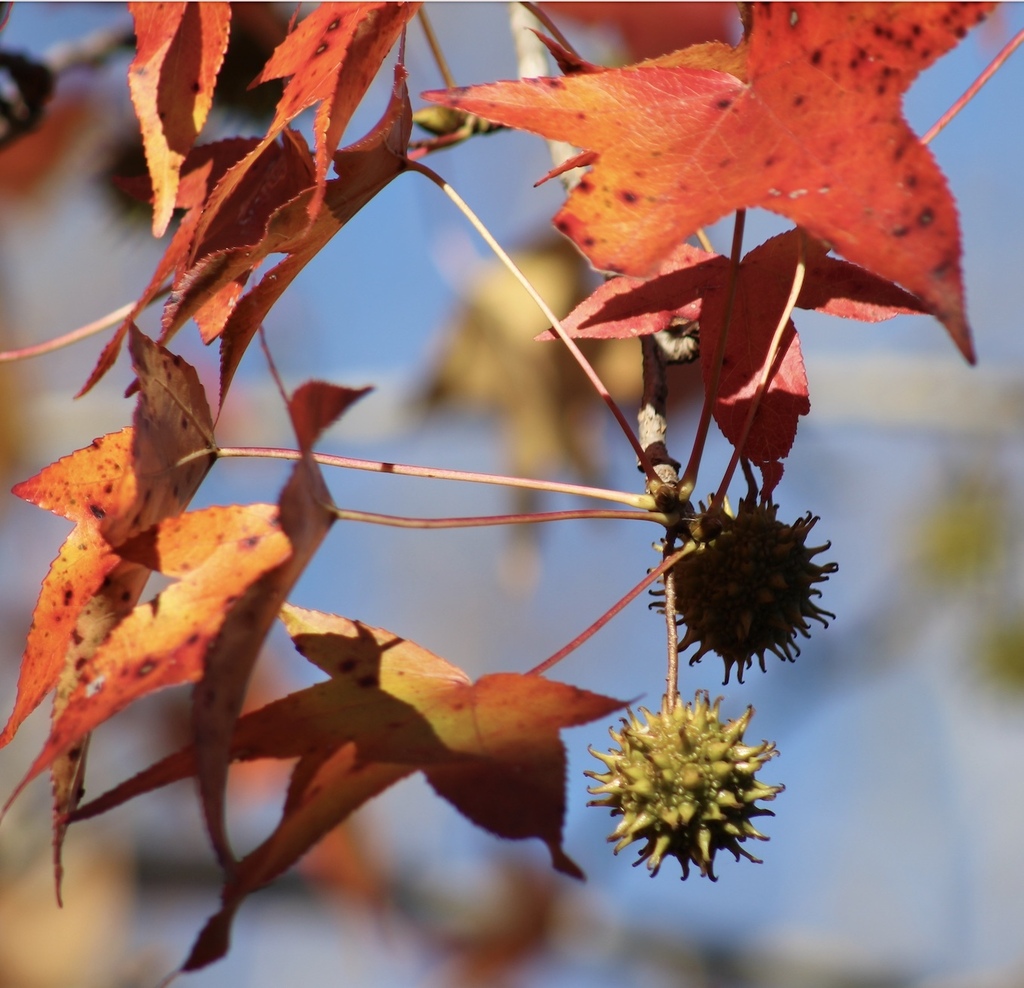
American sweetgum
Liquidambar styraciflua
Liquidambar styraciflua, commonly known as the American sweetgum among other names, is a deciduous tree in the genus Liquidambar native to warm temperate areas of eastern North America and tropical montane regions of Mexico and Central America. Sweetgum is one of the main valuable forest trees in the southeastern United States, and is a popular ornamental tree in temperate climates. It is recognizable by the combination of its five-pointed star-shaped leaves (similar to maple leaves) and its hard, spiked fruits. It is currently classified in the plant family Altingiaceae, but was formerly considered a member of the Hamamelidaceae.
From the article Liquidambar styraciflua on Wikipedia (CC BY-SA), quoted section by section
Range & habitat
Sweetgum is one of the most common hardwoods in the southeastern and Mid-Atlantic United States, where it occurs naturally in lowlands from southwestern Connecticut south to central Florida, through central Ohio and west to Illinois, southern Missouri, and eastern Texas, but not colder highland areas of Appalachia or the Midwestern states. The species also occurs in Mexico from southern Nuevo León south to Chiapas, as well as in Guatemala, El Salvador, Belize, Nicaragua and Honduras. In Mexico and Central America, it is a characteristic plant of cloud forests, growing at middle elevations in various mountainous areas where the climate is humid and more temperate. The US government distribution maps for this species are incorrect concerning the southern limit of distribution in Florida. This species occurs abundantly at Highlands Hammock State Park in Sebring, Highlands County, Florida, and even southwest of Lake Okeechobee.
Wikipedia: “Distribution”
In medicine
Traditionally, sweet gum has been used in Chinese medicine to treat issues such as diarrhea, coughs, and skin sores.
Wikipedia: “Medicinal”
How it is grown
Liquidambar styraciflua is a popular ornamental and forestal tree, cultivated for its distinctive foliage and intense autumn colors. It is commonly grown throughout its native North American range as well as many other temperate parts of the world, including moderately high elevations in the tropics. It is highly regarded in Bogotá, Colombia. The species grows best in moist, acidic loam or clay soil, and tolerates poor drainage. It typically grows with other coastal plain species such as willow oak and sweetbay magnolia. Its salt tolerance is moderate. Chlorosis can develop on alkaline soil, especially where organic matter is low. Also, the American sweetgum tree does not grow well in shady areas. Grown as an ornamental tree in Australia, Liquidambar styraciflua has a distribution on mainland Australia from southwestern Western Australia, southern South Australia, New South Wales, Victoria, and all the way up to the Atherton Tablelands in far North Queensland. During the late 1970s and throughout the 1980s, Sweetgums were a popular landscaping and street tree. …
Wikipedia: “Cultivation”
In human culture
The earliest known published record of L. styraciflua is in a work by Spanish naturalist Francisco Hernández published posthumously in 1615, in which he describes the species as a large tree producing a fragrant gum resembling liquid amber, whence the genus name Liquidambar. In John Ray's Historia Plantarum (1686) it is called Styrax liquida. However, the first mention of any use of the amber is described by Juan de Grijalva, the nephew of the governor of Cuba, in the year 1517. Juan de Grijalva tells of gift exchanges with the Mayas "who presented them with, among other things, hollow reeds of about a span long filled with dried herbs and sweet-smelling liquid amber which, when lighted in the way shown by the natives, diffused an agreeable odour." The species was introduced into Europe in 1681 by John Banister, the missionary collector sent out by Bishop Compton, who planted it in the palace gardens at Fulham in London, England.
Fossil record. An ancestor of Liquidambar styraciflua is known from Tertiary-aged fossils in Alaska, Greenland, and the mid-continental plateau of North America, much farther north than Liquidambar now grows. A similar plant is also found in Miocene deposits of the Tertiary of Europe.
Wikipedia: “History”
Where it lives
Recorded sightings
—
geo-referenced records in GBIF, from museums, herbaria and field observers.
Drag the globe to turn it. Dots are where records exist, not a range map; darker means more records.
In the stacks
Searching the stacks…
Every page naming Liquidambar styraciflua in the Biodiversity Heritage Library →
This page is assembled live from iNaturalist, GBIF, Wikipedia, the Source Library and the Internet Archive. It is not yet part of the hand-edited codex. iNaturalist taxon 49658.