- Plants
- ›Vascular Plants
- ›flowering plants
- ›monocots
- ›lilies, supplejacks, and allies
- ›lily family
- ›true lily subfamily
- ›true lilies and allies
- ›Lilium
- ›Sinomartagon
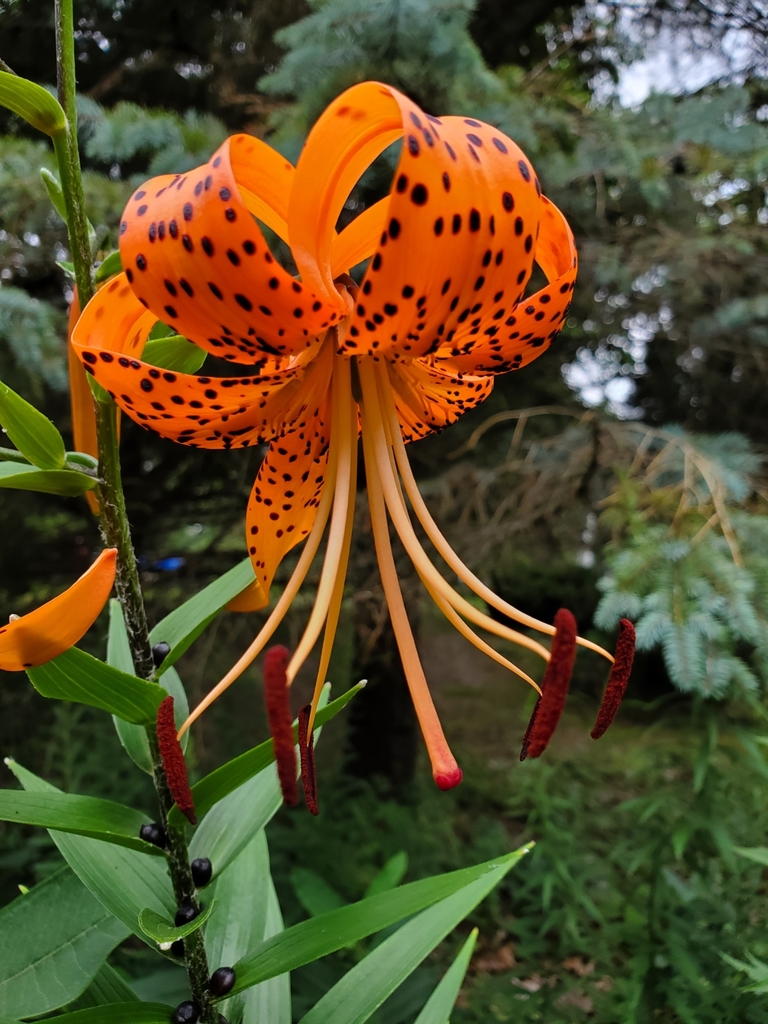
tiger lily
Lilium lancifolium
Lilium lancifolium (syn. L. tigrinum) is an Asian species of lily, native to China, Japan, Korea, and the Russian Far East. It is widely planted as an ornamental because of its showy orange-and-black flowers, and sporadically occurs as a garden escapee in North America, particularly the eastern United States including New England, and has made incursions into some southern states such as Georgia.
It has the English name tiger lily, but that name has been applied to other species as well.
From the article Lilium lancifolium on Wikipedia (CC BY-SA), quoted section by section
Description
Like other true lilies, the flowers are borne on upright stems that are 80–200 centimetres (31–79 inches) tall and bear lanceolate leaves 6–10 cm (2+1⁄2–4 in) long and 1–2 cm (3⁄8–3⁄4 in) broad. L. lancifolium produces aerial bulblets, known as bulbils, in the leaf axils. These bulbils are uncommon in Lilium species and they produce new plants that are clones of the original plant. The flowers are odorless. Each lasts a few days and if pollinated produces capsules with many thin seeds. Extrafloral nectaries on the species were first noted by Zimmerman 1932.
Reproduction. These lilies are capable of both sexual and asexual reproduction, dependent on the cytotype. Some populations of the plant are diploid (have two copies of their chromosomes) and some populations are triploid (have three copies of their chromosomes). The North American population is mainly triploid, while the Asian populations may be either. The diploid populations can undergo both forms of reproduction. The triploid populations, however, are sterile and limited to asexual reproduction only. They mainly reproduce by forming bulbils in the leaf axis.
At the table
It is cultivated and wild foraged in Asia for its edible bulbs. The cultivar 'Splendens' has gained the Royal Horticultural Society's Award of Garden Merit. In Taiwan, both the flower and bulbs are used as food, as are the other related species: L. brownii var. viridulum, L. pumilum and L. candidum.
Wikipedia: “Uses”
Toxicity
A case study of the successful treatment of a cat that ingested this particular species was published in 2007.
Wikipedia: “Cat toxicity”
Where it lives
Recorded sightings
—
geo-referenced records in GBIF, from museums, herbaria and field observers.
Drag the globe to turn it. Dots are where records exist, not a range map; darker means more records.
In the old herbals & bestiaries


In the stacks
Searching the stacks…
Every page naming Lilium lancifolium in the Biodiversity Heritage Library →
This page is assembled live from iNaturalist, GBIF, Wikipedia, the Source Library and the Internet Archive. It is not yet part of the hand-edited codex. iNaturalist taxon 49524.