- Animals
- ›Arthropods
- ›Hexapods
- ›Insects
- ›Winged and Once-winged Insects
- ›Flies
- ›Nematoceran Flies
- ›Gnats and Allies
- ›Fungus Gnats and Gall Midges
- ›Gall and Forest Midges
- ›Gall Midges
- ›Lasiopteridi
- ›Dasineurini
- ›Rabdophaga
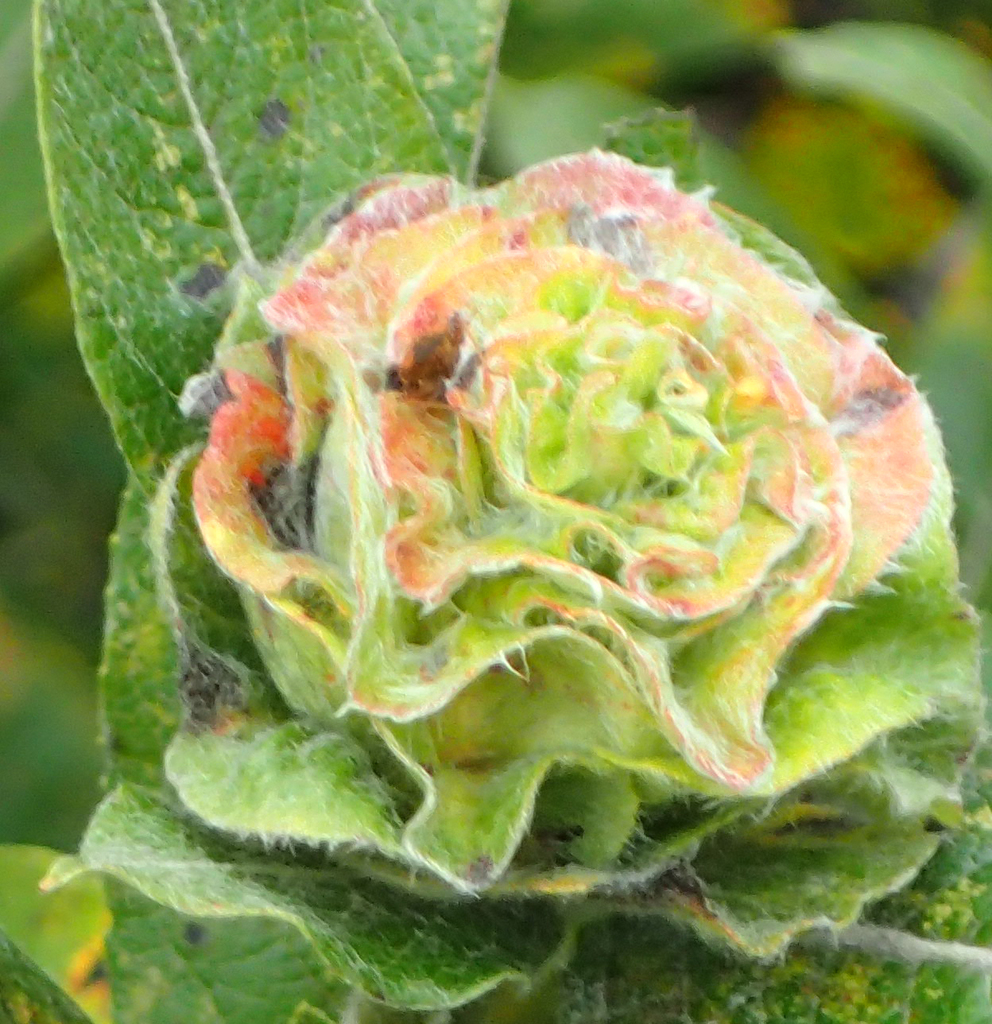
Willow Rose Gall Midge
Rabdophaga rosaria
Rabdophaga rosaria is a gall midge which forms Camellia galls or terminal rosette gall on willow species. It was first described by Hermann Loew in 1850.
From the article Rabdophaga rosaria on Wikipedia (CC BY-SA), quoted section by section
Description
Willows are extremely susceptible to gall induction and growth manipulation and Salix is one of the plant genera with the highest known numbers of associated galler species. Rabdophaga rosaria is probably a group of closely related, unnamed species, possibly each restricted to one species of willow. Galls should be recorded as R rosaria and the host plant should also be recorded. The gall consists of from thirty to sixty leaves, shortened and crowded together in rosettes on white willow (S. alba), crack willow (S. fragilis), goat willow (S. caprea) and purple willow (S. purpurea) willows as well as the eared sallow (S. aurita) and grey sallow (S. cinerea). The oviposition of this species results in a chemical interaction that halts the lengthwise growth of infected willow shoots, the leaves however continue to develop and thus the characteristic "rose" forms at the tip of the affected shoot.
Characteristics. Rabdophaga rosaria is found on willow branches and the gall diameter depends upon the species, being larger on Salix caprea at 8 centimetres (3.1 in) than on Salix alba at 3 cm (1.2 in). The development in the United Kingdom begins in May / June with leaf expansion and reaches maturity in August / September while the leaves are still green. The gall becomes brown and remains on the tree over winter until it is forced off by new growth in spring.
Range & habitat
Rabdophaga rosaria is widely distributed throughout the United Kingdom and is locally common. It is abundant in Finland.
Wikipedia: “Distribution”
Listen
Looking for field recordings…
Where it lives
Recorded sightings
—
geo-referenced records in GBIF, from museums, herbaria and field observers.
Drag the globe to turn it. Dots are where records exist, not a range map; darker means more records.
In the stacks
Searching the stacks…
Every page naming Rabdophaga rosaria in the Biodiversity Heritage Library →
This page is assembled live from iNaturalist, GBIF, Wikipedia, the Source Library and the Internet Archive. It is not yet part of the hand-edited codex. iNaturalist taxon 494431.