- Plants
- ›Vascular Plants
- ›flowering plants
- ›Dicots
- ›Roses, Elms, Figs, and Allies
- ›rose family
- ›brambles, roses, strawberries, and allies
- ›rose tribe
- ›Rosa
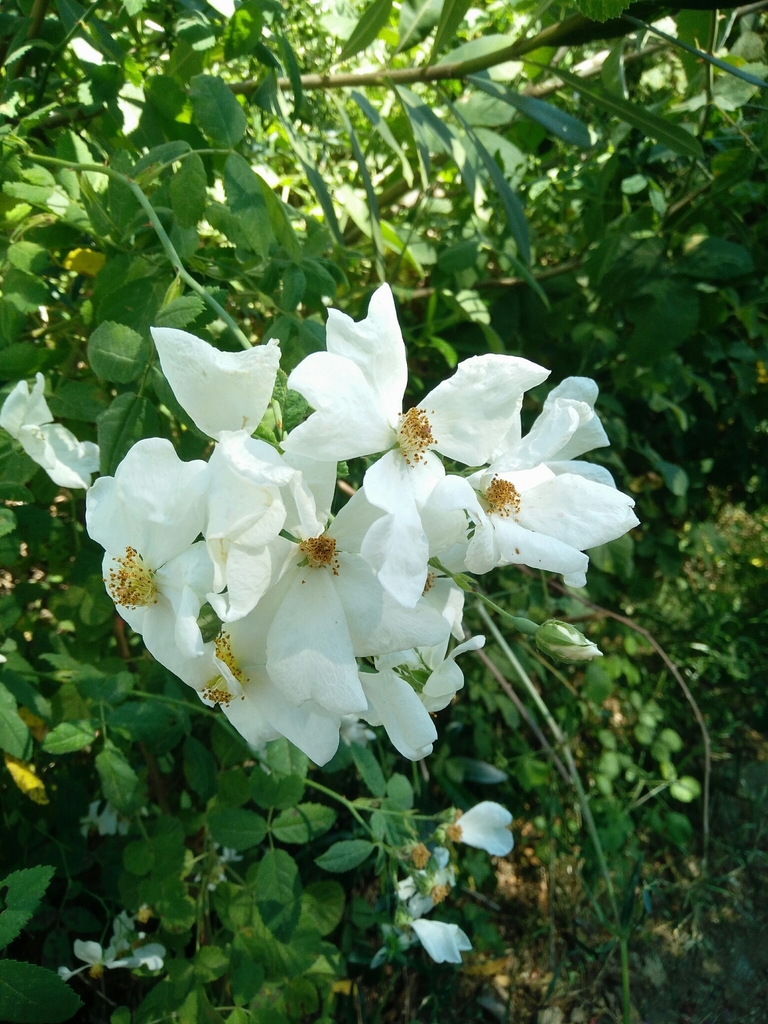
Phoenician Rose
Rosa phoenicia
Rosa phoenicia, the Phoenician rose, is a rambling or climbing, thorny wild rose species within the family Rosaceae. Native to the temperate Eastern Mediterranean and the Fertile Crescent, the species is an obligate or facultative geophyte specialized to freshwater alluvial floodplains, wetlands, and riparian banks. First systematically described in 1849, the plant holds significant horticultural and evolutionary importance as one of the direct ancestral progenitors involved in the ancient hybridization of the cultivated Damask rose. It has been proposed as an ancestor of the Damascene rose Rosa × damascena.
From the article Rosa phoenicia on Wikipedia (CC BY-SA), quoted section by section
Description
Rosa phoenicia is a deciduous, multi-stemmed rambling or climbing shrub that uses adjacent forest canopies, thickets, or terrain features to scale to heights between 2.5 and 5 m (8.2 and 16.4 ft). Its long, highly flexible, greenish-brown woody branches are densely armed with sharp, curved, recurved prickles that facilitate its scrambling habit. The alternate compound leaves are imparipinnate, typically composed of five to seven ovate-oblong leaflets with sharply serrated margins and a glabrous to lightly pubescent green upper surface. The blooming period occurs once annually in late spring and early summer, typically extending from May through July depending on local altitudes. The inflorescence is arranged in large, terminal, paniculate corymbs that produce small clusters of white flowers. Each solitary flower features five petals, measures 3 to 4 cm (1.2 to 1.6 in) in diameter, and possesses a strong, sweet fragrance. The defining taxonomic character is the reproductive column of fused, glabrous styles protruding directly above a deep ring of yellow stamens. In autumn, the fertilized flowers ripen into smooth, bright red-orange, spherical pseudo-fruits (hips) containing small, hard achenes.
Range & habitat
The native distribution of Rosa phoenicia is centered on Western Asia and the Eastern Mediterranean basin. Its established wild populations occur across the Golan Heights, western Jordan, Lebanon, Syria, northern Iraq, and the western and southern maritime regions of Turkey. Outlying historical records also trace its presence across the East Aegean Islands. Ecologically, the species acts as a competitive riparian specialist. It is restricted to damp, highly organic alluvial soils, riverbanks, marsh edges, drainage canals, and permanent mountain streams. It requires open sun to partial shade and relies on a high, constant water table to thrive. Within Levantine wetland biomes, it routinely aggregates with wild blackberry bushes (Rubus sanguineus) and common oleanders (Nerium oleander) to form thick, impenetrable riparian hedgerows.
Wikipedia: “Distribution and habitat”
In human culture
The Phoenician rose was discovered and formally described by the Swiss systematic botanist Edmond Boissier in 1849. The initial description was compiled within the first series of Boissier's fundamental Levant survey, Diagnoses Plantarum Orientalium Novarum. Taxonomically, Rosa phoenicia is assigned to Rosa section Synstylae, a monophyletic lineage composed of species whose floral styles are structurally fused into a singular, prominent column projecting from the center of the hypanthium. Throughout its documented geographical variations, several heterotypic synonyms have been noted in botanical catalogs:
Rosa arvensis var. trojana Boulenger (1933), recorded from western Anatolia. Rosa chlorocarpa Fenzl & Heinr.Braun (1886), documented from regional herbaria in Vienna. Rosa phoenicia var. kurdica Nábělek (1923), collected from the montane landscapes of Kurdistan. The specific epithet phoenicia directly honors the ancient maritime region of Phoenicia, where the type specimens were natively collected along the coastal plains of modern-day Lebanon.
Wikipedia: “Taxonomy and history”
Where it lives
Recorded sightings
—
geo-referenced records in GBIF, from museums, herbaria and field observers.
Drag the globe to turn it. Dots are where records exist, not a range map; darker means more records.
In the stacks
Searching the stacks…
Every page naming Rosa phoenicia in the Biodiversity Heritage Library →
This page is assembled live from iNaturalist, GBIF, Wikipedia, the Source Library and the Internet Archive. It is not yet part of the hand-edited codex. iNaturalist taxon 492983.