- Plants
- ›Vascular Plants
- ›flowering plants
- ›Dicots
- ›Sunflowers, Bellflowers, Fanflowers, and Allies
- ›Sunflowers, Daisies, Asters, and Allies
- ›Asteroideae
- ›paper daisies
- ›cudweeds, everlastings, and pussytoes
- ›Helichrysum
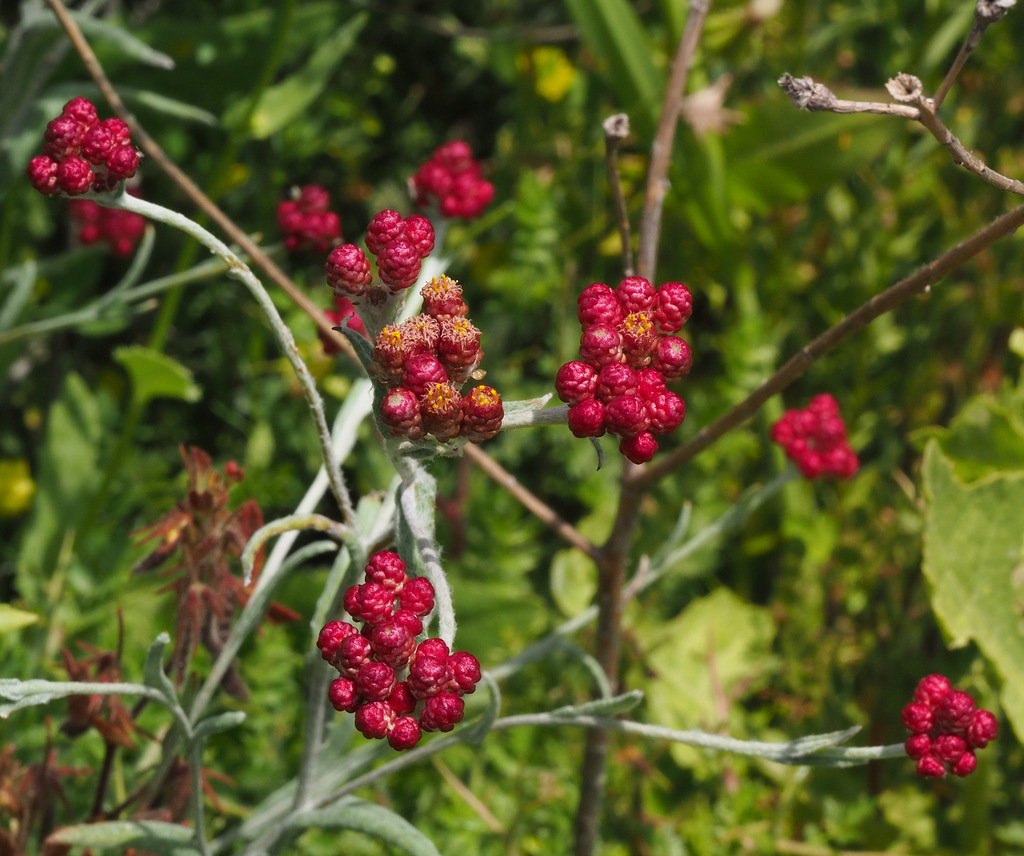
Scarlet Everlasting
Helichrysum sanguineum
Helichrysum sanguineum, known in English as red everlasting and red cudweed, is a flowering plant of the genus Helichrysum in the family Asteraceae. It grows in mountain forests in the Levant where it blooms in April–June. The flower, known in Hebrew as "Blood of the Maccabees"
From the article Helichrysum sanguineum on Wikipedia (CC BY-SA), quoted section by section
Range & habitat
The plant grows in the Levant, including: western Syria, the Mediterranean coast of Lebanon and Mount Lebanon up to an altitude of 1000 m, on the Golan Heights, in most of the northern and central part of Israel and the West Bank (Upper and Lower Galilee, around the Sea of Galilee, on Mount Carmel and the Coastal Plain south of it, Mount Gilboa, the northern part of the Jordan Valley, Samaria, the Judaean Mountains and the Shefela), and the mountainous Gilead region in Jordan (the areas of Jerash and Dibeen, Ajloun, and Al-Salt). In Israel, Helichrysum sanguineum is an endangered species.
Wikipedia: “Distribution”
In human culture
The Hebrew name Dam hamakabim was coined by the botanist Ephraim Hareuveni in 1917. The symbolic connection to Israeli war casualties first appeared in a poem by Haim Gouri written in memory of 35 Palmach comrades killed in January 1948. Since 2019, the non-profit organization Dam HaMaccabim has been distributing pins with the flower throughout Israel.
Wikipedia: “History”
Where it lives
Recorded sightings
—
geo-referenced records in GBIF, from museums, herbaria and field observers.
Drag the globe to turn it. Dots are where records exist, not a range map; darker means more records.
In the stacks
Searching the stacks…
Every page naming Helichrysum sanguineum in the Biodiversity Heritage Library →
This page is assembled live from iNaturalist, GBIF, Wikipedia, the Source Library and the Internet Archive. It is not yet part of the hand-edited codex. iNaturalist taxon 492866.