- Plants
- ›Vascular Plants
- ›flowering plants
- ›Dicots
- ›Sunflowers, Bellflowers, Fanflowers, and Allies
- ›Sunflowers, Daisies, Asters, and Allies
- ›chicories, dandelions, and allies
- ›Lettuce, Chicory, Dandelion and Salsify Tribe
- ›Scolyminae
- ›Catananche
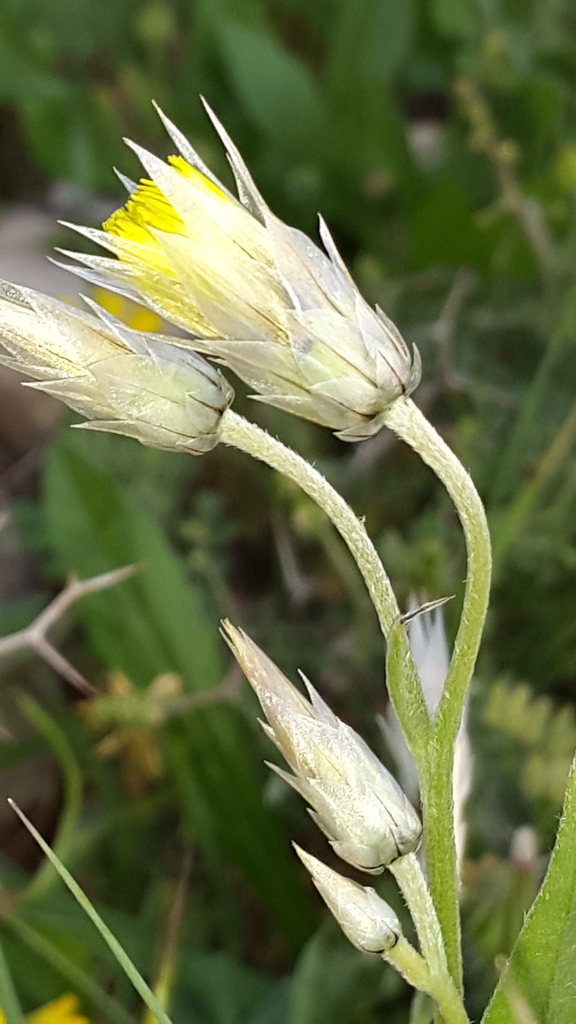
Yellow Succory
Catananche lutea
Catananche lutea, is a woolly annual plant, in the family Asteraceae, with most leaves in a basal rosette, and some smaller leaves on the stems at the base of the branches. Seated horizontal flowerheads develop early on under the rosette leaves. Later, not or sparingly branching erect stems grow to 8–40 cm high, carrying solitary flowerheads at their tips with a papery involucre whitish to beige, reaching beyond the yellow ligulate florets. Flowers are present between April and June. This plant is unique for the five different types of seed it develops, few larger seeds from the basal flowerheads, which remain in the soil, and smaller seeds from the flowerheads above ground that may be spread by the wind or remain in the flowerhead when it breaks from the dead plant. This phenomenon is known as amphicarpy. The seeds germinate immediately, but in one type, germination is postponed. It naturally occurs around the Mediterranean. Sources in English sometimes refer to this species as yellow succory.
From the article Catananche lutea on Wikipedia (CC BY-SA), quoted section by section
Description
Catananche lutea is a low to medium height (usually 8–40 cm or 3-16 in) annual herbaceous plant, with a leaf rosette. This species is diploid and has eighteen chromosomes (2n = 18).
Leaves, stems. Young plants above ground consist of a rosette with many linear to narrowly elliptic leaves with the widest point at, before or beyond midlength 3–27 cm long and 0.7–2 cm wide, with an entire margin or with a few widely distanced teeth, an acute or obtuse tip, and the base narrowing, pale green in color on both surfaces due to the pubescent hairs. Young plants produce seated, horizontally oriented cleistogamic flowerheads under the rosette leaves. Later, erect, weakly branched or unbranched flowering stems develop, which are covered in a white layer of pilose hairs. These stems carry few shorter pale green leaves which are increasingly smaller towards the top, at the foot of the branches.
Flowerheads and florets. The terminal branches of the stem are up to 20 cm long and mostly do not carry bracts. Two types of flowerhead (or capitula) occur: early – probably cleistogamous – subterranean flowerheads at the base under the rosette leaves, which have between one and three florets, and capitula on the stems, which have many florets. …
Range & habitat
Catananche lutea prefers calcareous (chalky), loamy soils in open, disturbed habitats.
Wikipedia: “Habitat”
What it does
The aerial flowers are pollinated by a wide variety of insects, but self-fertilisation occurs, and is probably the only type of fertilisation in the horizontal flowerheads. Catananche lutea has both flower heads on long erect stems (aerial) and flower heads on very short stems between or under the leaves of the basal rosette (subterranean). The subterranean flower heads contain two types of cypsela, while in the aerial flower heads three different types can be found, which are located next to the involucre, encircling the centre and at the centre of the receptacle respectively. The subterranean cypselas occur between February and April, are fewer in number, but much larger and heavier than aerial cypselas. A high proportion of the first type of subterranean cypselas germinates quickly, while in the second type germination is spread over time due to inhibition by hormones from the fruit skin. The cypselas in the aerial flower heads form from April to May and neither shows delayed germination, but the three types differ in the way they disperse. Those bordering the involucre have short and scaly pappus and are subtended by a bract, to be released with the flower head when it breaks free from the dead mother plant, resulting in dispersal over a short distance. …
Wikipedia: “Ecology”
In human culture
The simple translation of the root words from the Greek κατάνάγκη (katanagkē), itself a contraction of κατά (kata), "down" and άνάγκη (anagkē), "force", is "compulsion", which is suggested to refer to the use of this plant in love potions, and is reflected in the vernacular name Cupid's dart. The species epithet lutea is the Latin for "yellow".
Wikipedia: “Etymology”
Where it lives
Recorded sightings
—
geo-referenced records in GBIF, from museums, herbaria and field observers.
Drag the globe to turn it. Dots are where records exist, not a range map; darker means more records.
In the old herbals & bestiaries

In the stacks
Searching the stacks…
Every page naming Catananche lutea in the Biodiversity Heritage Library →
This page is assembled live from iNaturalist, GBIF, Wikipedia, the Source Library and the Internet Archive. It is not yet part of the hand-edited codex. iNaturalist taxon 492793.