- Plants
- ›Vascular Plants
- ›flowering plants
- ›Dicots
- ›Mints, Plantains, Olives, and Allies
- ›Plantain Family
- ›Toadflaxes and Allies
- ›Antirrhinum
- ›Antirrhinum
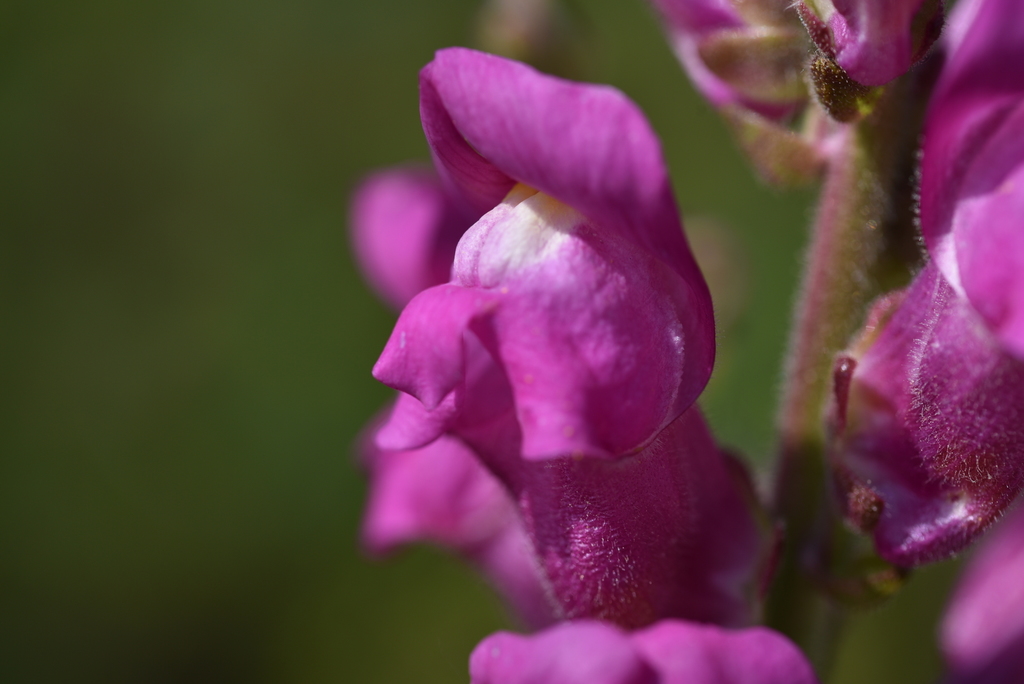
Snapdragon
Antirrhinum majus
Antirrhinum majus, the common snapdragon (often – especially in horticulture – simply "snapdragon"), is a species of flowering plant belonging to the genus Antirrhinum. The plant was placed in the family Plantaginaceae following a revision of its prior classical family, Scrophulariaceae.
The common name "snapdragon", originates from the flowers' reaction to having their throats squeezed, which causes the "mouth" of the flower to snap open like a dragon's mouth. It is widely used as an ornamental plant in borders and as a cut flower. It is perennial but usually cultivated as an annual plant. The species has been in culture since the 15th century.
From the article Antirrhinum majus on Wikipedia (CC BY-SA), quoted section by section
Description
It is an herbaceous perennial plant, growing to 0.5–1 m tall, rarely up to 2 m. The leaves are spirally arranged, broadly lanceolate, 1–7 cm long and 2–2.5 cm broad. The upper glandular stalk is stalk-round, sometimes woody to the middle. The opposite leaves are simple, elliptic or ovate to broad-lanceolate, sometimes linear and usually bleak. Leaflets are missing. The flowers are produced on a tall spike, each flower is 3.5-4.5 cm long, zygomorphic, with two 'lips' closing the corolla tube lobed divided into three parts and is purple red, almost 5 cm long. Wild plants have pink to purple flowers, often with yellow lips. Most 8 to 30 short stalked flowers are in an inflorescence together; the inflorescence axis is glandular hairy. The crown is 25 to 45 (rarely to 70) millimeters long and in different colors (red, pink, orange, yellow, white). The "maw" of the crown is closed by protuberance of the lower lip, one speaks here of "masked", and everted baggy at the bottom. There is a circle with four stamens. The plants are pollinated by bumblebees, who are strong enough to gently and briefly open male flowers to enter and exit them without difficulty, collecting pollen in the process. A snapdragon's calyx is up to 8 mm long, with sepals of equal length, oblong to space. The ovary is hypogynous, or superior. …
How it is grown
Antirrhinum majus can survive a certain amount of frost, as well as higher temperatures, but does best at 17–25 °C (63–77 °F). Nighttime temperatures around 15–17 °C (59–63 °F) encourage growth in both the apical meristem and stem. The species is able to grow well from seeds, flowering quickly in 3 to 4 months. It can also be grown from cuttings. Though perennial, the species is often cultivated as a biennial or annual plant, particularly in colder areas where it may not survive the winter. Numerous cultivars are available, including plants with lavender, orange, pink, yellow, or white flowers, and also plants with peloric flowers, where the normal flowering spike is topped with a single large, symmetrical flower. The cultivars 'Floral Showers Deep Bronze' and 'Montego Pink' have gained the Royal Horticultural Society's Award of Garden Merit. The trailing (creeping) variety is often referred to as A. majus pendula (syn. A. pendula, A. repens). It often escapes from cultivation, and naturalised populations occur widely in Europe north of the native range, and elsewhere in temperate regions of the world. Past common names for Antirrhinum majus include: great snapdragon, lion's-mouth, rabbit's mouth, bonny rabbits, calf-snout, toad's mouth, bulldogs, and lion's-snap.
Wikipedia: “Cultivation”
Where it lives
Recorded sightings
—
geo-referenced records in GBIF, from museums, herbaria and field observers.
Drag the globe to turn it. Dots are where records exist, not a range map; darker means more records.
In the old herbals & bestiaries

Introductio Generalis in Rem Herbariam
Augustus Quirinus Rivinus · 1690 · p.167

Discourses on the Six Books of Dioscorides
Dioscorides; Pietro Andrea Mattioli (comm.) · 1568 · p.1438

Hortus Eystettensis
Basilius Besler · 1640 · p.175

Hortus Eystettensis
Basilius Besler · 1640 · p.176

Commentaries on the Six Books of Pedanius Dioscorides on Medical Matter
Pietro Andrea Mattioli · 1565 · p.1368

Commentaries on the Six Books of Pedanius Dioscorides on Medical Matter
Pietro Andrea Mattioli · 1565 · p.1369

Florum et coronariarum historia
Rembert Dodoens · 1568 · p.89

Florum et coronariarum historia
Rembert Dodoens · 1568 · p.87

Six Groups of the History of Plants
Rembert Dodoens · 1583 · p.202

Six Groups of the History of Plants
Rembert Dodoens · 1583 · p.202

Herbarium Portatile, Oder Behendes Kräuter- und Gewächs-Buch: Darinn nicht allein 1363. so wol Einheimische als Außländndische Kräuter mit Lateinisch und Deutscher Benennung abgebildet, sondern auch die meisten, so in der Medicin gebräuchlich, kürtzlich erkläret werden
Panckow, Thomas · 1656 · p.297
In the stacks
Searching the stacks…
Every page naming Antirrhinum majus in the Biodiversity Heritage Library →
This page is assembled live from iNaturalist, GBIF, Wikipedia, the Source Library and the Internet Archive. It is not yet part of the hand-edited codex. iNaturalist taxon 48969.