- Animals
- ›Arthropods
- ›Hexapods
- ›Insects
- ›Winged and Once-winged Insects
- ›Beetles
- ›Water, Rove, Scarab, Long-horned, Leaf, and Snout Beetles
- ›Staphyliniform Beetles
- ›Rove, Ant-like stone, and Carrion Beetles
- ›Rove Beetles
- ›Burying and Carrion Beetles
- ›Nicrophorini
- ›Nicrophorus
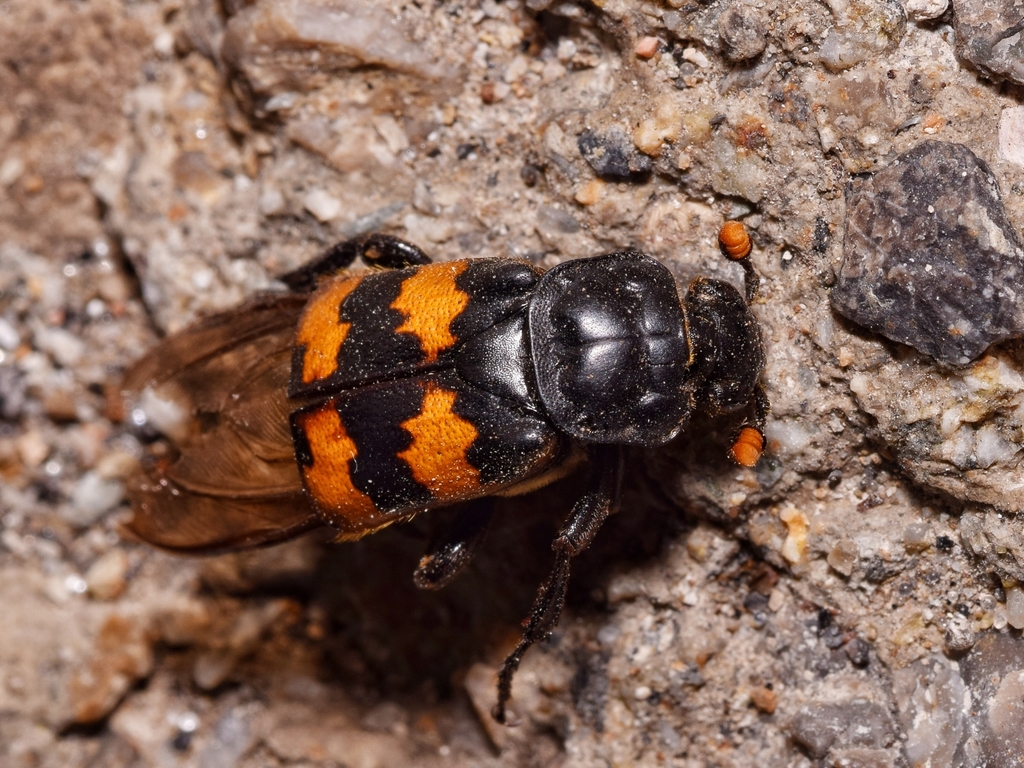
Nicrophorus interruptus
Nicrophorus interruptus is a species of burying beetles or sexton beetles belonging to the family Silphidae subfamily Nicrophorinae.
From the article Nicrophorus interruptus on Wikipedia (CC BY-SA), quoted section by section
Description
The adults grow up to 26 millimetres (1.0 in) long. They are mostly black with two orange-red markings on the elytra and a yellow pubescence on protruding abdominal segments. They are also characterized by the absence of hairs on the thorax and straight tibias on the hind legs. The front and posterior orange-red markings on the elytra are separated from one another at the suture. They have large club-like antennae equipped with black and reddish tips containing chemoreceptors, capable of detecting a dead animal from a long way away.
Range & habitat
Nicrophorus interruptus is the rarest but widespread among the large red and black carrion beetles. They are present in most of Europe, in the eastern Palearctic realm, in the Near East and in North Africa.
Wikipedia: “Distribution”
Listen
Looking for field recordings…
Where it lives
Recorded sightings
—
geo-referenced records in GBIF, from museums, herbaria and field observers.
Drag the globe to turn it. Dots are where records exist, not a range map; darker means more records.
In the stacks
Searching the stacks…
Every page naming Nicrophorus interruptus in the Biodiversity Heritage Library →
This page is assembled live from iNaturalist, GBIF, Wikipedia, the Source Library and the Internet Archive. It is not yet part of the hand-edited codex. iNaturalist taxon 489639.