- Plants
- ›Vascular Plants
- ›flowering plants
- ›Dicots
- ›Legumes, Milkworts, and Allies
- ›Legumes
- ›Acacias, Mimosas, Mesquites, and Allies
- ›Vachellia
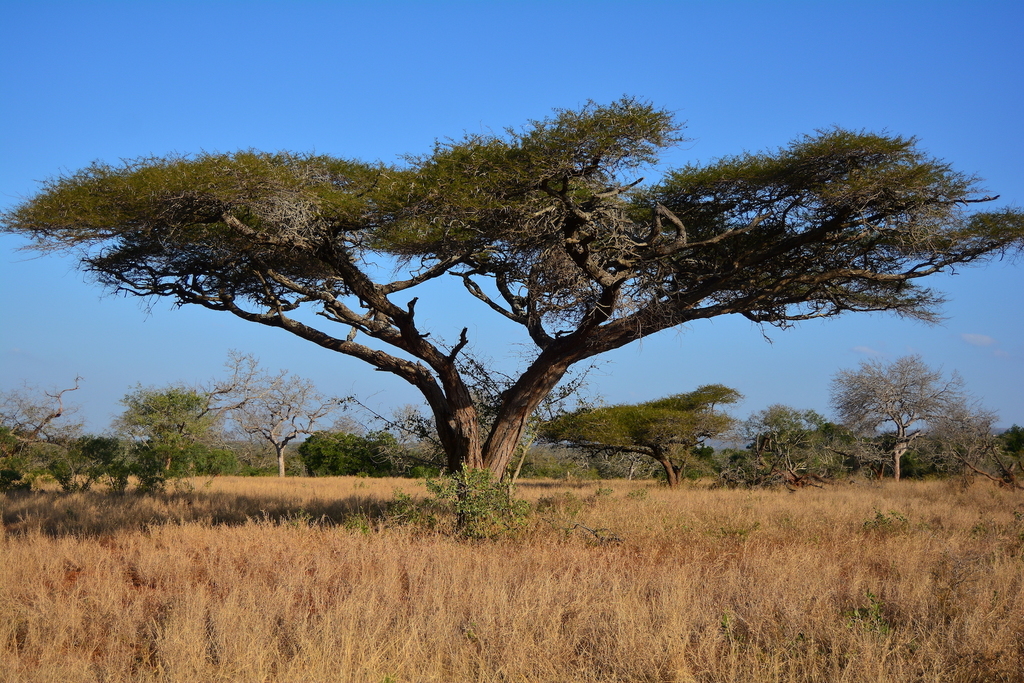
umbrella thorn
Vachellia tortilis
Vachellia tortilis, widely known as Acacia tortilis but now attributed to the genus Vachellia in the Fabaceae subfamily Mimosoideae, is the umbrella thorn acacia, also known as umbrella thorn and Israeli babool, a medium to large canopied tree native to most of Africa, primarily to the savanna and Sahel of Africa (especially the Somali peninsula and Sudan), but also occurring in the Middle East.
From the article Vachellia tortilis on Wikipedia (CC BY-SA), quoted section by section
Description
In extremely arid conditions, it may occur as a small, wiry bush. In good conditions, it grows up to 21 m (70 ft) in height. The tree carries leaves that grow to approx. 2.5 cm (1 in) in length with between 4 and 10 pair of pinnae each with up to 15 pairs of leaflets. Its most interesting feature is that it has pairs of thorns; one long, straight and pale, the second short, curved and dark. The flowers are small and white, highly aromatic, and occur in tight clusters. The seeds are produced in pods which are flat and coiled into a springlike structure. The plant is known to tolerate high alkalinity, drought, high temperatures, sandy and stony soils, strongly sloped rooting surfaces, and to withstand sandblasting too. Also, plants older than two years have shown a degree of frost resistance.
Wikipedia: “Characteristics”
Range & habitat
Vachellia tortilis is widespread in Africa, being found in countries like Tunisia, Morocco, Uganda, Angola, Zimbabwe, Djibouti, and Botswana. It tends to grow in areas where temperatures vary from 0 to 50 °C (32 to 122 °F) and rainfall is anywhere from about 100–1,000 mm (3.9–39.4 in) per year.
Wikipedia: “Distribution and growing conditions”
Where it lives
Recorded sightings
—
geo-referenced records in GBIF, from museums, herbaria and field observers.
Drag the globe to turn it. Dots are where records exist, not a range map; darker means more records.
In the stacks
Searching the stacks…
Every page naming Vachellia tortilis in the Biodiversity Heritage Library →
This page is assembled live from iNaturalist, GBIF, Wikipedia, the Source Library and the Internet Archive. It is not yet part of the hand-edited codex. iNaturalist taxon 489563.