- Plants
- ›Vascular Plants
- ›flowering plants
- ›Dicots
- ›laurels, spicebushes, and allies
- ›laurels
- ›Umbellularia
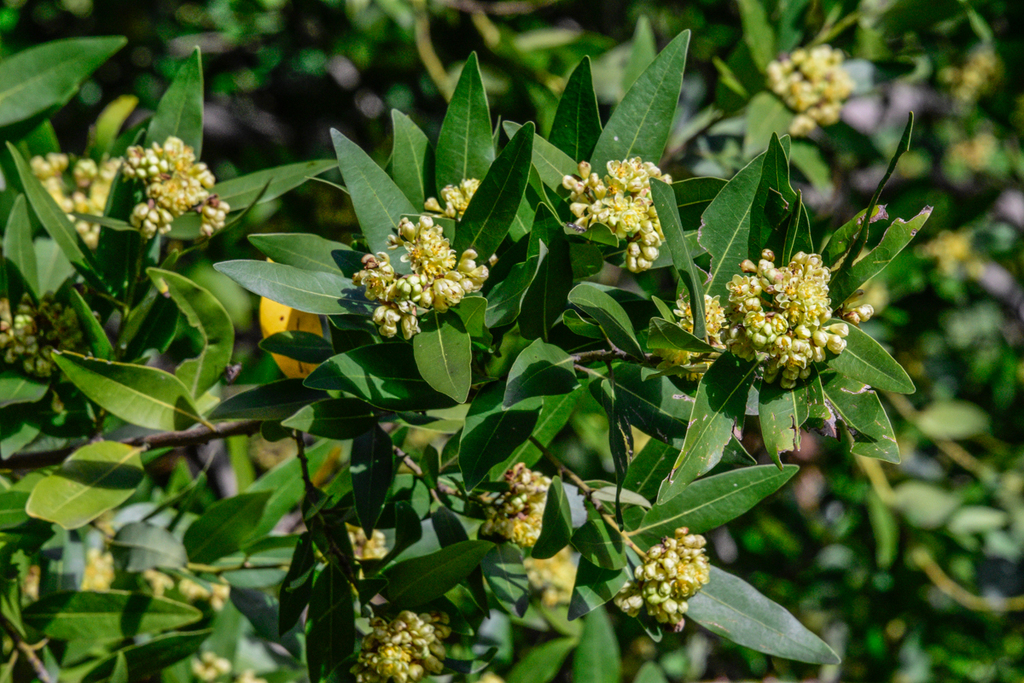
California bay
Umbellularia californica
Umbellularia californica is a large hardwood tree native to coastal forests and the Sierra foothills of California, and extending into the coastal forests southwestern Oregon and the mountains of northwestern Baja California. It is the sole species in the genus Umbellularia, in the laurel family Lauraceae. The tree's pungent leaves have a similar flavor to bay leaves, though stronger, and it may be mistaken for bay laurel.
In Yuki, it is called pōl'-cum ōl. In Oregon, this tree is known as Oregon myrtle, while in California it is called California bay laurel, which may be shortened to California bay or California laurel. It has also been called pepperwood, spicebush, cinnamon bush, peppernut tree, headache tree, mountain laurel, and balm of heaven.
From the article Umbellularia on Wikipedia (CC BY-SA), quoted section by section
Description
It is an evergreen tree or shrub growing to up to 30 metres (98 feet) tall with a trunk up to 90 centimetres (35 inches) in diameter. The largest recorded tree is in Mendocino County, California, and measured (as of 1997) 33 m (108 ft) in height with a 36 m (119 ft) spread. The thin bark is smooth and gray-brown when young, later turning reddish brown and scaly. The fragrant leaves are smooth-edged and lance-shaped, 3–15 cm (1+1⁄4–6 in) long and around a third as wide, similar to the related bay laurel, though usually narrower, and without the crinkled margin of that species. The leaves are green, and lighter on the underside. The bark and leaves have a pungent scent resembling camphor when bruised, due to a chemical known as umbellulone. The flowers are small, yellow or yellowish-green, produced in small umbels (hence the scientific name Umbellularia, "little umbel"). Unlike other "bay laurels" of the genus Laurus, Umbellularia has perfect flowers (male and female parts in the same flower). The fruit, also known as "California bay nut", is a round and green drupe 2–2.5 cm long and 2 cm broad, lightly spotted with yellow, maturing purple. Under the thin, leathery skin, it consists of an oily, fleshy covering over a single hard, thin-shelled pit, and resembles a miniature avocado. …
Range & habitat
Umbellularia is found in southwest Oregon and in California south to San Diego County. It is also found in the western foothills of the Sierra Nevada mountains. It occurs from sea level up to 1,600 m (5,200 ft) elevation. It is an introduced species in British Columbia, Washington, and northern Oregon. It mostly inhabits redwood forests, California mixed woods, yellow pine forest, and oak woodlands. Bays occur in oak woodland close to the coast, and in northern California where moisture is sufficient, usually in or near riparian areas. The species is very shade tolerant. It is reduced to a shrub in extreme dry and hot habitats.
During the Miocene, oak-laurel forests were found in Central and Southern California. Typical tree species included oaks ancestral to present-day California oaks, and an assemblage of trees from the laurel family, including Nectandra, Ocotea, Persea, and Umbellularia. Only one native species from the laurel family, Umbellularia californica, remains in California today.
Wikipedia: “Distribution and habitat”
What it does
U. californica can reproduce vegetatively and can sprout prolifically from root collar stump and trunk. Sprouts and sucker will form wherever there is enough light such as recent openings in the forest canopy. It is common for stumps to be ringed with new growth and for standing and fallen trunks to produce suckers. The bark of this species is thin and does not protect against fire. Fire kills the seedlings, saplings and even mature trees. However, top-killed U. californica (where the base and roots have remained alive), can resprout rapidly after a fire, with one study observing new sprouts 4-6 weeks after winter and spring fires. Flowers have even been noted on first year sprouts, showing this species adaptations to this phenomenon. Deer browse the fresh sprouts.
The species is a host of Phytophthora ramorum, the pathogen that causes the disease sudden oak death. It is important in this sense because it is one of two tree species (tanoak being the other) on which the pathogen readily produces spores.
Wikipedia: “Ecology”
Where it lives
Recorded sightings
—
geo-referenced records in GBIF, from museums, herbaria and field observers.
Drag the globe to turn it. Dots are where records exist, not a range map; darker means more records.
In the stacks
Searching the stacks…
Every page naming Umbellularia californica in the Biodiversity Heritage Library →
This page is assembled live from iNaturalist, GBIF, Wikipedia, the Source Library and the Internet Archive. It is not yet part of the hand-edited codex. iNaturalist taxon 48807.