- Plants
- ›Vascular Plants
- ›flowering plants
- ›Dicots
- ›proteas, lotuses, planes, and allies
- ›Protea family
- ›Paired Proteas
- ›Banksieae
- ›Banksiinae
- ›Banksia
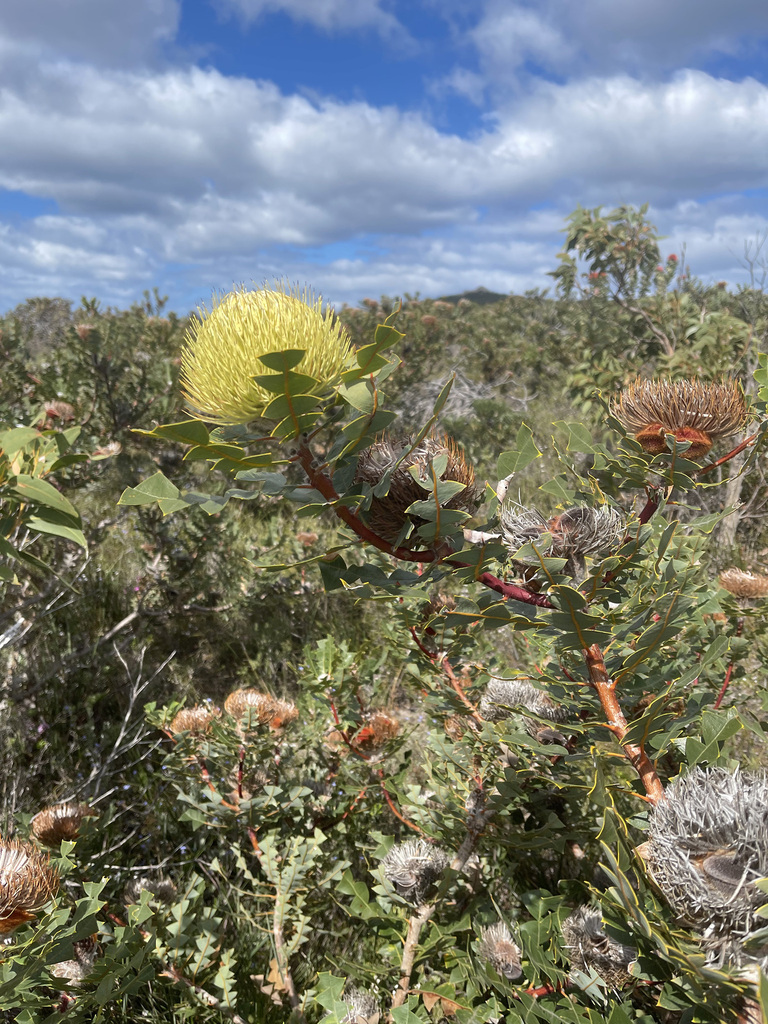
Baxters Banksia
Banksia baxteri
Banksia baxteri, commonly known as Baxter's banksia or bird's nest banksia, is a species of shrub that is endemic to Western Australia. It has greyish brown bark, hairy stems, deeply serrated leaves with triangular lobes and lemon-yellow flowers in an oval flower spike that grows on the end of branches.
From the article Banksia baxteri on Wikipedia (CC BY-SA), quoted section by section
Description
Banksia baxteri is an erect shrub that typically groups to a height of 1–5 m (3 ft 3 in – 16 ft 5 in) and that does not form a lignotuber. The branchlets and leaves are densely covered with woolly, white hairs when young. The leaves are wedge-shaped, 70–170 mm (2.8–6.7 in) long and 25–75 mm (0.98–2.95 in) wide in outline on a petiole 5–15 mm (0.20–0.59 in) long, divided to the midlobe with between four and seven triangular lobes on each side surrounded by V-shaped spaces. The flowers are arranged in a broad oval inflorescence 75–86 mm (3.0–3.4 in) wide on the ends of branches, the individual flowers lemon-yellow with a perianth 39–43 mm (1.5–1.7 in) long and the pistil 42–49 mm (1.7–1.9 in) long. Flowering occurs from December to May but mainly from January to March. Only a few follicles 35–42 mm (1.4–1.7 in) long, 17–22 mm (0.67–0.87 in) high and 15–20 mm (0.59–0.79 in) wide develop surrounded by the old flowers.
Range & habitat
Baxter's banksia grows with other shrubs such as Lambertia inermis, usually in deep sand and mostly occurs within 50 km (31 mi) of the coast between East Mount Barren and Israelite Bay.
Wikipedia: “Distribution and habitat”
What it does
A 1980 field study at Cheyne Beach showed it to be pollinated by the New Holland honeyeater and white-cheeked honeyeater. Banksia baxteri is serotinous, that is, it has an aerial seed bank in its canopy in the form of the follicles of the old flower spikes. These are opened with fire and release seed in large numbers, which germinate and grow after rain. Seed can last for many years; old spikes 9 to 12 years old have been found to have seed that remains 100% viable.
Wikipedia: “Ecology”
Where it lives
Recorded sightings
—
geo-referenced records in GBIF, from museums, herbaria and field observers.
Drag the globe to turn it. Dots are where records exist, not a range map; darker means more records.
In the stacks
Searching the stacks…
Every page naming Banksia baxteri in the Biodiversity Heritage Library →
This page is assembled live from iNaturalist, GBIF, Wikipedia, the Source Library and the Internet Archive. It is not yet part of the hand-edited codex. iNaturalist taxon 487473.