- Plants
- ›Vascular Plants
- ›flowering plants
- ›Dicots
- ›Mints, Plantains, Olives, and Allies
- ›Mint Family
- ›Nepetoideae
- ›Mentheae
- ›catmints, ground ivies, and hyssops
- ›Nepeta
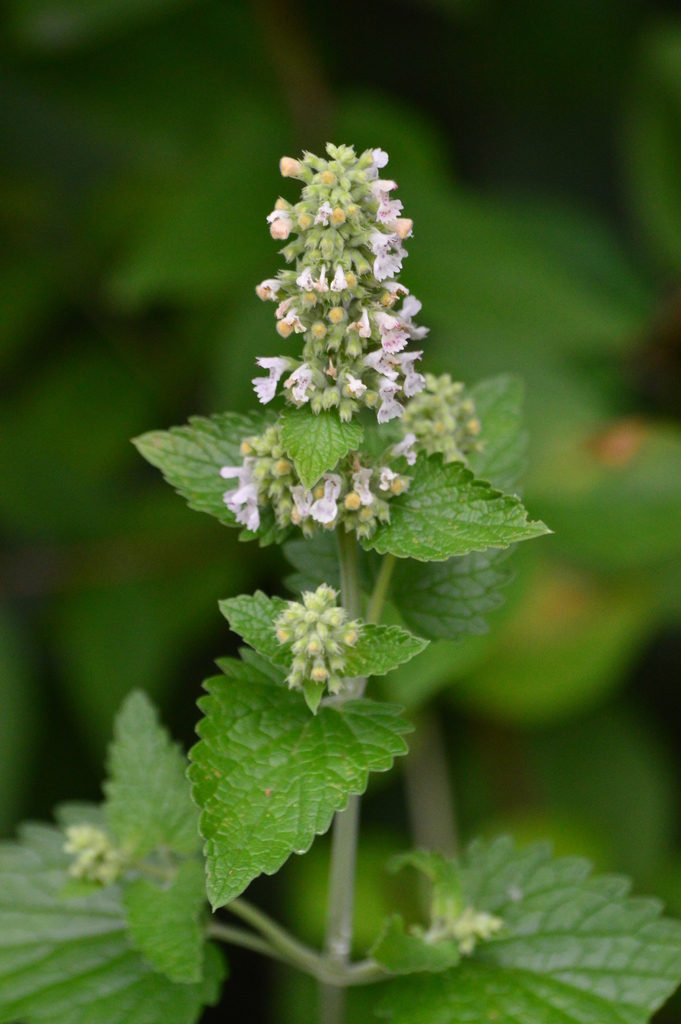
Catnip
Nepeta cataria
Nepeta cataria, commonly known as catnip or catmint, is a species of the genus Nepeta in the mint family. It is native to southern and eastern Europe, northern parts of the Middle East, and Central Asia. The plant is widely naturalized in northern Europe, New Zealand, and North America. The common name catmint can also refer to the genus as a whole.
Catnip is a short-lived perennial herb that grows between 30–100 cm (12–39 in) tall. It has square stems, grayish canescent leaves that vary in shape and have serrated edges, fragrant small bilabiate flowers arranged in raceme spikes, and produces small three-sided nutlets containing one to four seeds. It was described by Carl Linnaeus in 1753, with no subspecies but multiple botanical synonyms. Its name is derived from medieval Latin and reflects its historical association with cats and various traditional names dating back to medieval England.
From the article Catnip on Wikipedia (CC BY-SA), quoted section by section
Description
Nepeta cataria is a short-lived perennial that grows 30 to 100 cm (12 to 39 in) tall, usually with several stems. Each of its stems is square in cross section, as typical of the mint family, and somewhat gray in color. It is a herbaceous plant that regrows from a taproot. It does not root deeply. Older plants tend to have more branches with particularly healthy plants becoming mound shaped. The leaves are canescent in appearance, white in color due to being covered in fine hairs, especially so on the lower side of the leaves. They are attached in pairs to opposite sides of the stems. Leaf shapes vary from cordate (heart-shaped), deltoid (triangular), to ovate (egg-shaped). They are attached by leaf stems and have a length of 2 to 9 cm (0.8 to 3.5 in) and 0.6 to 6 cm (0.2 to 2.4 in) wide. The edges of the leaves are coarsely crenate to serrate, having a wavy, rounded edge to have asymmetrical teeth like those of a saw that point forward. The flowers are in loose groups in an inflorescence. The lowest flowers are more widely spaced and at the end more tightly packed into a spike. The inflorescences lie at the end of the branches and may be 2 to 8 cm (0.8 to 3.1 in) long, with inconspicuous bracts. A single plant may produce several thousand flowers, but at any given time, less than 10% of them will be in full bloom. …
Range & habitat
According to Plants of the World Online, the native range of catnip includes a large part of Eurasia. In Europe it is certainly native to the south around the Mediterranean and in the east, but sources disagree on its native status in the north in countries like the Baltic Countries, Germany, the Netherlands, and United Kingdom. Around the Mediterranean it is identified as native in Portugal, Spain, France, Corsica, Italy, Switzerland, the former Yugoslavia, Albania, and Greece. In the East it is native to Bulgaria, Romania, Ukraine, Belarus, European Russia, and the Caucasus. It is generally agreed to be an introduced species in Scandinavia, Poland, and may also grow in Ireland. In Asia its range extends from Turkey into Syria, Lebanon, and Iraq. Eastward it continues to Iran and Pakistan and the western Himalayas, but no further into India. It is native to all of Central Asia including Afghanistan, Kazakhstan, Kyrgyzstan, Tajikistan, Turkmenistan, and Uzbekistan and also extends to western Siberia. Its native status in China is disputed as it also is in the Russian Far East, Nepal, Korea, and Japan. In Africa it may grow in Morocco, but this report is doubtful. It also grows as introduced species on the island of Java. In Australia it has been reported in the states of South Australia, New South Wales, Victoria, Queensland, and Tasmania. …
Wikipedia: “Range and habitat”
At the table
The plant terpenoid nepetalactone is the main chemical constituent of the essential oil of Nepeta cataria. Nepetalactone can be extracted from catnip by steam distillation.
Cultivation. Nepeta cataria is cultivated as an ornamental plant for use in gardens. It is also grown for its attractant qualities to house cats and butterflies. The plant is drought-tolerant and deer-resistant. It can be a repellent for certain insects, including aphids and squash bugs. Catnip is best grown in full sunlight and grows as a loosely branching, low perennial. The cultivar Nepeta cataria 'Citriodora', also known as lemon catmint, is known for the strong lemon-scent of its leaves.
Biological control. The iridoid that is deposited on cats who have rubbed themselves against the plants and scratched the surfaces of catnip and silver vine (Actinidia polygama) leaves repels mosquitoes. The compound iridodial, an iridoid extracted from catnip oil, has been found to attract lacewings that eat aphids and mites.
As an insect repellent. Nepetalactone is a mosquito and fly repellent. Oil isolated from catnip by steam distillation is a repellent against insects, in particular mosquitoes, cockroaches, and termites. Research suggests that, while it may be a more effective spatial repellant than DEET, it is not as effective as SS220 or DEET when used on human skin. …
Wikipedia: “Uses”
Where it lives
Recorded sightings
—
geo-referenced records in GBIF, from museums, herbaria and field observers.
Drag the globe to turn it. Dots are where records exist, not a range map; darker means more records.
In the old herbals & bestiaries

On the Virtues of Herbs
Macer Floridus · 1150 · p.86

The Book of Health: The Art of Distillation
Brunschwig, Hieronymus · 1505 · p.195

On the Names of Plants
Hieronymus Bock (Tragus) · 1552 · p.87

Commentaries on the Six Books of Dioscorides
Pietro Andrea Mattioli · 1560 · p.530

Commentaries on the Six Books of Dioscorides on Medical Matter
Pietro Andrea Mattioli · 1563 · p.486

Commentaries on the Six Books of Pedanius Dioscorides on Medical Matter
Pietro Andrea Mattioli · 1565 · p.891

Collected Illustrations of the Three Realms: Plants
王圻, 王思義 · 1607 · p.62

Natural Magic (Magia Naturalis)
Wolfgang Hildebrand · 1616 · p.660

On the Virtues of Herbs
Macer Floridus (Odo of Meung) · 1090 · p.42

Albertus Magnus on Women and the Birth of Children
Albertus, Magnus, Heiliger · 1700 · p.27
In the stacks
Searching the stacks…
Every page naming Nepeta cataria in the Biodiversity Heritage Library →
This page is assembled live from iNaturalist, GBIF, Wikipedia, the Source Library and the Internet Archive. It is not yet part of the hand-edited codex. iNaturalist taxon 48622.