- Plants
- ›Vascular Plants
- ›flowering plants
- ›Dicots
- ›Legumes, Milkworts, and Allies
- ›Legumes
- ›Faboideae
- ›brooms, lupines, and allies
- ›Cytisus
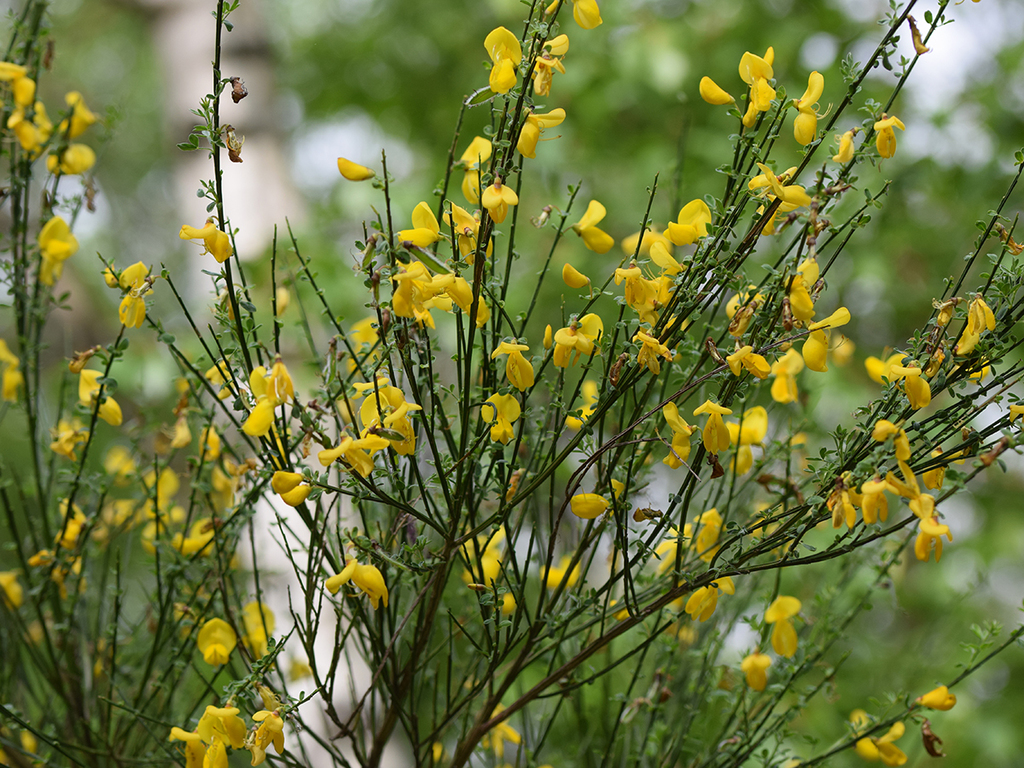
Scotch Broom
Cytisus scoparius
Cytisus scoparius (syn. Sarothamnus scoparius), the common broom or Scotch broom, is a deciduous leguminous shrub native to western and central Europe. In Great Britain and Ireland, the standard name is broom; this name is also used for other members of the Genisteae tribe, such as French broom or Spanish broom; and the term common broom is sometimes used for clarification. In other English-speaking countries, the most common name is "Scotch broom" (or Scots broom); however, it is known as English broom in Australia.
Though this plant is native to Europe, it has spread to many other parts of the world with human introduction. Scotch broom is now common in certain areas of North America and South America, and is considered an invasive species. In North America, Scotch broom was frequently planted in gardens, and was later used for erosion control along highway cuts and fills. Scotch broom is slightly toxic and unpalatable to livestock, and its seeds are viable for up to ten years, allowing them to regrow many years later, after extermination of the plant.
From the article Cytisus scoparius on Wikipedia (CC BY-SA), quoted section by section
Description
Plants of C. scoparius typically grow to 1–3 metres (3+1⁄2–10 feet) tall, rarely to 4 m (13 ft), with main stems up to 5 centimetres (2 inches) thick, rarely 10 cm (4 in). Stems are ridged and green. The shrubs have green shoots with small deciduous trifoliate leaves 5–15 millimetres (1⁄4–5⁄8 in) long, and in spring and summer are covered in profuse golden yellow flowers 20–30 mm (3⁄4–1+1⁄8 in) from top to bottom and 15–20 mm wide. Flowering occurs after 50–80 growing degree-days. The seed pods have long hairs only along their seams. In late summer, its legumes (seed pods) mature black, 2–3 cm (3⁄4–1+1⁄4 in) long, 8 mm (3⁄8 in) broad and 2–3 mm thick; they burst open, often with an audible crack, forcibly throwing seed from the parent plant. This species is adapted to Mediterranean and coastal climates, and its range is limited by cold winter temperatures. It also adapts to windy oceanic climates. The seeds, seedlings, and young shoots are sensitive to frost; adult plants are hardier, and branches affected by freezing temperatures regenerate quickly. C. scoparius contains toxic alkaloids that depress the heart and nervous system. As a legume, this shrub can fix nitrogen in the soil through a symbiotic relationship with Rhizobium bacteria.
Phytochemicals. One of the main alkaloids of this plant is cytisine. …
Range & habitat
Cytisus scoparius is native to western and central Europe, being common in Great Britain and Republic of Ireland. It is found in sunny sites, usually on dry, sandy soils at low altitudes, tolerating very acidic soil conditions. Outside of its native range, it is an ecologically destructive colonizing invasive species in grassland, shrub and woodland, and other habitats.
Wikipedia: “Distribution and habitat”
At the table
Broom contains scoparin, which is a diuretic. The plant also is used as a cathartic and as a cardiac stimulant, which is credited to the presence of sparteine. A decoction or infusion of broom can be used to treat dropsy due to its diuretic action. An ointment can be made from the flowers to treat gout. Oxysparteine, produced from the action of acid on the sparteine, is useful as a cardiac stimulant and has the advantage over digoxin that it does not accumulate in the body. A medicinal beer was brewed from this herb, called broom ale, as a remedy for dropsy.
Wikipedia: “Uses”
How it is grown
Cytisus scoparius is widely cultivated as an ornamental plant, with several cultivars selected for variation in flower colour, including "Moonlight" with deep yellow flowers, "Andreanus" and "Firefly" with dark orange-red flowers, and growth habit, including "Pendula" with pendulous branchlets.
Wikipedia: “Cultivation”
In human culture
In Welsh mythology, Blodeuwedd is the name of a woman made from the flowers of broom, meadowsweet (Filipendula ulmaria) and the oak by Math fab Mathonwy and Gwydion to be the wife of Lleu Llaw Gyffes. Her story is part of the Fourth Branch of the Mabinogi, the tale of Math son of Mathonwy. Broom was considered a sign of plenty when it bore many flowers. However a traditional rhyme from Sussex warns: "Sweep the house with blossomed broom in May/sweep the head of the household away." Broom was also used in a decorated bundle of broom at weddings in place of rosemary when that was scarce, and its strong smell was said to be able to tame wild horses and dogs. In Italy, the shrub was burnt with the intent of stopping witches.
Royal symbols. The name of the House of Plantagenet, rulers of England in the Middle Ages, may have been derived from common broom, which was then known as planta genista in Latin. The plant was used as a heraldic badge by Geoffrey V of Anjou and five Plantagenet kings of England as a royal emblem. The broomscod, or seed-pod, was the personal emblem of Charles VI of France.
Wikipedia: “Culture”
Where it lives
Recorded sightings
—
geo-referenced records in GBIF, from museums, herbaria and field observers.
Drag the globe to turn it. Dots are where records exist, not a range map; darker means more records.
In the stacks
Searching the stacks…
Every page naming Cytisus scoparius in the Biodiversity Heritage Library →
This page is assembled live from iNaturalist, GBIF, Wikipedia, the Source Library and the Internet Archive. It is not yet part of the hand-edited codex. iNaturalist taxon 48538.