- Animals
- ›Arthropods
- ›Hexapods
- ›Insects
- ›Winged and Once-winged Insects
- ›Ants, Bees, Wasps, and Sawflies
- ›Narrow-waisted Wasps, Ants, and Bees
- ›Ants, Bees, and Stinging Wasps
- ›Bees and Apoid Wasps
- ›Bees
- ›Mason, Leafcutter, Carder, and Resin Bees
- ›Megachilinae
- ›Osmiini
- ›Osmia
- ›Helicosmia
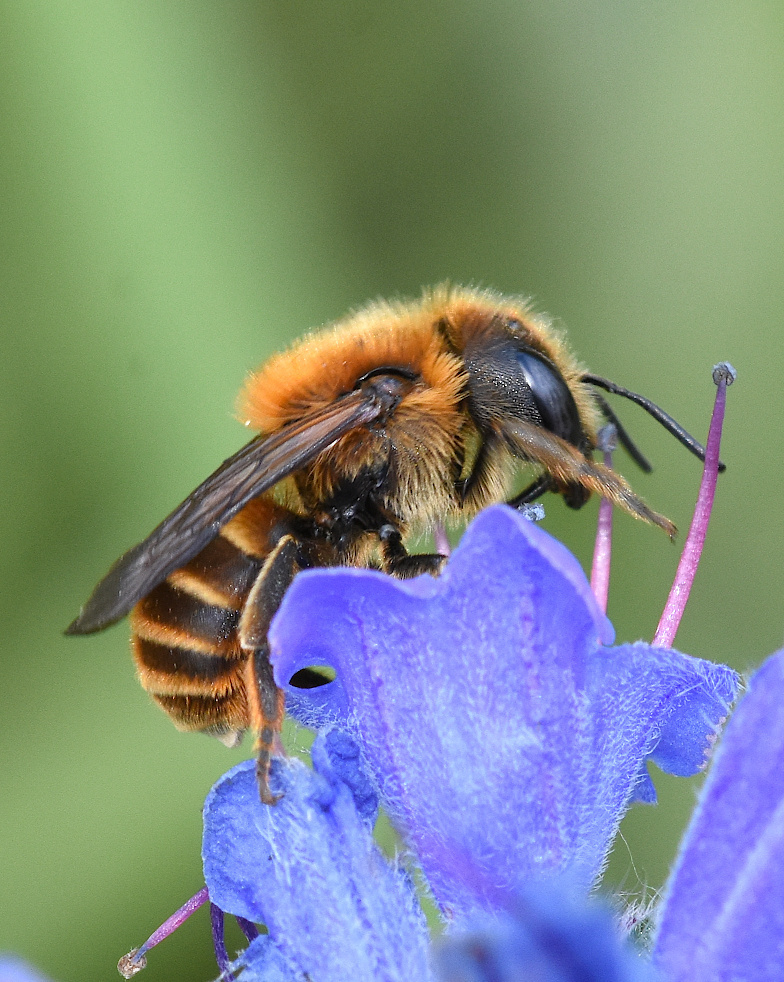
Gold-fringed Mason Bee
Osmia aurulenta
Osmia aurulenta is a Palearctic species of mason bee.
From the article Osmia aurulenta on Wikipedia (CC BY-SA), quoted section by section
Description
8–10 mm. Males in the field cannot be distinguished from similar Osmia species, especially when they are older. Females in a fresh state may be confused with the slimmer Osmia rufohirta due to the bright rust-red hairs of the thorax, the rust-red narrow tergite bandages and the rust-red belly brush. Females that are old are similar to Osmia tridentata.
Range & habitat
From Portugal through Europe and Asia Minor to the Caucasus; north to Ireland and southern Scotland, to 59.5° N in Norway, 58° N in Sweden, in Russia to Udmurtia; south to Sicily, Greece and Lebanon.
Wikipedia: “Range”
What it does
The flight period ranges in a generation from March to July, beginning of March to the beginning of September in Switzerland. Polylectic with preference for Fabaceae. So far, the use of the pollen of the six plant families Asteraceae, Boraginaceae, Cistaceae, Fabaceae, Lamiaceae and Plantaginaceae has been proven. Nests in empty, medium-sized to large snail shells, preferred are those of Helix pomatia. In the medium-sized houses there are only 1–4 cells lying one behind the other, in snail shells the cells are next to each other in the front area. The dividing walls of the cells and the nest closure are made from chewed pieces of Fragaria, Helianthemum and others. The outer wall of the snail shell is covered with plant mortar like a camouflage net. After completion of the nest closure, the snail shell – in contrast to Osmia bicolor, for example – is no longer moved. Parasites: Cuckoo bee is Stelis punctulatissima. The wasps Sapyga quinquepunctata, Chrysura trimaculata, Chrysura cuprea, Chrysis hirsuta and Chrysura dichroa and wasps of the genus Pteromalus are known as parasites.
Wikipedia: “Ecology”
Listen
Looking for field recordings…
Where it lives
Recorded sightings
—
geo-referenced records in GBIF, from museums, herbaria and field observers.
Drag the globe to turn it. Dots are where records exist, not a range map; darker means more records.
In the stacks
Searching the stacks…
Every page naming Osmia aurulenta in the Biodiversity Heritage Library →
This page is assembled live from iNaturalist, GBIF, Wikipedia, the Source Library and the Internet Archive. It is not yet part of the hand-edited codex. iNaturalist taxon 484587.