- Plants
- ›Vascular Plants
- ›flowering plants
- ›monocots
- ›Agaves, Orchids, Irises, and Allies
- ›Orchids
- ›Higher Epidendroid Orchids
- ›Cymbidieae
- ›Cymbidium Alliance Orchids
- ›Cymbidium
- ›Cyperorchis
- ›Iridorchis
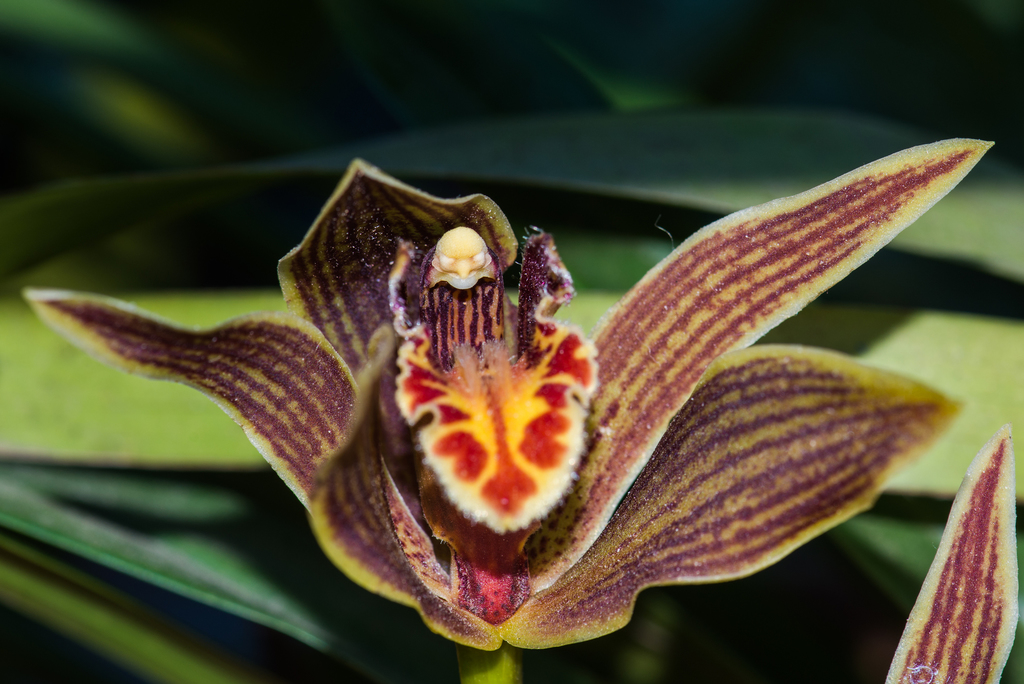
Cymbidium iridioides
Cymbidium iridioides, commonly known as the Iris-Like Cymbidium is a species of boat orchid. It is a pseudobulbous epiphyte found from Himalaya to south-central China.
From the article Cymbidium iridioides on Wikipedia (CC BY-SA), quoted section by section
Description
It is a pseudobulbous epiphyte. The pseudobulbs are 4 to 11 cm (1.6 to 4.3 in) long and 2 to 5 cm (0.79 to 1.97 in) wide, and are ellipsoid-ovoid to narrowly ovoid. The flowers are 9 to 10 cm (3.5 to 3.9 in) in diameter, the pedicel and ovary are 40 to 45 mm (1.6 to 1.8 in). The sepals and the petals are yellowish green, with 7–9 brownish to reddish brown longitudinal stripes. The lip is yellowish, with red or brown stripes on the lateral lobes and on the mid-lobe. The sepals are narrowly obovate-oblong, and are 37 to 45 mm (1.5 to 1.8 in) × 12 to 15 mm (0.47 to 0.59 in). The petals are slightly falcate, and are 35 to 46 mm (1.4 to 1.8 in) × 7 to 9 mm (0.28 to 0.35 in)
== References ==
Range & habitat
Cymbidium iridioides is native to Assam, south-central China, Himalaya, Myanmar, Nepal, Tibet, Vietnam. Under natural conditions, it is found on trees or rocks, and on shaded cliffs at elevations of 900–2800 meters from sea level.
Wikipedia: “Distribution and habitat”
Where it lives
Recorded sightings
—
geo-referenced records in GBIF, from museums, herbaria and field observers.
Drag the globe to turn it. Dots are where records exist, not a range map; darker means more records.
In the stacks
Searching the stacks…
Every page naming Cymbidium iridioides in the Biodiversity Heritage Library →
This page is assembled live from iNaturalist, GBIF, Wikipedia, the Source Library and the Internet Archive. It is not yet part of the hand-edited codex. iNaturalist taxon 484262.