- Plants
- ›Vascular Plants
- ›flowering plants
- ›Dicots
- ›Roses, Elms, Figs, and Allies
- ›rose family
- ›Amygdaloideae
- ›Amygdaleae
- ›Prunus
- ›Cerasus
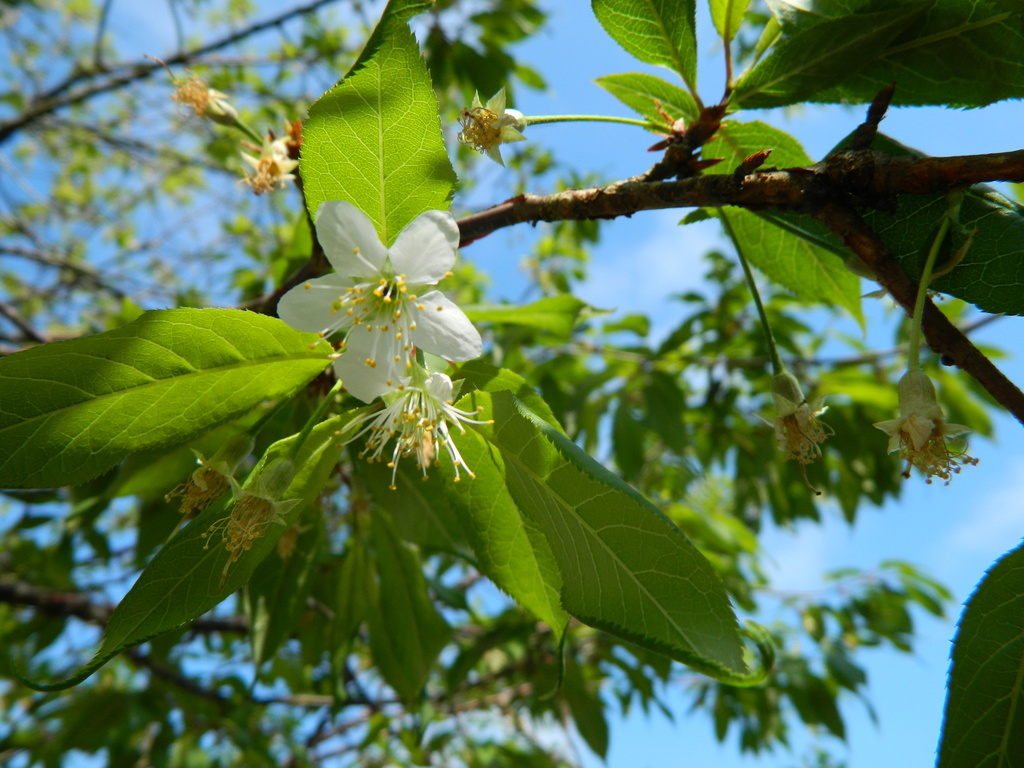
Tibetan Cherry
Prunus serrula
Prunus serrula, called birch bark cherry, birchbark cherry, paperbark cherry, or Tibetan cherry, is a species of cherry native to China, and is used as an ornamental in many parts of the world for its striking coppery-red bark.
From the article Prunus serrula on Wikipedia (CC BY-SA), quoted section by section
Description
Prunus serrula is a small deciduous tree, often with multiple stems, reaching a height of 20–30 feet (6–9 m). The leaves are arranged alternately, simple, 5–10 cm long and 1.5–2.0 cm broad and a serrate margin. The smooth bark is a brownish red, with prominent horizontal lenticels. The outer layer of the bark is remarkably tough, approaching the strength of Mylar.
Flowers. The flowers, typical of Prunus, are produced in clusters of one to three. The fruit is a small oval bright red drupe.
How it is grown
Prunus serrula is grown as an ornamental tree, especially for winter interest. It tolerates a variety of soil types and has a wide pH range. It prefers full sun and does well in USDA hardiness zones 5 to 8. Its potential as an invasive species is low, as it is susceptible to many common garden diseases and pests such as fire blight, powdery mildew and Japanese beetles. It is sometimes grafted to Prunus serrulata (Japanese cherry) crowns, forming a tree with red bark and showier flowers. In 2012 the 'Branklyn' variety gained the Royal Horticultural Society's Award of Garden Merit.
Wikipedia: “Cultivation”
Where it lives
Recorded sightings
—
geo-referenced records in GBIF, from museums, herbaria and field observers.
Drag the globe to turn it. Dots are where records exist, not a range map; darker means more records.
In the stacks
Searching the stacks…
Every page naming Prunus serrula in the Biodiversity Heritage Library →
This page is assembled live from iNaturalist, GBIF, Wikipedia, the Source Library and the Internet Archive. It is not yet part of the hand-edited codex. iNaturalist taxon 484175.