- Plants
- ›Vascular Plants
- ›flowering plants
- ›Dicots
- ›Buttercups, Poppies, and Allies
- ›Poppy Family
- ›Poppy Subfamily
- ›Eschscholzieae
- ›Eschscholzia
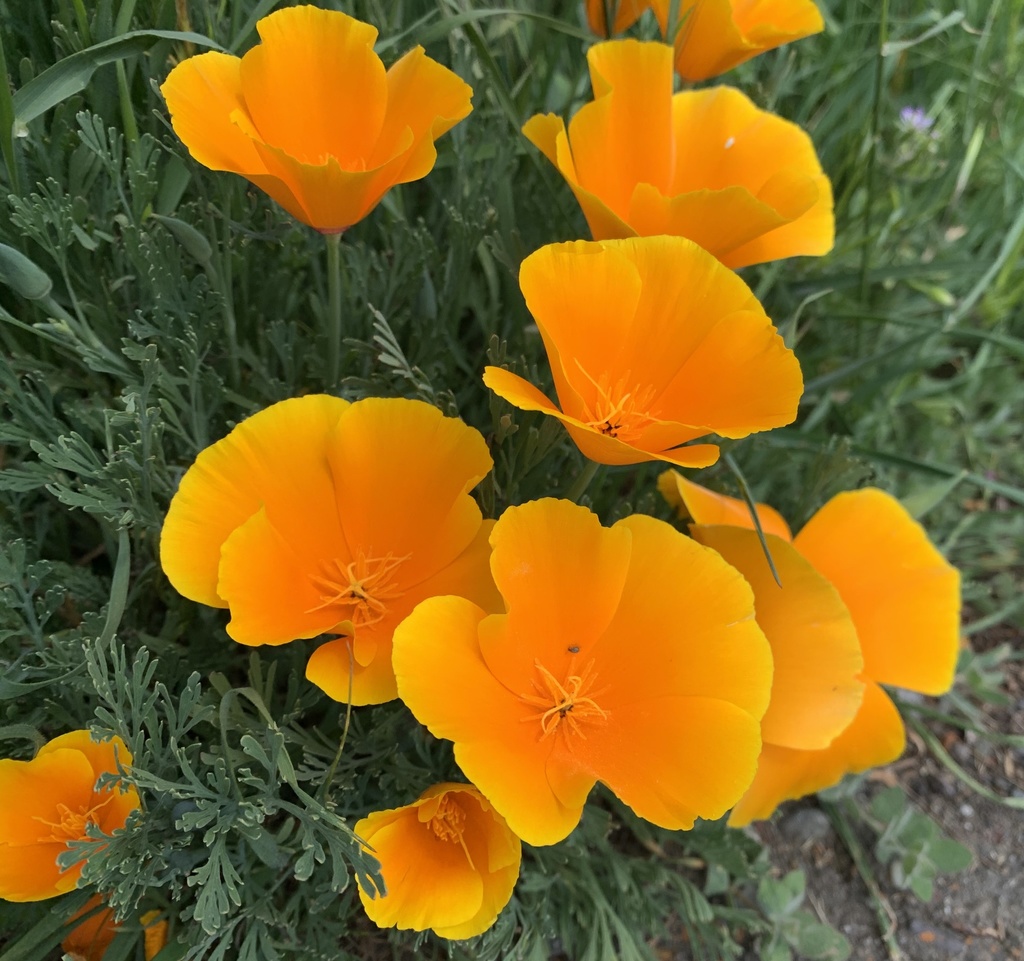
California poppy
Eschscholzia californica
Eschscholzia californica, the California poppy, golden poppy, Mexican poppy, California sunlight or cup of gold, is a species of flowering plant in the family Papaveraceae, native to the United States and Mexico. It is cultivated as an ornamental plant flowering in summer (spring in southern Australia), with showy flowers in brilliant shades of red, orange and yellow (occasionally pink and white). It is also used as food or a garnish. It had various uses in indigenous herbalism. It became the official state flower of California in 1903.
From the article Eschscholzia californica on Wikipedia (CC BY-SA), quoted section by section
Description
California poppy is a perennial or annual plant growing to 5–12 in (13–30 cm) tall with alternately branching glaucous blue-green foliage. The leaves are alternately divided into round, lobed segments. The flowers are solitary on long stems, silky-textured, with four petals, each petal 2 to 6 cm (0.79 to 2.36 in) long and broad; flower color ranges through yellow, orange and red. Flowering occurs from February to September in the northern hemisphere. The petals close at night (or in cold, windy weather) and open again the following morning, although they may remain closed in cloudy weather. The fruit is a slender, dehiscent capsule 3 to 9 cm (1.2 to 3.5 in) long, which splits in two, sometimes explosively with an audible snap, to release numerous small 1.5–1.8 mm (0.059–0.071 in) wide black or dark brown seeds. The plant will reseed under ideal conditions, or when winters are cold. Anecdotally, it can be an aggressive reseeder in the home garden context, eventually becoming a groundcover. It survives mild winters in its native range, dying completely in colder climates.
Habitat. Its native habitat includes California and extends to Oregon, Washington, Nevada, Arizona, New Mexico, Sonora and northwest Baja California. The Antelope Valley California Poppy Reserve is located in northern Los Angeles County. …
At the table
California poppy leaves are used as food or garnish, while the seeds are used in cooking. There are no clinical trials showing it can effectively treat psychiatric disorders in humans.
Chemical compounds. E. californica contains californidine (N+(CH3)2), allocryptopine, eschscholtzine N-CH3 (californidine), and other similar (Papaveraceae) alkaloids, as well as berberine.
Preparation. The California poppy has been used through two methods: fresh petals to create a syrup, and dried petals added to water to make an infusion or boiled for tea.
Wikipedia: “Uses”
How it is grown
E. californica is drought-tolerant, self-seeding, and easy to cultivate. It is best grown as an annual, in full sun, and well-draining sandy or loam soil. Horticulturalists have produced numerous cultivars with a range of colors and blossom and stem forms. These typically do not breed true on reseeding. Seeds are often sold as mixtures. The following cultivars have gained the Royal Horticultural Society's Award of Garden Merit:-
'Apricot chiffon' (yellow flushed with pink and orange) 'Dali' (red) 'Rose chiffon' (pink and white)
Wikipedia: “Cultivation”
Where it lives
Recorded sightings
—
geo-referenced records in GBIF, from museums, herbaria and field observers.
Drag the globe to turn it. Dots are where records exist, not a range map; darker means more records.
In the stacks
Searching the stacks…
Every page naming Eschscholzia californica in the Biodiversity Heritage Library →
This page is assembled live from iNaturalist, GBIF, Wikipedia, the Source Library and the Internet Archive. It is not yet part of the hand-edited codex. iNaturalist taxon 48225.