- Plants
- ›Vascular Plants
- ›flowering plants
- ›monocots
- ›Agaves, Orchids, Irises, and Allies
- ›agave and allies
- ›Dragon tree subfamily
- ›cast-iron plants and lilies of the valley
- ›Convallaria
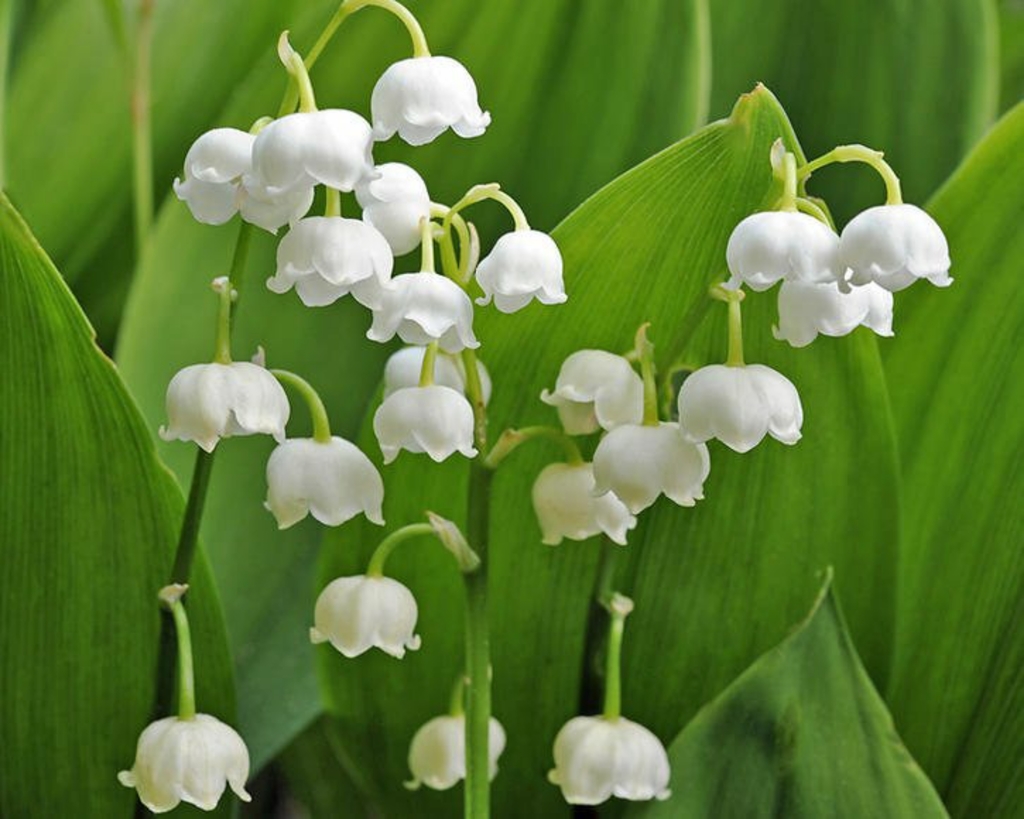
European lily of the valley
Convallaria majalis
Lily-of-the-valley (Convallaria majalis), also written as lily of the valley, is a woodland flowering plant with sweetly scented, pendent, bell-shaped white flowers borne in sprays in spring. It is native to Europe, Western Asia and Northern Asia.
The former varieties Convallaria majalis var. montana (native to eastern North America) and Convallaria majalis var. keiskei (native to eastern Asia), are now split as the separate species Convallaria pseudomajalis and Convallaria keiskei, respectively.
From the article Lily of the valley on Wikipedia (CC BY-SA), quoted section by section
Description
Convallaria majalis is a herbaceous perennial plant that often forms extensive colonies by spreading underground stems called rhizomes. New upright shoots are formed at the ends of stolons in summer. These grow in the spring into new leafy shoots that still remain connected to the other shoots under ground. The stems grow to 15–35 cm (6–14 in) tall, with two (rarely three) leaves 5–20 cm (2–8 in) long and 3–7 cm (1–3 in) broad. The flowering stems have a one-sided raceme of six to twelve pendulous flowers on the upper part of the stem. The flowers have six white tepals (rarely pink, as in the cultivar Convallaria majalis 'Rosea', which has pink tepals), fused at the base to form a bell shape with reflexed tips; they are 5–10 mm (0.2–0.4 in) diameter, and are sweetly scented. Flowering is in late spring, typically May to June in Britain. The fruit is a poisonous small orange-red berry approximately 5–7 mm (0.2–0.3 in) diameter, containing an average of 3.9 large whitish to brownish seeds that dry to a clear translucent round bead 1–3 mm (0.04–0.12 in) wide. The fruit persists for an average of 47.5 days. The fruit averages 85.8% water, and their dry weight includes 14.6% carbohydrates and 1.3% lipids. Plants are self-incompatible, and colonies consisting of a single clone do not set seed.
Range & habitat
Convallaria majalis is a native of Europe, where it largely avoids the Mediterranean margin, and is also absent from Ireland as a native species, though is naturalised there. Like many perennial flowering plants, C. majalis exhibits dual reproductive modes by producing offspring asexually by vegetative means and sexually by seed, produced via the fusion of gametes.
Wikipedia: “Distribution”
What it does
Convallaria majalis is a plant of partial shade, and a mesophile type that prefers warm summers. It grows widely in both acidic soils and alkaline soils, liking soils that are silty or sandy, but also locally in wet fen soils, with preferably a plentiful amount of humus. It is a Euroasiatic and suboceanic species that occurs from sea level up to 490 m (1,600 ft) altitude in Great Britain, and in central and southern Europe up to 2,300 m (7,500 ft) altitude. Convallaria majalis is used as a food plant by the larvae of some moth and butterfly (Lepidoptera) species including the grey chi. Adults and larvae of the leaf beetle Lilioceris merdigera are also able to tolerate the cardenolides and thus feed on the leaves. The fruit is sometimes removed by graniviorous rodents, consuming most of the seeds but only a small proportion of the fruit pulp. Their hoarding of both seeds and whole fruit has been observed. As some seeds inevitably escape predation, they also act as seed dispersers.
Wikipedia: “Ecology”
In medicine
The plant has been used in folk medicine for centuries. There is a reference to "Lilly of the valley water" in Robert Louis Stevenson's 1886 novel Kidnapped, where it is said to be "good against the Gout", and that it "comforts the heart and strengthens the memory" and "restores speech to those that have the dumb palsey". There is no scientific evidence that lily of the valley has any effective medicinal uses for treating human diseases.
Wikipedia: “Folk medicine”
Toxicity
All parts of the plant are potentially poisonous, including the red berries which may be attractive to children. If ingested, the plant can cause abdominal pain, nausea, vomiting, and irregular heartbeats.
Wikipedia: “Toxicology”
In human culture
The lily-of-the-valley was the national flower of Yugoslavia, and it also became the national flower of Finland in 1967. In the "language of flowers", the lily of the valley signifies the return of happiness.
Myths and religion. The name "lily of the valley" is apparently a reference to the biblical phrase "lily of the valleys" (sometimes also translated as "lily of the valley"), from Song of Songs 2:1 (שׁוֹשַׁנַּת הָעֲמָקִים). European herbalists' use of the phrase to refer to a specific plant species seems to have appeared relatively late, in the 15th or 16th century. The genus name Convallaria (coined by Carl Linnaeus) derives from lilium convallium, the term used in the Vulgate translation of Song of Songs.
In culture. The lily of the valley is represented both literally and symbolically in art, literature, music, and other media. The flower is the theme of a poem by Paul Laurence Dunbar, and Tchaikovsky wrote the poem "Lilies of the Valley" (Ландыши) in December 1878 while in Florence. In Anton Chekhov's 1898 short story "A Doctor's Visit", drops of convallaria are mentioned as medicine. …
Wikipedia: “Cultural symbolism”
Where it lives
Recorded sightings
—
geo-referenced records in GBIF, from museums, herbaria and field observers.
Drag the globe to turn it. Dots are where records exist, not a range map; darker means more records.
In the old herbals & bestiaries


In the stacks
Searching the stacks…
Every page naming Convallaria majalis in the Biodiversity Heritage Library →
This page is assembled live from iNaturalist, GBIF, Wikipedia, the Source Library and the Internet Archive. It is not yet part of the hand-edited codex. iNaturalist taxon 48206.