- Animals
- ›Arthropods
- ›Hexapods
- ›Insects
- ›Winged and Once-winged Insects
- ›Beetles
- ›Water, Rove, Scarab, Long-horned, Leaf, and Snout Beetles
- ›Scarabaeiform Beetles
- ›Scarabs, Stag Beetles, and Allies
- ›Scarabs
- ›June Beetles
- ›Melolonthini
- ›Melolontha
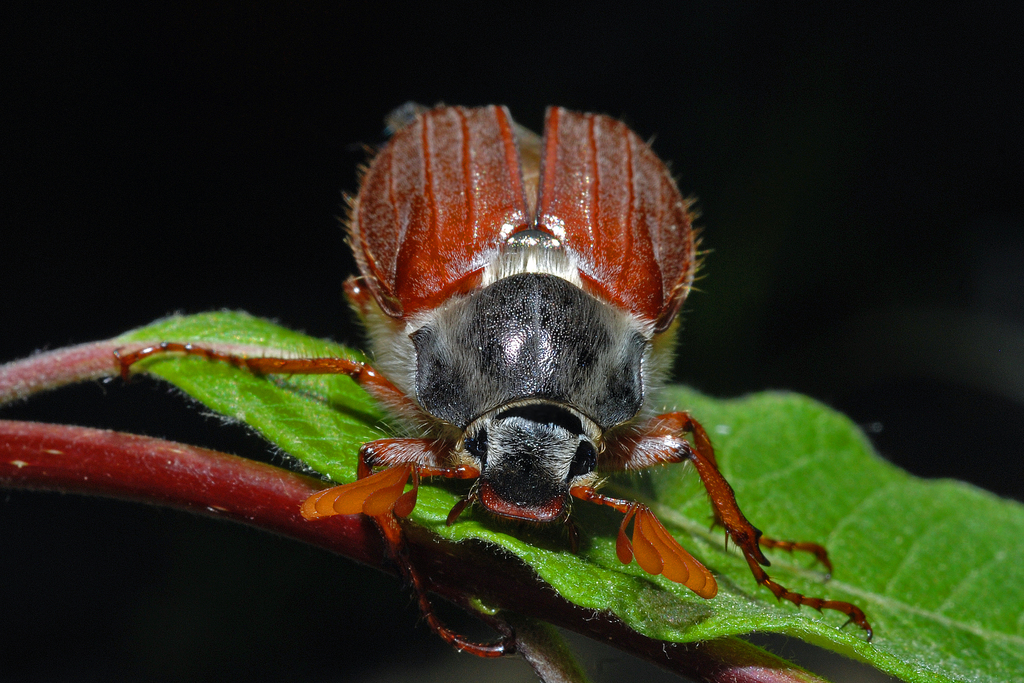
Common Cockchafer
Melolontha melolontha
The common cockchafer (Melolontha melolontha), known colloquially as the Maybug, Maybeetle, or doodlebug, among many other names, is a species of scarab beetle belonging to the genus Melolontha. It is native to Europe, and it is also one of the several closely-related and morphologically similar species of Melolontha called cockchafers, alongside Melolontha hippocastani (the forest cockchafer) as the latter also shows sexual dimorphism, mating practices, and key physical features such as the number of lamellae.
The cockchafer develops via metamorphosis, in which the beetle undergoes stages of eggs, larvae, pupae and adults.
From the article Cockchafer on Wikipedia (CC BY-SA), quoted section by section
Range & habitat
The cockchafer is widespread across Europe, particularly in temperate regions with suitable soil conditions for larval development. It has also been reported in parts of Asia, including Turkey and the Caucasus region. Geographical barriers, climatic conditions, and ecological factors may limit the cockchafer's dispersal; it does not occur in the mountainous regions of Tyrol, for example, because it cannot survive at the high altitudes and low temperatures of the Alps. It typically disperses no more than 2 to 3 km (1.2 to 1.9 mi) from where it emerges and remains in close proximity to the fields or grasslands where it occurs.
Wikipedia: “Distribution and habitat”
What it does
The adult cockchafer appears between late April and early June and lives for about five to seven weeks. After two to three weeks, the female begins laying eggs, typically depositing them in fields at a depth of around 15 to 25 cm (6 to 10 in). Each female may repeat this process until she has laid between 60 and 80 eggs. Adults feed primarily on the leaves of oak, sycamore, maple, hornbeam, beech and plum trees, and occasionally on other trees, including the chestnut. The larva, known as a "chafer grub" or "white grub", hatches four to six weeks after the egg is laid, and feeds on the roots of plants, including the potato. The grub develops underground for three to four years, or up to five years in colder climates, growing to a length of approximately 4–5 cm (1.6–2.0 in). It then pupates in the summer, developing into an adult cockchafer over the following six weeks. The adult cockchafer overwinters in the earth by staying in its pupal chamber at depths usually between 5 to 40 cm (2 to 16 in) although it may be found as deep as 100 cm (40 in). It emerges in spring, from April to May. Cockchafer populations undergo periodic fluctuations in abundance, with particularly large emergences occurring every three or four years, depending on the region. Historically, an additional cycle of approximately 30–40 years was observed, during which populations reached unusually high levels.
Wikipedia: “Life cycle”
In human culture
The name cockchafer derives from the late-17th-century usage of cock (in the sense of expressing size or vigour) + chafer which simply means an insect of this type, referring to its propensity for gnawing and damaging plants. The term chafer has its root in Old English ceafor or cefer, of Germanic origin and is related to the Dutch kever, all of which mean gnawer as it relates to the jaw. The term melolontha is derived from the Ancient Greek word mēlolónthē which means cockchafer.
Wikipedia: “Etymology”
Listen
Looking for field recordings…
Where it lives
Recorded sightings
—
geo-referenced records in GBIF, from museums, herbaria and field observers.
Drag the globe to turn it. Dots are where records exist, not a range map; darker means more records.
In the stacks
Searching the stacks…
Every page naming Melolontha melolontha in the Biodiversity Heritage Library →
This page is assembled live from iNaturalist, GBIF, Wikipedia, the Source Library and the Internet Archive. It is not yet part of the hand-edited codex. iNaturalist taxon 48197.