- Animals
- ›Arthropods
- ›Crustaceans
- ›Typical Crustaceans
- ›Malacostracans
- ›Decapods, Isopods, and allies
- ›Decapods and Krill
- ›Decapods
- ›Crabs, Lobsters, Shrimps, and Allies
- ›Anomurans
- ›Hermit Crabs
- ›Pagurid Hermit Crabs
- ›Pagurus
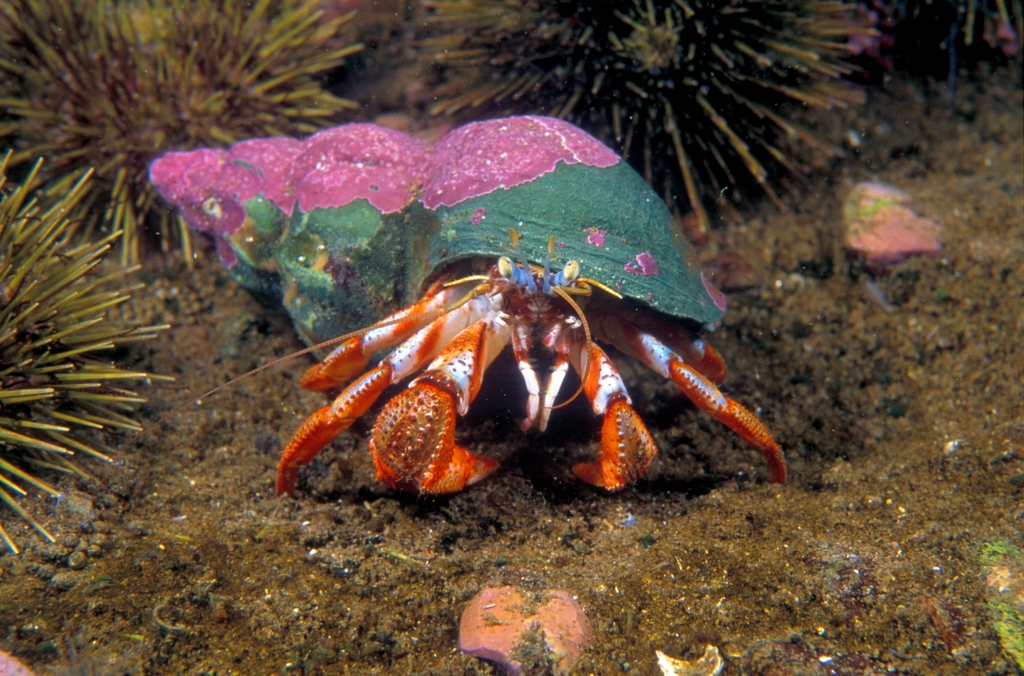
Acadian hermit crab
Pagurus acadianus
Pagurus acadianus, the Acadian hermit crab, is a species of hermit crab in the family Paguridae. It is found in Western Atlantic Ocean.
From the article Pagurus acadianus on Wikipedia (CC BY-SA), quoted section by section
Range & habitat
The Acadian hermit crab, also known as Pagurus acadianus, can be found in the Western Atlantic Ocean, including areas such as the Vineyard Sound. In addition, the Acadian hermit crab has been cited as the most abundant species of crab in Salisbury Cove, Maine by William C. Grant, Jr, during his extensive study of hermit crabs populating this area in 1961.
Wikipedia: “Distribution”
What it does
Though very little is known on the specific reproductive behavior of Pagurus acadianus, information on their adolescence was attained by Roberts during his laboratory studies of this species. Roberts found that the incubation period of the larva is approximately 30 days, and the optimal temperature during gestation is 55.4 degrees Fahrenheit. Once they hatch, the size of the eggs is about 0.58 by 0.64 millimeters, and can be distinguished by varying hues of red and yellow coloration, in addition to distinctive eyespots. Both larval and adult Acadian hermit crabs are often confused with the closely related Pagurus berhnardus, or the common marine hermit crab of western Europe, and this comparison has been the focal point of many scientific evaluations, as demonstrated by Benedict's work.
Wikipedia: “Reproduction and development”
In human culture
Pagurus acadianus was first identified in scientific literature by scientist J.E. Benedict in 1901. As examined by Morris H. Roberts, Jr.’s, Benedict was able to differentiate this organism from that of a very similar taxa, Pagurus benhardus, due to physical variations. Benedict observed that Pagurus acadianus had larger eyestalks, shorter fingers of the chelae and sharper chelipeds, all of which are necessary identifiers of the Acadian hermit crab. Taxonomically, the Acadian hermit crab belongs to the Arthropoda phyla. Arthropods belong to the most populous animal phylum, with a recorded million (and counting) species. Arthropods include crustaceans and insects, and are characterized by the breadth of their variation in morphology, or their relationship among similar organisms based on comparisons between physical, chemical and taxonomic similarities. This can often be seen through the use of phylogenetic trees and cladograms. The Acadian hermit crab belongs to the Pagurus genera, along with the hairy hermit crab, or Pagurus pubescens, and the aforementioned Pagurus bernhardus. The abundance of their populations is seasonally dependent, with a peak in richness in the month of June, and a staggering decrease from the months of November to March. In addition, they are most plentiful in seawater temperatures ranging from 32 degrees Fahrenheit to 41 degrees Fahrenheit. …
Wikipedia: “History”
Where it lives
Recorded sightings
—
geo-referenced records in GBIF, from museums, herbaria and field observers.
Drag the globe to turn it. Dots are where records exist, not a range map; darker means more records.
In the stacks
Searching the stacks…
Every page naming Pagurus acadianus in the Biodiversity Heritage Library →
This page is assembled live from iNaturalist, GBIF, Wikipedia, the Source Library and the Internet Archive. It is not yet part of the hand-edited codex. iNaturalist taxon 48167.