- Plants
- ›Vascular Plants
- ›flowering plants
- ›Dicots
- ›borages
- ›borage family
- ›Cynoglossoideae
- ›Cynoglosseae
- ›Cynoglossum
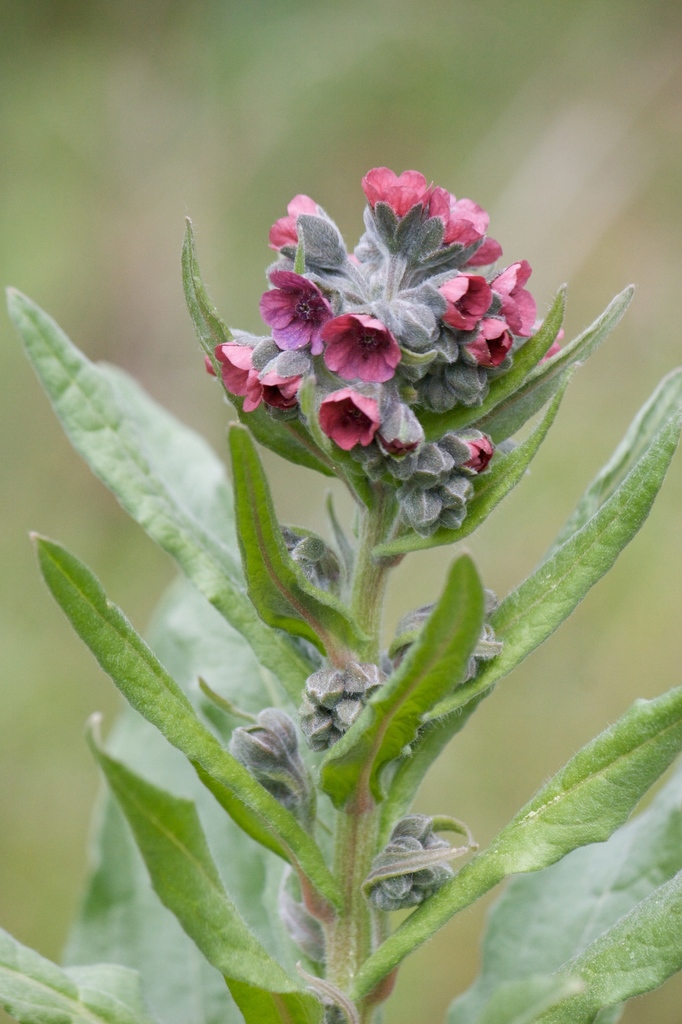
hound's-tongue
Cynoglossum officinale
Cynoglossum officinale (houndstongue, houndstooth, dog's tongue, gypsy flower, and rats and mice due to its smell) is a herbaceous plant of the family Boraginaceae, found in most parts of Europe, and also North America where it was accidentally introduced.
From the article Cynoglossum officinale on Wikipedia (CC BY-SA), quoted section by section
Description
It can be either annual or biennial. Leaves are greyish and softly haired, lanceolate to oblong. Reddish-purple funnel-shaped flowers bloom between May and September. The plant owes its common and scientific name to the long greyish leaves that are reminiscent of a dog's tongue and were once given as a remedy for dog bites.
Range & habitat
Found in most parts of Europe, and also North America, where it was accidentally introduced including in British Columbia, where it is designated a noxious weed under the British Columbia Weed Control Act. It lives in wet places, sand dunes, waste land and hedges.
Wikipedia: “Distribution and habitat”
In medicine
In 1725, houndstooth was presented in the family dictionary, Dictionaire oeconomique, as part of a cure for madness. In that book, madness was viewed as "a distemper, not only of the understanding, but also of the reason and memory, proceeding from a cold, which drys up everything it meets with that is humid in the brain." To cure madness, Dictionaire oeconomique noted: You must shave the head of the unhappy patient, and after that, apply to it a pidgeon, or a hen quite alive; or else bathe it with some brandy distilled with rosemary, elder, hounds tooth, and the roots of bugloss, or with the oyl of elder flowers: they rub their heads and wash their feet with a decoction of the flowers of camomile, melilot, balm gentle and laurel; they put into their noses the juice of comfrey, with either two or three spoonfuls of honey-water, broth, or white-wine, wherein wormwood and sage are infus'd ; or else they do for five and twenty days together, mix with their broth in the morning, halt a dram of the ashes of tortoise, and they put into the pot bugloss, borage, with a pinch of rosemary to season it. In the 1830s, houndstooth was known in France to be made into an emollient and diuretic for daily use in inflammatory diseases, especially of the urinary organs. …
Wikipedia: “Herbalism”
Toxicity
Cynoglossum officinale contains tumorigenic pyrrolizidine alkaloids. It is toxic to cows and is especially dangerous to pasture owners.
In human culture
The name "houndstongue" (and the Latin genus Cynoglossum) comes from the shape of the leaf.
Wikipedia: “Etymology”
Where it lives
Recorded sightings
—
geo-referenced records in GBIF, from museums, herbaria and field observers.
Drag the globe to turn it. Dots are where records exist, not a range map; darker means more records.
In the old herbals & bestiaries

Jan Moninckx; Maria Moninckx — Moninckx Atlas, vol. 1 (1686)
Jan Moninckx; Maria Moninckx · 1687 · p.13

Commentaries on the Six Books of Dioscorides on Medical Matter
Pietro Andrea Mattioli · 1563 · p.682

Commentaries on the Six Books of Pedanius Dioscorides on Medical Matter
Pietro Andrea Mattioli · 1565 · p.1362

Herbarius
1485 · p.84

Herbal of Virtues
1499 · p.83

The Book of Health: The Art of Distillation
Brunschwig, Hieronymus · 1505 · p.149

Garden of Health
1507 · p.91

Living Images of Plants
Otto Brunfels · 1532 · p.183

Living Images of Plants
Otto Brunfels · 1532 · p.182

The Great Herbary with all the figures of the herbs
1532 · p.100

Living Images of Plants
Otto Brunfels · 1532 · p.186

Notable Commentaries on the History of Plants
Leonhart Fuchs · 1542 · p.442
In the stacks
Searching the stacks…
Every page naming Cynoglossum officinale in the Biodiversity Heritage Library →
This page is assembled live from iNaturalist, GBIF, Wikipedia, the Source Library and the Internet Archive. It is not yet part of the hand-edited codex. iNaturalist taxon 48152.