- Plants
- ›Vascular Plants
- ›flowering plants
- ›Dicots
- ›Soapberries, Cashews, Mahoganies, and Allies
- ›soapberry family
- ›Acer
- ›Rubra
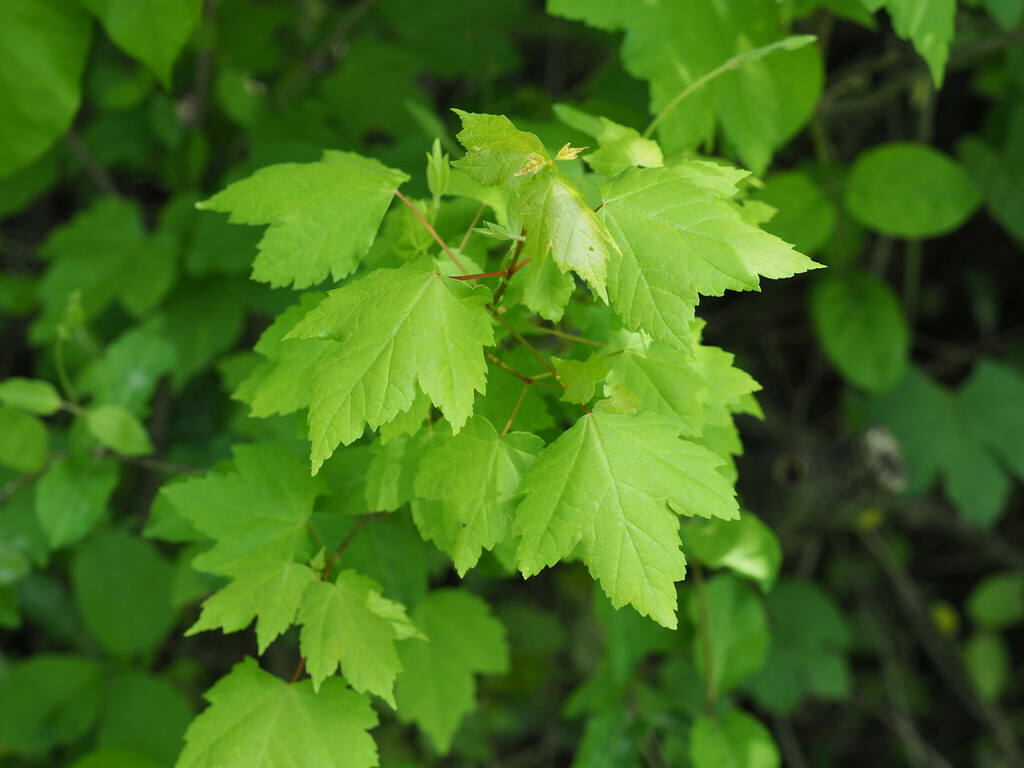
red maple
Acer rubrum
Acer rubrum, the red maple, also known as swamp maple, water maple, or soft maple, is a North American tree species. Many of its features, especially its deciduous leaves, are quite variable in form. At maturity, it often attains a height around 30 metres (100 ft). Its flowers, petioles, twigs, and seeds are all red to varying degrees.
Red maple is one of the most common and widespread deciduous trees of eastern North America. Its distribution ranges from southeastern Manitoba around the Lake of the Woods on the border with Ontario and Minnesota, east to Newfoundland, south to Florida, and southwest to East Texas. Over most of its range, red maple is adaptable to a very wide range of site conditions. It can be found growing in swamps, on poor, dry soils, and almost anywhere in between from sea level to about 900 m (3,000 ft).
From the article Acer rubrum on Wikipedia (CC BY-SA), quoted section by section
Description
Though A. rubrum is sometimes easy to identify, it is highly variable in morphological characteristics. It is a medium to large tree, reaching heights of 27 to 38 m (90 to 120 ft) and exceptionally over 41 m (135 ft) in the southern Appalachians where conditions favour its growth. The leaves are usually 9 to 11 cm (3+1⁄2 to 4+1⁄4 in) long on a full-grown tree. The trunk diameter often ranges from 46 to 88 cm (18 to 35 in); depending on the growing conditions, however, open-grown trees can attain diameters of up to 153 cm (60 in). The trunk remains free of branches until some distance up the tree on forest grown trees, while individuals grown in the open are shorter and thicker with a more rounded crown. Trees on poorer sites often become malformed and scraggly. Generally the crown is irregularly ovoid with ascending whip-like curved shoots. The bark is a pale grey and smooth when the individual is young. As the tree grows the bark becomes darker and cracks into slightly raised long plates. The tallest known living red maple is near Sevierville in the Great Smoky Mountains National Park, with a height of 43.59 m (143.0 ft), and the largest known is near Armada, Michigan, with a height of 38.1 m (125 ft) and a bole circumference, at breast height, of 4.95 m (16 ft 3 in). The leaves of the red maple are deciduous and arranged oppositely on the twig. …
Range & habitat
Acer rubrum is one of the most abundant and most widespread trees in eastern North America. It can be found from the south of Newfoundland, through Nova Scotia, New Brunswick, and southern Quebec to the southwest west of Ontario, extreme southeastern Manitoba and northern Minnesota; southward through Wisconsin, Illinois, Missouri, eastern Oklahoma, and eastern Texas in its western range; and east to Florida. It has the largest continuous range along the North American Atlantic Coast of any tree that occurs in Florida. In total it ranges 2,600 km (1,600 mi) from north to south. The species is native to all regions of the United States east of the 95th meridian. The tree's range ends where the −40 °C (−40 °F) mean minimum isotherm begins, namely in southeastern Canada. A. rubrum is not present in most of the Prairie Peninsula of the northern Midwest (although it is found in Ohio), the coastal prairie in southern Louisiana and southeastern Texas and the swamp prairie of the Florida Everglades. Red maple's western range stops with the Great Plains where conditions become too dry for it. The absence of red maple from the Prairie Peninsula is most likely due to the tree's poor tolerance of wildfires. …
Wikipedia: “Distribution and habitat”
What it does
Red maple's maximum lifespan is 150 years, but most live less than 100 years. The tree's thin bark is easily damaged from ice and storms, animals, and when used in landscaping, being struck by flying debris from lawn mowers, allowing fungi to penetrate and cause heart rot. Its ability to thrive in a large number of habitats is largely due to its ability to produce roots to suit its site from a young age. In wet locations, red maple seedlings produce short taproots with long, well-developed lateral roots; while on dry sites, they develop long taproots with significantly shorter laterals. The roots are primarily horizontal, however, forming in the upper 25 cm (9.8 in) of the ground. Mature trees have woody roots up to 25 m (82 ft) long. They are very tolerant of flooding, with one study showing that 60 days of flooding caused no leaf damage. At the same time, they are tolerant of drought due to their ability to stop growing under dry conditions, and then producing a second-growth flush when conditions improve, even if growth has stopped for 2 weeks. A. rubrum is one of the first plants to flower in spring. A crop of seeds is generally produced every year with a bumper crop often occurring every second year. A single tree between 5 and 20 cm (2.0 and 7.9 in) in diameter can produce between 12,000 and 91,000 seeds in a season. …
Wikipedia: “Ecology”
At the table
In the lumber industry Acer rubrum is considered a "soft maple", a designation it shares, commercially, with its cousin silver maple (A. saccharinum). In this context, the term "soft" is more comparative than descriptive; i.e., "soft maple", while softer than sugar maple, is still a fairly hard wood, being comparable to black cherry (Prunus serotina). Like A. saccharum, the wood of red maple is close-grained, but its texture is softer, less dense, and has not as desirable an appearance, particularly under a clear finish. However, the wood from A. rubrum while being typically less expensive than hard maple, has greater dimensional stability than that of A. saccharum, and machines and stains more readily. Thus, high grades of wood from the red maple can be substituted for hard maple, particularly when it comes to making stain/paint-grade furniture. Red maple lumber contains a greater percentage of "curly" (aka "flame"/"fiddleback") figure, prized by musical instrument/custom furniture makers, as well as the veneer industry. As a soft maple, the wood tends to shrink more during the drying process than with the hard maples. Red maple is used for the production of maple syrup, though the hard maples A. saccharum (sugar maple) and A. nigrum (black maple) are more commonly utilized. …
Wikipedia: “Other uses”
How it is grown
Red maple's rapid growth, ease of transplanting, attractive form, and value for wildlife (in the eastern US) has made it one of the most extensively planted trees. In parts of the Pacific Northwest, it is one of the most common introduced trees. Its popularity in cultivation stems from its vigorous habit, its attractive and early red flowers, and most importantly, its flaming red fall foliage. The tree was introduced into the United Kingdom in 1656 and shortly thereafter entered cultivation. There it is frequently found in many parks and yards. Red maple is a good choice of a tree for urban areas when there is ample room for its root system. Forming an association with arbuscular mycorrhizal fungi can help A. rubrum grow along city streets. It is more tolerant of pollution and road salt than sugar maples, although the tree's fall foliage is not as vibrant in this environment. Like several other maples, its low root system can be invasive and it makes a poor choice for plantings near paving. It attracts squirrels, who eat its buds in the early spring, although squirrels prefer the larger buds of the silver maple. Red maples have attributes that make them conducive to bonsai, and have year-round features that make them frequent display trees.
Cultivars. …
Wikipedia: “Cultivation”
Where it lives
Recorded sightings
—
geo-referenced records in GBIF, from museums, herbaria and field observers.
Drag the globe to turn it. Dots are where records exist, not a range map; darker means more records.
In the stacks
Searching the stacks…
Every page naming Acer rubrum in the Biodiversity Heritage Library →
This page is assembled live from iNaturalist, GBIF, Wikipedia, the Source Library and the Internet Archive. It is not yet part of the hand-edited codex. iNaturalist taxon 48098.