- Animals
- ›Arthropods
- ›Hexapods
- ›Insects
- ›Winged and Once-winged Insects
- ›Butterflies and Moths
- ›Hawk, Sphinx, Silk, Emperor, and Allied Moths
- ›Sphinx Moths
- ›Macroglossine Sphinx Moths
- ›Dilophonotini
- ›Philampelina
- ›Eumorpha
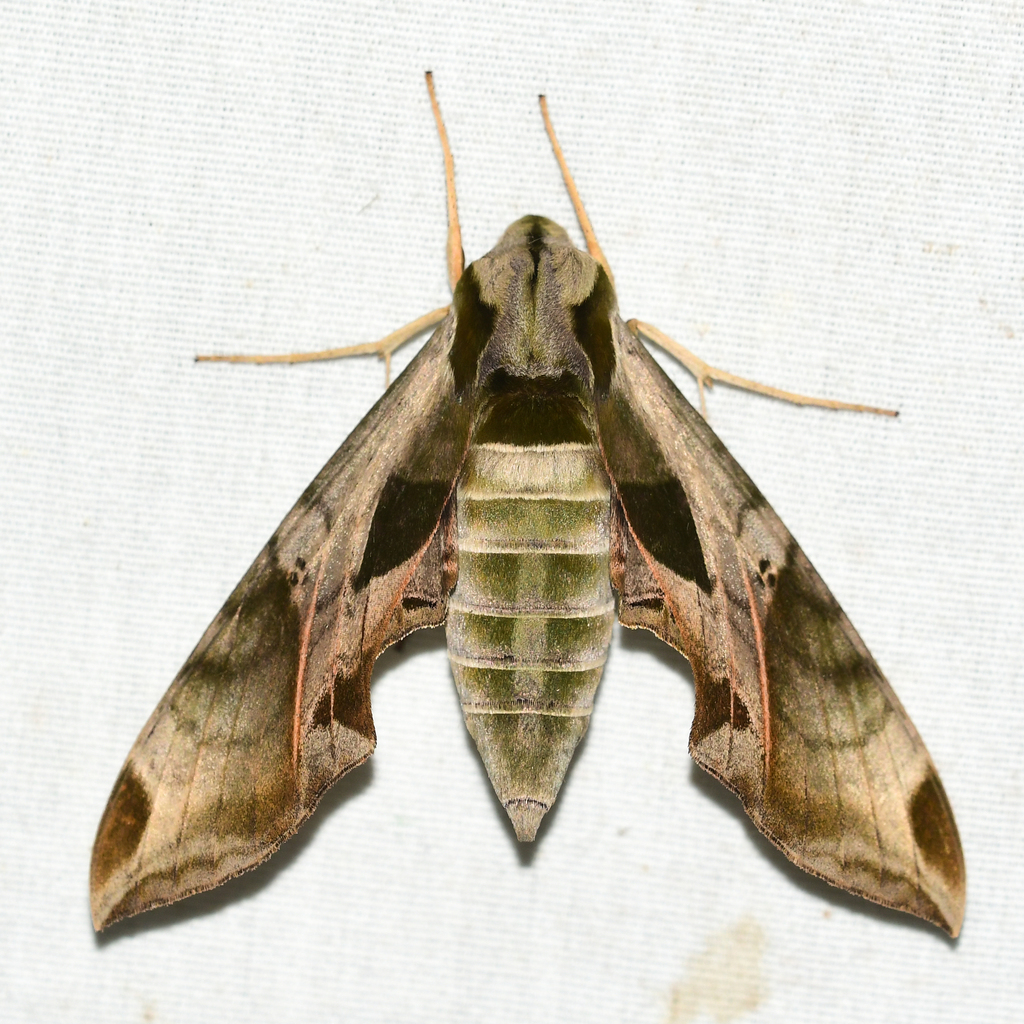
Pandorus Sphinx
Eumorpha pandorus
The Pandora sphinx moth (Eumorpha pandorus), also called the pandorus sphinx moth, is a North American moth in the family Sphingidae. It is a large, greenish gray moth with darker patches and pink edges and small pink eyespots. The underside is usually pale yellow-green or brown. It has a wingspan of 3¼–4½ inches (8.2–11.5 cm), females being slightly larger than males. Pandora sphinx moths fly during dusk. Some places see only one generation a year, while others...
From the article Eumorpha pandorus on Wikipedia (CC BY-SA), quoted section by section
Description
The pandora sphinx moth has a wingspan of 3.25–4.6 inches (8.3–11.7 cm). Its wings are opaque and have a greenish-olive background on the dorsal surfaces. The wings are narrow and are held deltaform at rest. Females generally have a larger abdomen than males. There are green markings on the dorsal forewing with a two-toned double spot extending from the base along the forewing's inner margin. When the wings are folded, the latter spot aligns with a dark mark on the moth's body that covers each tegula. A green marking with a pale outline is visible near the apex of the forewing. The dorsal surfaces of the hindwings, when extended, reveal black patches on a white background that becomes greenish-olive near the termens. Pink is present around the torni of the hindwings and in isolated areas on the dorsal forewings. Small dark eyespots on the hindwings and the forewings, there found in the discal position bearing two tiny "pupils," are visible even when the wings are folded. The ventral surfaces of the wings are a pale shade of yellow-green or brown. E. pandorus shares the southern part of its range with E. intermedia. It is distinguished from the latter species by the shape of the darker portion of its basal two-toned spot on the end that faces the forewing's outer margin: it is strongly wing-shaped in E. …
Range & habitat
The species is widespread in the east, the southeast and the center of North America, from Nova Scotia and Ontario to Florida and eastern Texas. American Southwest.
Wikipedia: “Distribution”
Listen
Looking for field recordings…
Where it lives
Recorded sightings
—
geo-referenced records in GBIF, from museums, herbaria and field observers.
Drag the globe to turn it. Dots are where records exist, not a range map; darker means more records.
In the stacks
Searching the stacks…
Every page naming Eumorpha pandorus in the Biodiversity Heritage Library →
This page is assembled live from iNaturalist, GBIF, Wikipedia, the Source Library and the Internet Archive. It is not yet part of the hand-edited codex. iNaturalist taxon 47914.