- Plants
- ›Vascular Plants
- ›flowering plants
- ›Dicots
- ›Soapberries, Cashews, Mahoganies, and Allies
- ›soapberry family
- ›Acer
- ›Negundo
box elder
Acer negundo
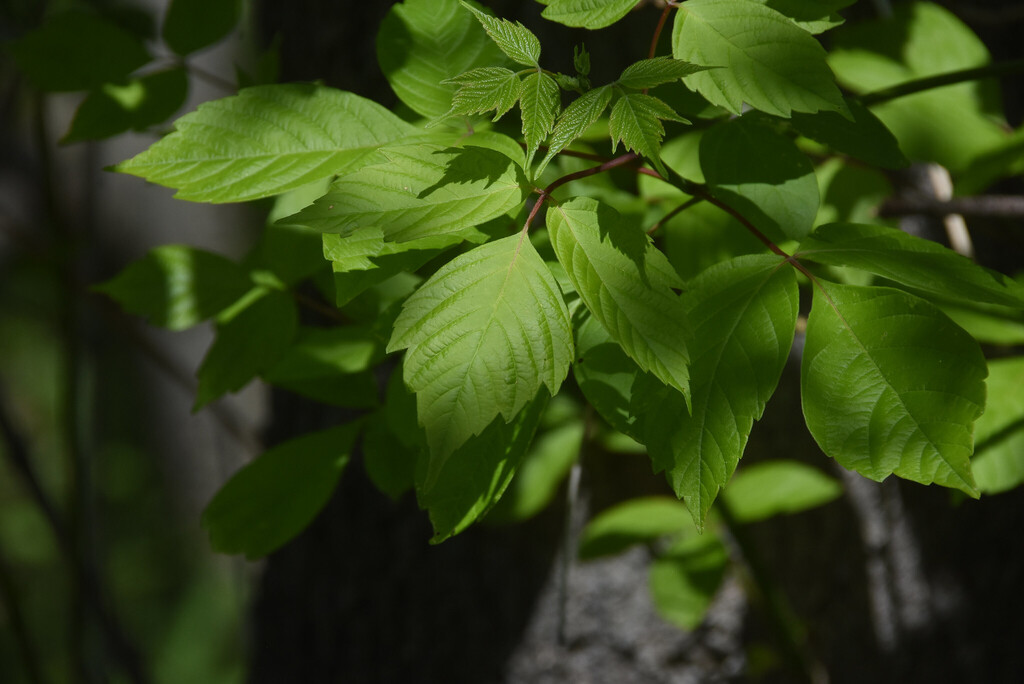
Acer negundo, also known as the box elder, boxelder maple, Manitoba maple or ash-leaved maple, is a species of maple native to North America from Canada to Honduras. It is a fast-growing, short-lived tree with opposite, ash-like compound leaves. It is sometimes considered a weedy or invasive species, and has been naturalized throughout much of the world, including South America, Australia, New Zealand, South Africa, and Eurasia.
From the article Acer negundo on Wikipedia (CC BY-SA), quoted section by section
Description
Acer negundo is a fast-growing and fairly short-lived tree that grows up to 10–25 m (35–80 ft) tall, with a trunk diameter of 30–50 cm (12–20 in), rarely up to 1 m (3 ft 3 in) diameter. It often has several trunks and can form impenetrable thickets. The typical lifespan of box elder is 60–75 years. Under exceptionally favorable conditions, it may live to 100 years. The shoots are green, often with a whitish to pink or violet waxy coating when young. Branches are smooth, somewhat brittle, and tend to retain a fresh green color rather than forming a bark of dead, protective tissue. The bark on its trunks is pale gray or light brown, deeply cleft into broad ridges, and scaly. Unlike most other maples (which usually have simple, palmately lobed leaves), Acer negundo has pinnately compound leaves that usually have three to seven leaflets. Simple leaves are also occasionally present; technically, these are single-leaflet compound leaves. Although some other maples (such as Acer griseum, Acer mandshuricum and the closely related A. cissifolium) have trifoliate leaves, only A. negundo regularly displays more than three leaflets. The leaflets are about 5–10 cm (2–4 in) long and 3–7 cm (1+1⁄4–2+3⁄4 in) wide with slightly serrate margins. …
Range & habitat
Acer negundo is native across much of the US (mostly in the east) and south-central Canada, and can be found as far south as Guatemala and Honduras. It has also been naturalized throughout much of the world, including South America, Australia, New Zealand, South Africa, much of Europe, and parts of Asia. Although native to North America, it is considered a weedy species in some areas, such as in parts of the Northeastern US, and has increased greatly in these areas. In 1928, Joseph Illick, chief forester for the state of Pennsylvania, wrote in Pennsylvania Trees that box elder was "rare and localized" in the state. After World War II, box elder's rapid growth made it a popular landscaping tree in suburban housing developments despite its poor form, vulnerability to storm damage, and tendency to attract large numbers of box elder bugs. Intentional cultivation has thus made the tree far more abundant than it once was. It can quickly colonize both cultivated and uncultivated areas and the range is therefore expanding both in North America and elsewhere. In Europe where it was introduced in 1688 as a park tree it is able to spread quickly and is considered an invasive species in parts of Central Europe, including Germany, the Czech Republic, Hungary, Slovenia, Poland and Russia where it can form mass growth in lowlands, disturbed areas, and riparian biomes on calcareous soils. …
Wikipedia: “Distribution and habitat”
What it does
Several birds and some squirrels feed on the seeds. The evening grosbeak uses them extensively. The boxelder bug (Boisea trivittata) lays its eggs on all maples, but prefers this species, clustering the eggs in bark crevices. The rosy maple moth (Dryocampa rubicunda) also lays its eggs on the leaves of maple trees, including Acer negundo. The larvae feed on the leaves, and in very dense populations can cause defoliation. Small galls are formed on the leaves by a bladder mite, Aceria negundi. A gall midge, Contarinia negundinis joins and enlarges the galls of Aceria negundi. The midge sometimes creates a separate, tubular gall on the midrib or veins of the undersides of the leaves. The cottony maple leaf scale, Pulvinaria acericola, occurs on the foliage of Acer negundo. A leaf spot fungus, Septoria negundinis creates black-ringed lesions on the leaves.
Wikipedia: “Ecology”
At the table
The sap has been used to make syrup by Native Americans, including the Dakota, Omaha, Pawnee, Ponca, Winnebago, Cree, Sioux, and the indigenous people of Montana. The Chiricahua and Mescalero Apache dry scrapings of the inner bark and keep it as winter food, and they also boil the inner bark until sugar crystallizes out of it. The Cheyenne mix the boiled sap with shavings from the inner sides of animal hides and eat them as candy. The Ojibwe mix the sap with that of the sugar maple and drink it as a beverage.
Wikipedia: “As food”
In medicine
Acer negundo has been used by Native Americans for several medicinal purposes. The Cheyenne burn the wood as incense for making spiritual medicines, and during Sun Dance ceremonies. The Meskwaki use a decoction of the inner bark as an emetic, and the Ojibwe use an infusion of the inner bark for the same purpose.
Wikipedia: “Medicinal use”
Toxicity
A protoxin present in the seeds of Acer negundo, hypoglycin A, has been identified as a major risk factor for, and possibly the cause of, a disease in horses, seasonal pasture myopathy (SPM). SPM is an equine neurological disease which occurs seasonally in certain areas of North America and Europe, with symptoms including stiffness, difficulty walking or standing, dark urine and eventually breathing rapidly and becoming recumbent. Ingestion of sufficient quantities of box elder seeds or other parts of the plant results in breakdown of respiratory, postural, and cardiac muscles. The cause of SPM was unknown for centuries despite the disease being well known among affected areas and was only positively determined in the 21st century. It is analogous to Jamaican vomiting sickness in humans, also caused by hypoglycin A. Acer negundo pollen, which is released in winter or spring (varying with latitude and elevation) is a severe allergen.
How it is grown
Although its weak wood, irregular form, and prolific seeding might make it seem like a poor choice for a landscape tree, A. negundo is one of the most common maples in cultivation. Long-term success has been noted as far north as Yellowknife. Many cultivars have been developed, such as:
Auratum: yellowish leaves with smooth undersides Aureomarginatum: creamy yellow leaf margins Baron: Hardier & seedless variety Elegans: distinctively convex leaves Flamingo: pink and white variegation (very popular) Pendulum: with weeping branches Variegatum: creamy white leaf margins Violaceum: younger shoots and branches have bluish color
Wikipedia: “Cultivation”
In human culture
Box Elder County, Utah is named for this tree, as is the town of Box Elder, South Dakota.
Wikipedia: “In culture”
Where it lives
Recorded sightings
—
geo-referenced records in GBIF, from museums, herbaria and field observers.
Drag the globe to turn it. Dots are where records exist, not a range map; darker means more records.
In the stacks
Searching the stacks…
Every page naming Acer negundo in the Biodiversity Heritage Library →
This page is assembled live from iNaturalist, GBIF, Wikipedia, the Source Library and the Internet Archive. It is not yet part of the hand-edited codex. iNaturalist taxon 47726.