- Plants
- ›Vascular Plants
- ›flowering plants
- ›Dicots
- ›geraniums, bridal wreaths, and allies
- ›Geranium family
- ›Erodium
- ›Cicutaria
- ›Erodium cicutarium
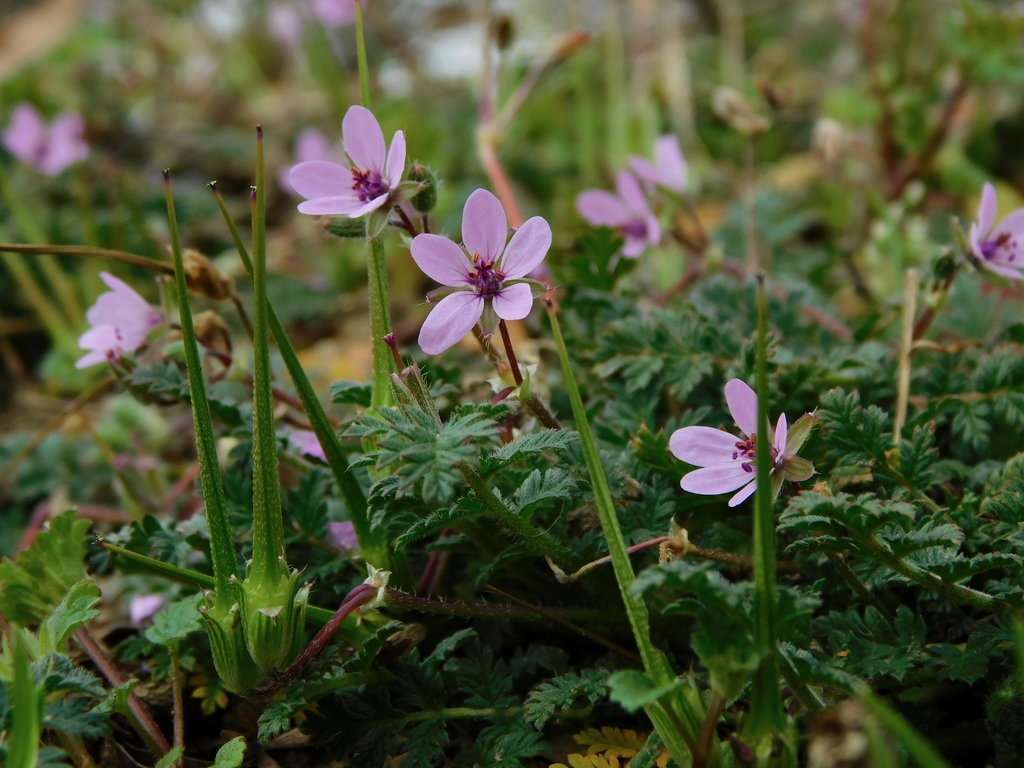
Redstem Stork's-bill
Erodium cicutarium
Erodium cicutarium, also known as common stork's-bill, redstem filaree, redstem stork's bill or pinweed, is a herbaceous annual – or in warm climates, biennial – member of the family Geraniaceae of flowering plants. It is native to Macaronesia, temperate Eurasia and north and northeast Africa, and was introduced to North America in the eighteenth century, where it has since become naturalized, particularly in the deserts and arid grasslands of the southwestern United States. It is also naturalized elsewhere, including South America and southern Africa.
From the article Erodium cicutarium on Wikipedia (CC BY-SA), quoted section by section
Description
Common stork's-bill is a herb that typically grows in rosettes pressed flat to the ground, with a deep tap root that allows it to survive through the summer on dry soils. It can develop stems up to 60 cm long that are sometimes red and sometimes green, and may be erect or prostrate, and have simple or glandular hairs which become more abundant towards the top. Plants with glandular hairs are sticky, but those with simple hairs are much less so. It has no scent. The leaves are arranged in a basal rosette at the beginning of the year, later occurring in opposite pairs along the stem. They are pinnate, almost twice-pinnate as each leaflet is deeply toothed or divided more than halfway to the midrib, and the whole leaf can vary in size from 2–20 cm long, either with a petiole or not. Like the stems, the leaves can be covered with glandular or simple hairs. The stems bear bright pink flowers which often have dark spots on the bases. The flowers are arranged in a loose cluster and have ten filaments – five of which are fertile – and five styles. The leaves are pinnate to pinnate-pinnatifid, with hairy stems. The long seed-pod, shaped like the bill of a stork, bursts open in a spiral when ripe, sending the seeds (which have long tails called awns) into the air.
Seed dispersal behavior. …
Range & habitat
Erodium cicutarium has a very extensive native range. It includes all of Europe with the exception of Iceland. In Africa its native range extends across the north from Morocco to Egypt and also in Chad and Eritrea, but not in Sudan. It is also native in most of Asia according to Plants of the World Online with the exceptions of Southeast Asia, central China, and Mongolia. It now grows as an introduced plant in Taiwan, Korea, Japan, and the eastern half of the Russian Far East. Elsewhere it has been introduced to North and South America, southern Africa and Tasmania. The plant is widespread across North America after being introduced by European colonists. It grows as an annual in the continent's northern half. In the southern areas of North America, the plant tends to grow as a biennial with a more erect habit and with much larger leaves, flowers, and fruits. It flowers from May until August. Common stork's-bill can be found in bare, sandy, grassy places both inland and around the coasts. It is a food plant for the larvae of the brown argus butterfly. The seeds of this plant are collected by various species of harvester ants.
Wikipedia: “Distribution and ecology”
At the table
The young leaves are edible raw or cooked. The whole plant is reportedly edible with a flavor similar to sharp parsley if picked young. According to John Lovell's Honey Plants of North America (1926), "the pink flowers are a valuable source of honey (nectar), and also furnish much pollen". Among the Zuni people, a poultice of chewed root is applied to sores and rashes and an infusion of the root is taken for stomachache.
Nutrition. Raw Hairy stork's bill are 90.6% water, 7.9% carbohydrates, 0.6% protein, 3% dietary fiber, 0.8% ash and 0.1% fat.
Wikipedia: “Uses”
Where it lives
Recorded sightings
—
geo-referenced records in GBIF, from museums, herbaria and field observers.
Drag the globe to turn it. Dots are where records exist, not a range map; darker means more records.
In the stacks
Searching the stacks…
Every page naming Erodium cicutarium in the Biodiversity Heritage Library →
This page is assembled live from iNaturalist, GBIF, Wikipedia, the Source Library and the Internet Archive. It is not yet part of the hand-edited codex. iNaturalist taxon 47687.