On eBird ↗
Perija Tapaculo
Live sightings near you, the range map, bar charts of when it is seen, and Macaulay Library photos and recordings.
Perijá Tapaculo
Scytalopus perijanus
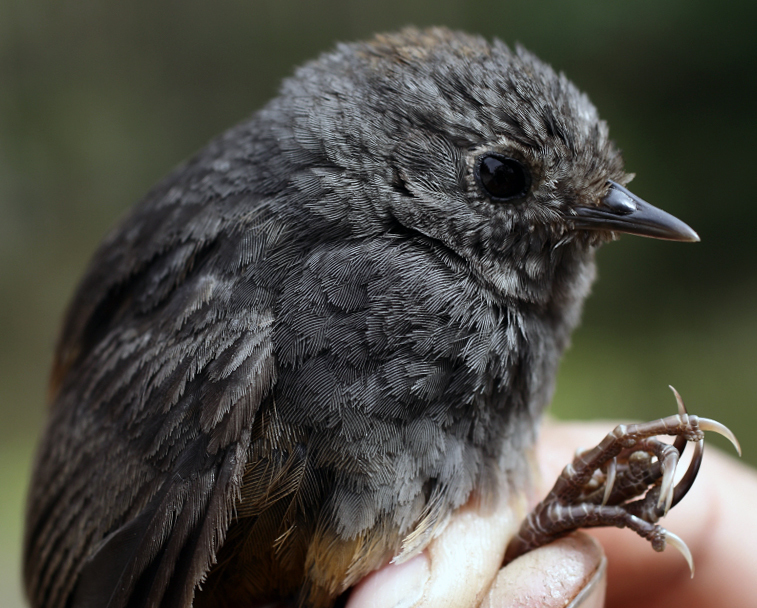
The Perijá tapaculo (Scytalopus perijanus) is a species of passerine bird in the family Rhinocryptidae (tapaculos). Endemic to the Serranía del Perijá mountain range on the Colombia–Venezuela border, the Perijá tapaculo is found at altitudes of 1,600–3,225 metres (5,200–10,600 feet). Its body is 10 to 12 centimetres (3.9 to 4.7 inches) long and its tail is about 4 cm (1.6 in) long. Specimens have long been stored in museums, but the species was described only in 2015 based on sixteen specimens found between July 2008 and February 2009. It is considered vulnerable to extinction.
Adults have neutral grey heads, brown necks, brown-sepia striped backs, and grey-white bellies, breasts, and throats. Males have some buff markings on their breasts, and less sharp brown spots on their napes than females. The Perijá tapaculo is a secretive bird and therefore difficult to observe; as a result its ecology is poorly known. It feeds on insects and reproduces between April and July. Its range is partially within Chamicero de Perijá Bird Reserve in Colombia and the Sierra de Perijá National Park in Venezuela.
From the article Perijá tapaculo on Wikipedia (CC BY-SA), quoted section by section
Description
The Perijá tapaculo is a small bird, 10 to 12 cm (3.9 to 4.7 in) in length with an average mass of 17 to 18 grams (about 0.6 oz). The bill averages 6.8 millimetres (0.27 inches) long, 2.9 mm (0.11 in) wide, and 3.5 mm (0.14 in) high. The legs are about 21 mm (0.83 in) long. The Perijá tapaculo's tarsus averages 21.1 millimetres (0.83 in) long. The wings measure 57.4 mm (2.26 in) on average and the tail is about 40 mm (1.6 in) long with between 8 and 12 rectrices. The forehead, lores, crown, mantle, and scapular area are a neutral grey colour. There is a brown spot on the nape. The top of the tail is brown, and the bottom is faintly striped brown. The bird's back and rump are striped brown-sepia, and the throat, breast, and belly are grey-white. Its lower belly and flanks are tawny. The iris is dark brown. Male specimens are distinguished by having less sharp brown spots on their napes, and the bottom of their breasts are mixed with a pale buff colour. The legs are brown on the back and whitish on the front. Young birds have a yellowish appearance with striped brown flanks. The bird's plumage colouration is most similar to the pale-bellied tapaculo. The S. g. morenoi subspecies of the pale-bellied tapaculo can be differentiated from the Perijá tapaculo by its entirely brown back and nape, and its different calls. …
Range & habitat
The Perijá tapaculo is endemic to the Serranía del Perijá, a mountain range on the Colombia–Venezuela border known for its high rates of endemism. It has been observed in nineteen localities on both sides of the border between altitudes of 1,600 and 3,225 m (5,200 and 10,600 ft) above sea level; in its northern range, there are no suitable forests below 1,600 m (5,200 ft). The bird has been observed at 1,800–3,120 m (5,900–10,200 ft) on the Venezuelan side, and at 1,600–3,225 m on the Colombian side. The Perijá tapaculo lives in and on the edges of humid rainforests, as well as in elfin forests and amongst woody páramo shrubs in high-mountain grassland areas, especially at altitudes of 2,500–3,000 m (8,200–9,800 ft). Some specimens have been observed feeding in dense thickets within 1 m (3 ft) of the ground, often near the forest. Others have been observed running among bushes through open grassy areas. The species has not been identified as being sympatric with any other species of the genus Scytalopus. However, there is a possibility that its range overlaps with that of the S. …
Wikipedia: “Distribution and habitat”
What it does
Like other species in genus Scytalopus, the Perijá tapaculo is secretive and therefore difficult to observe. The call and song differ from those of most other species in the genus, and the latter is composed of two short churrs repeating up to 65 times at 0.5 to 3 second intervals. The diet of the species is little known, but studies of the stomach contents of seven specimens suggested that they fed exclusively on insects. Little is known about the reproduction of the species, but it is believed to nest between April and July. The species builds its globular nests in underground cavities about 12 cm (4.7 in) in diameter and about 14.5 cm (5.7 in) in height, lined with mosses, grasses, and plant roots around a central space about 9 cm (3.5 in) wide. The nests are accessed by a short tunnel with a depth of 10 cm (3.9 in) and a diameter of 4.2 cm (1.7 in). Young birds may leave the nest at the end of June. Like those of other Scytalopus species, male specimens have demonstrated involvement in parenting.
Wikipedia: “Ecology and behaviour”
Listen
Looking for field recordings…
Where it lives
Recorded sightings
—
geo-referenced records in GBIF, from museums, herbaria and field observers.
Drag the globe to turn it. Dots are where records exist, not a range map; darker means more records.
In the stacks
Searching the stacks…
Every page naming Scytalopus perijanus in the Biodiversity Heritage Library →
This page is assembled live from iNaturalist, GBIF, Wikipedia, the Source Library and the Internet Archive. It is not yet part of the hand-edited codex. iNaturalist taxon 475001.