- Plants
- ›Vascular Plants
- ›flowering plants
- ›Dicots
- ›Legumes, Milkworts, and Allies
- ›Legumes
- ›Acacias, Mimosas, Mesquites, and Allies
- ›Ingeae
- ›Albizia
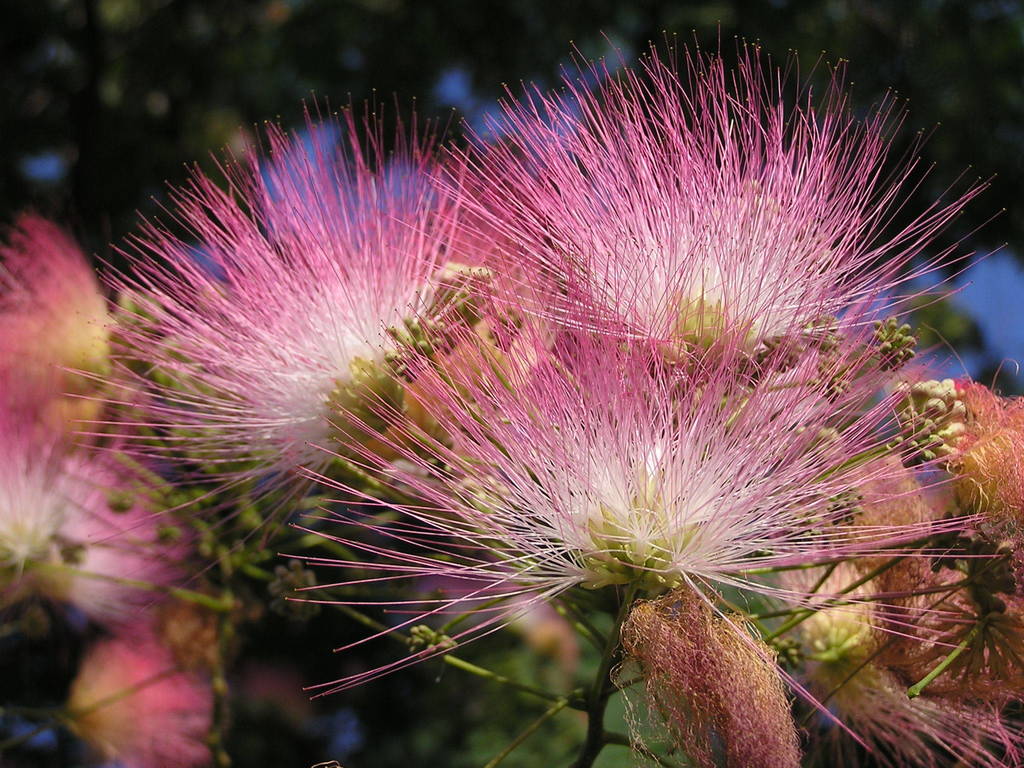
Persian silk tree
Albizia julibrissin
Albizia julibrissin, the Persian silk tree, pink silk tree, or mimosa tree, is a species of tree in the Fabaceae family, native to southwestern and eastern Asia.
From the article Albizia julibrissin on Wikipedia (CC BY-SA), quoted section by section
Description
Albizia julibrissin is a small deciduous tree with a broad crown of level or arching branches, growing to 5–16 m (16–52 ft) tall. Its bark is dark greenish grey, becoming vertically striped with age. Its leaves are large and frond-like: They are bipinnate, divided into 6–12 pairs of pinnae, each with 20–30 pairs of leaflets. Individual leaflets are oblong, 1–1.5 cm (0.4–0.6 in) long and 2–4 cm (0.8–1.6 in) broad. The true leaves are 20–45 cm (8–18 in) long and 12–25 cm (5–10 in) broad.
The flowers bloom throughout the summer in dense inflorescences, which resemble starbursts of pink silky threads. The true flowers have small calyx and corolla (except the central ones), with a tight cluster of prominent stamens, 2–3 cm long and white or pink with a white base. They have been observed to attract bees, butterflies and hummingbirds. Its fruit is a flat brown pod 10–20 cm (4–8 in) long and 2–2.5 cm (0.8–1.0 in) broad, containing several seeds inside. There are two varieties:
Albizia julibrissin var. julibrissin – the typical variety, described above Albizia julibrissin var. mollis – differs in the shoots being densely hairy
Range & habitat
Original habitats of the tree include regions from Iran (Persia) and the Republic of Azerbaijan to China and Korea. A. julibrissin is widely planted as an ornamental plant in parks and gardens, grown for its fine leaf texture, flowers and attractive horizontal canopy. Other positive attributes are a fast growth rate, low water requirements and the ability to thrive planted in full sun in hot summer climates. It is frequently planted in semi-arid areas like California's Central Valley, central Texas and Oklahoma. Although capable of surviving drought, growth will be stunted and the tree tends to look sickly. As such it should be given infrequent, deep waterings during the summer, which will benefit growth and flowering. The broad crown of a mature tree makes it useful for providing dappled shade. The flower colour varies from white in A. julibrissin f. alba, to rich red-tipped flowers. Variants with cream or pale yellow flowers are also reported. Other cultivars are becoming available: 'Summer Chocolate' has red foliage ageing to dark bronze, with pale pink flowers; 'Ishii Weeping' (or 'Pendula') has a drooping growth habit.
A. julibrissin f. rosea. There is also a form, A. julibrissin f. rosea (pink silk tree) which has, in the past, been classed either as a variety or as a cultivar. …
Wikipedia: “Habitat, cultivation and uses”
Where it lives
Recorded sightings
—
geo-referenced records in GBIF, from museums, herbaria and field observers.
Drag the globe to turn it. Dots are where records exist, not a range map; darker means more records.
In the old herbals & bestiaries

In the stacks
Searching the stacks…
Every page naming Albizia julibrissin in the Biodiversity Heritage Library →
This page is assembled live from iNaturalist, GBIF, Wikipedia, the Source Library and the Internet Archive. It is not yet part of the hand-edited codex. iNaturalist taxon 47443.