- Animals
- ›Arthropods
- ›Hexapods
- ›Insects
- ›Winged and Once-winged Insects
- ›Beetles
- ›Water, Rove, Scarab, Long-horned, Leaf, and Snout Beetles
- ›Cucujiform Beetles
- ›Longhorn Beetles and Allies
- ›Vesperid Beetles
- ›Vesperinae
- ›Vesperini
- ›Vesperus
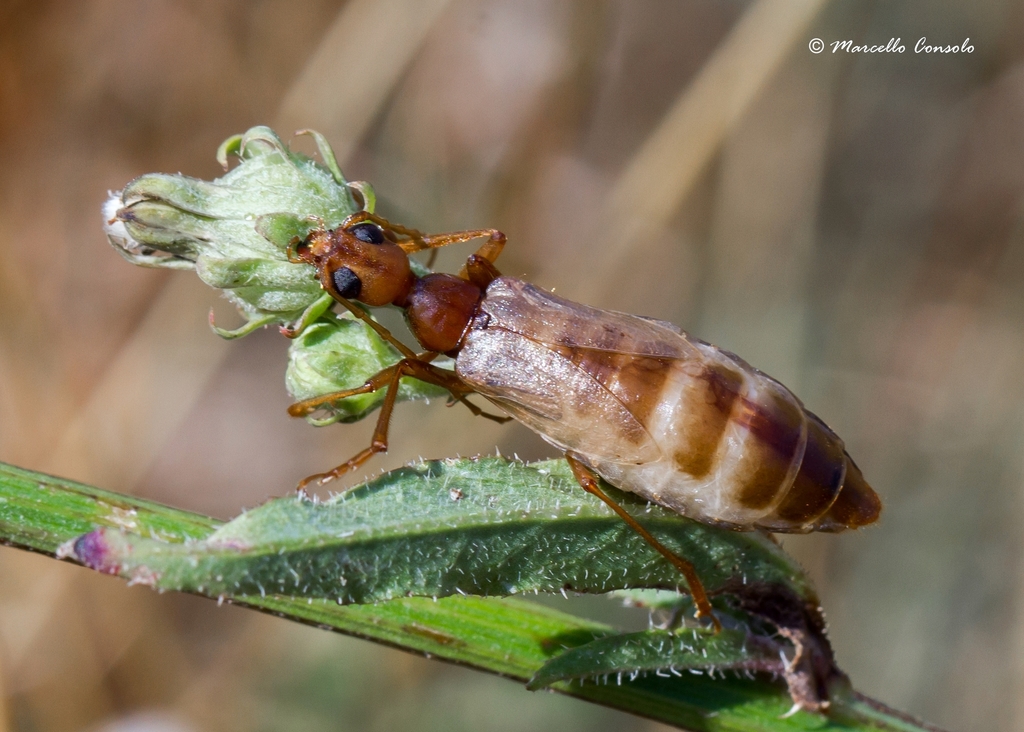
Vesperus luridus
Vesperus luridus is a species of beetle in the Vesperidae family
From the article Vesperus luridus on Wikipedia (CC BY-SA), quoted section by section
Description
Vesperus luridus can reach a body length (from front to elytral apex) of about 12–18 millimetres (0.47–0.71 in) in males, while females reach a size of about 16–22 millimetres (0.63–0.87 in). Elytra are elongate and body is slender. Basic coloration is brownish or yellowish diaphanous. Both males and females are of the same colour, This species shows an evident sexual dimorphism. The males are small, have wings and the elytra completely cover the abdomen. The antennas are much longer than in females. On the contrary the females are bigger, have very reduced wings (brachyptery) and are characterised by a swollen abdomen (physogastrism) holding enlarged ovaries. Elytra cover only partially the voluminous abdomen, letting visible the abdominal tergites. Adults of this species are nocturnals and can be encountered from late summer to autumn. The flying males become active at dusk and are attracted by artificial light. Larvae of these beetles have evolved some adaptations to subterranean life. In particular, they are characterised by a peculiar larval hypermetamorphosis, with some polymorphic larval instars. Larvae are polyphagous, but mainly feed on Grape-vine (Vitis vinifera) and Common Olive (Olea europaea). They are considered harmful to the cultivation of the grapevines, as the larvae dig tunnels in the roots.
Range & habitat
This species can be found in Croatia, France, Italy (including islands Sardinia and Sicily), Kosovo, Montenegro, Serbia, and Voivodina.
Wikipedia: “Distribution”
Listen
Looking for field recordings…
Where it lives
Recorded sightings
—
geo-referenced records in GBIF, from museums, herbaria and field observers.
Drag the globe to turn it. Dots are where records exist, not a range map; darker means more records.
In the stacks
Searching the stacks…
Every page naming Vesperus luridus in the Biodiversity Heritage Library →
This page is assembled live from iNaturalist, GBIF, Wikipedia, the Source Library and the Internet Archive. It is not yet part of the hand-edited codex. iNaturalist taxon 472867.