- Animals
- ›Chordates
- ›Vertebrates
- ›Mammals
- ›Therians
- ›Placental Mammals
- ›Armadillos, Sloths, and Anteaters
- ›Armadillos
- ›Short-nosed Armadillos
- ›Tolypeutidae
- ›Three-banded, Giant, and Naked-tailed Armadillos
- ›Priodontes
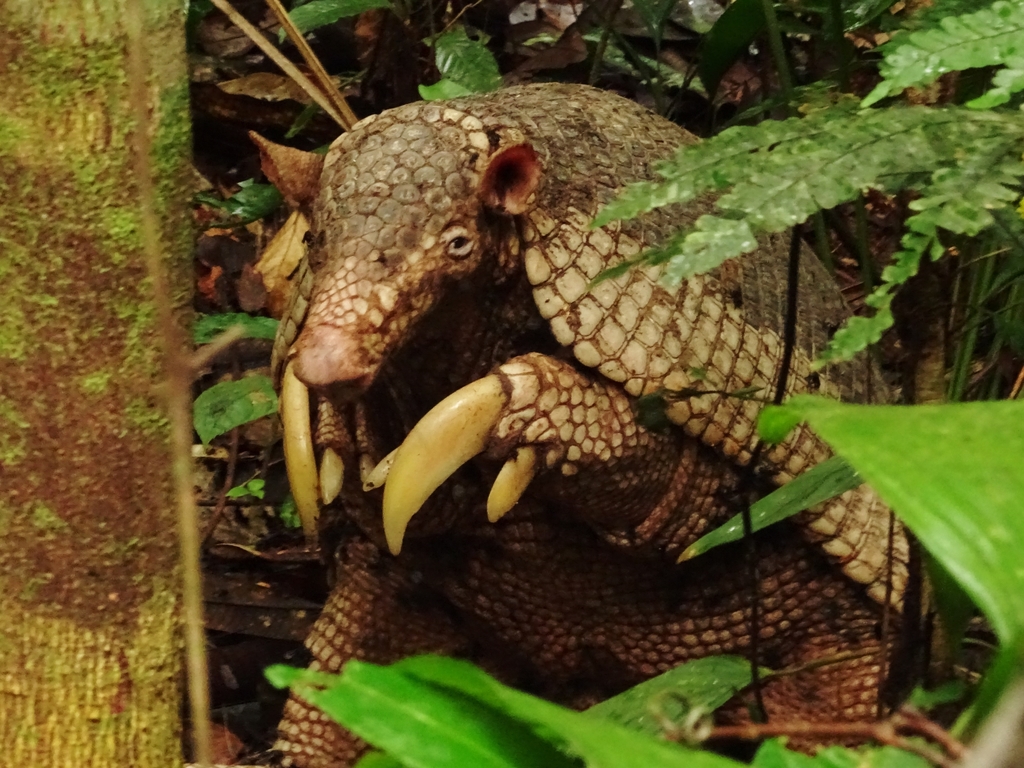
Giant Armadillo
Priodontes maximus
The giant armadillo (Priodontes maximus), colloquially tatu-canastra, tatou, ocarro or tatú carreta, is the largest living species of armadillo (although their extinct relatives the glyptodonts were much larger). It lives in South America, ranging throughout as far south as northern Argentina. It is considered to be a vulnerable species.
The giant armadillo prefers termites and some ants as prey, and often consumes the entire population of a termite mound. It also has been known to prey upon worms, larvae and larger creatures, such as spiders and snakes, and plants. Some giant armadillos have been reported to have eaten bees by digging into beehives.
From the article Giant armadillo on Wikipedia (CC BY-SA), quoted section by section
Description
The giant armadillo is the largest living species of armadillo, with 11 to 13 hinged bands protecting the body and a further three or four on the neck. Its body is dark brown in color, with a lighter, yellowish band running along the sides, and a pale, yellow-white head. This armadillo has around 80 to 100 teeth, which is more than any other terrestrial mammal. The teeth are all similar in appearance, being reduced premolars and molars; they grow constantly throughout life and lack enamel. These armadillos also possess extremely long front claws, including a sickle-shaped third claw up to 22 cm (8.7 in) in length, which are proportionately the largest of any living mammal. The tail is covered in small, rounded scales and does not have the heavy, bony scutes that cover the upper body and top of the head. The animal is almost entirely hairless, with just a few beige-colored hairs protruding between the scutes. The giant armadillo typically weighs around 18.7–32.5 kg (41–72 lb) when fully grown; however, a 54 kg (119 lb) specimen has been weighed in the wild and captive specimens have been weighed up to 80 kg (180 lb). The typical length of the species is 75–100 cm (30–39 in), with the tail adding another 50 cm (20 in).
Range & habitat
Giant armadillos are found throughout much of northern South America east of the Andes, except for eastern Brazil and Paraguay. In the south, they reach the northernmost provinces of Argentina, including Salta, Formosa, Chaco, and Santiago del Estero. There are no recognised geographic subspecies. They primarily inhabit open habitats, with cerrado grasslands covering about 25% of their range, but they can also be found in lowland forests.
Wikipedia: “Distribution and habitat”
What it does
Giant armadillos are solitary and nocturnal, spending the day in burrows. They also burrow to escape predators, being unable to completely roll into a protective ball. Compared with those of other armadillos, their burrows are unusually large, with entrances averaging 43 cm (17 in) wide, and typically opening to the west. Giant armadillos use their large front claws to dig for prey and rip open termite mounds. The diet is mainly composed of termites, although ants, worms, spiders, other invertebrates, small vertebrates and carrion are also eaten. Little is currently known about this species' reproductive biology, and no juveniles have ever been discovered in the field. The average sleep time of a captive giant armadillo is said to be 18.1 hours.
Some giant armadillos have been reported to have eaten bees by digging into beehives. In a long-term study on the species, that started in 2003 in the Peruvian Amazon, dozens of other species of mammals, reptiles and birds were found using the giant armadillos' burrows on the same day, including the rare short-eared dog (Atelocynus microtis). Because of this, the species is considered a habitat engineer, and the local extinction of Priodontes may have cascading effects in the mammalian community by impoverishing fossorial habitat. …
Wikipedia: “Biology and behavior”
Listen
Looking for field recordings…
Where it lives
Recorded sightings
—
geo-referenced records in GBIF, from museums, herbaria and field observers.
Drag the globe to turn it. Dots are where records exist, not a range map; darker means more records.
In the stacks
Searching the stacks…
Every page naming Priodontes maximus in the Biodiversity Heritage Library →
This page is assembled live from iNaturalist, GBIF, Wikipedia, the Source Library and the Internet Archive. It is not yet part of the hand-edited codex. iNaturalist taxon 47085.