- Plants
- ›Vascular Plants
- ›flowering plants
- ›Dicots
- ›Heathers, Balsams, Primroses, and Allies
- ›mitrastemon family
- ›Mitrastemon
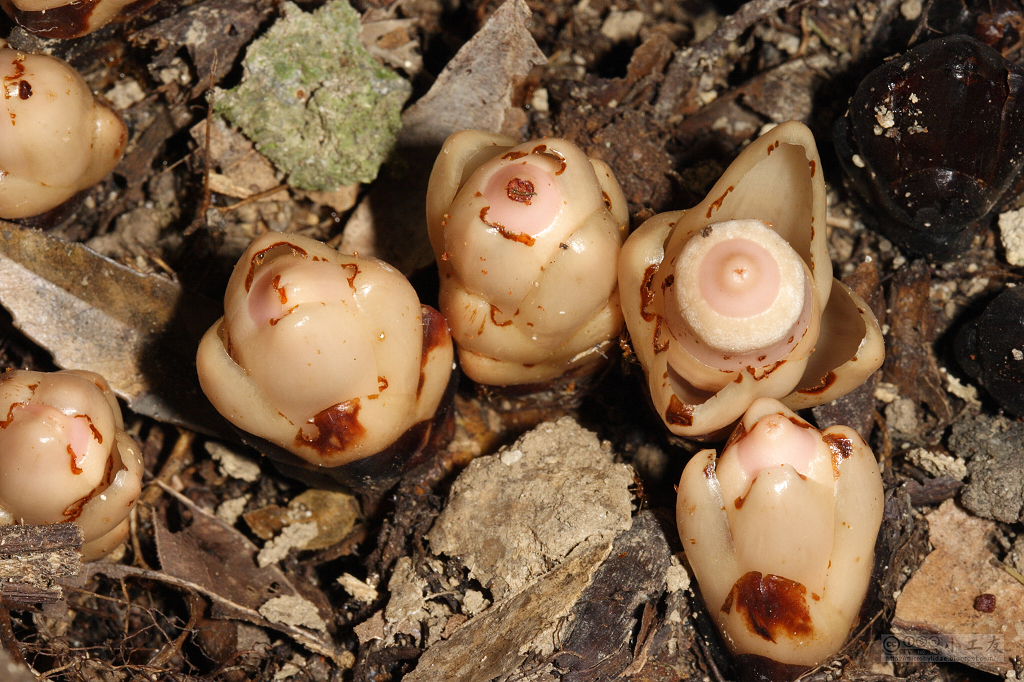
Mitrastemon yamamotoi
Mitrastemon is a genus of two widely disjunct species of parasitic plants. It is the only genus within the family Mitrastemonaceae. Mitrastemon species are root endoparasites, which grow on Fagaceae. It is also a non-photosynthetic plant that parasitizes other plants such as Castanopsis sieboldii.
From the article Mitrastemon on Wikipedia (CC BY-SA), quoted section by section
Range & habitat
Mitrastemon yamamotoi is distributed in tropical and subtropical forests of Southeast Asia and Japan. Mitrastemon matudae is distributed from southern Mexico to Colombia.
Wikipedia: “Distribution”
What it does
The plant is observed only during the winter season and it completes its visible life cycle from November to April (Mir et al., 2016). Mitrastemon is completely embedded within the tissues of its host, except during the reproduction stage when above-ground parts emerge from host tissues.
Wikipedia: “Life cycle”
In human culture
The parasitic species, Mitrastemon yamamotoi (Makino) Makino was found in Japan in 1909. It was originally named Mitrastemma yamamotoi Makino by botanist Tomitaro Makino (1862 – 1957), but was later renamed as Mitrastemon yamamotoi in 1911. Then species Mitrastemon matudae was discovered by botanist Eizi Matuda during an expedition to Mt. Ovando (near the town of Escuintla, Chiapas) in the state of Chiapas, Mexico (Matuda, 1947). The species was originally named by a botanist friend of Matuda, Yoshimatsu Yamamoto (1893-1947), in 1925–1926, but then published in 1936. Mitrastemon yamamotoi is a protandrous plant. Its flowers go through a male phase before transforming into their final female form. The flowers of M. yamamotoi attract a variety of insects ranging from wasps to flies and beetles. Among these, beetles are the best pollinators for this plant since their visit to the flower would pick up a large amount of pollen and they would pollinate from each of the flowers that they had already visited. The plant is endemic to tropical and subtropical forest regions such as southeast Asia and Japan.
Wikipedia: “History”
Where it lives
Recorded sightings
—
geo-referenced records in GBIF, from museums, herbaria and field observers.
Drag the globe to turn it. Dots are where records exist, not a range map; darker means more records.
In the stacks
Searching the stacks…
Every page naming Mitrastemon yamamotoi in the Biodiversity Heritage Library →
This page is assembled live from iNaturalist, GBIF, Wikipedia, the Source Library and the Internet Archive. It is not yet part of the hand-edited codex. iNaturalist taxon 469684.