- Animals
- ›Arthropods
- ›Hexapods
- ›Insects
- ›Winged and Once-winged Insects
- ›Beetles
- ›Water, Rove, Scarab, Long-horned, Leaf, and Snout Beetles
- ›Elateriform Beetles
- ›Buprestoidea
- ›Jewel Beetles
- ›Agrilinae
- ›Agrilini
- ›Agrilus
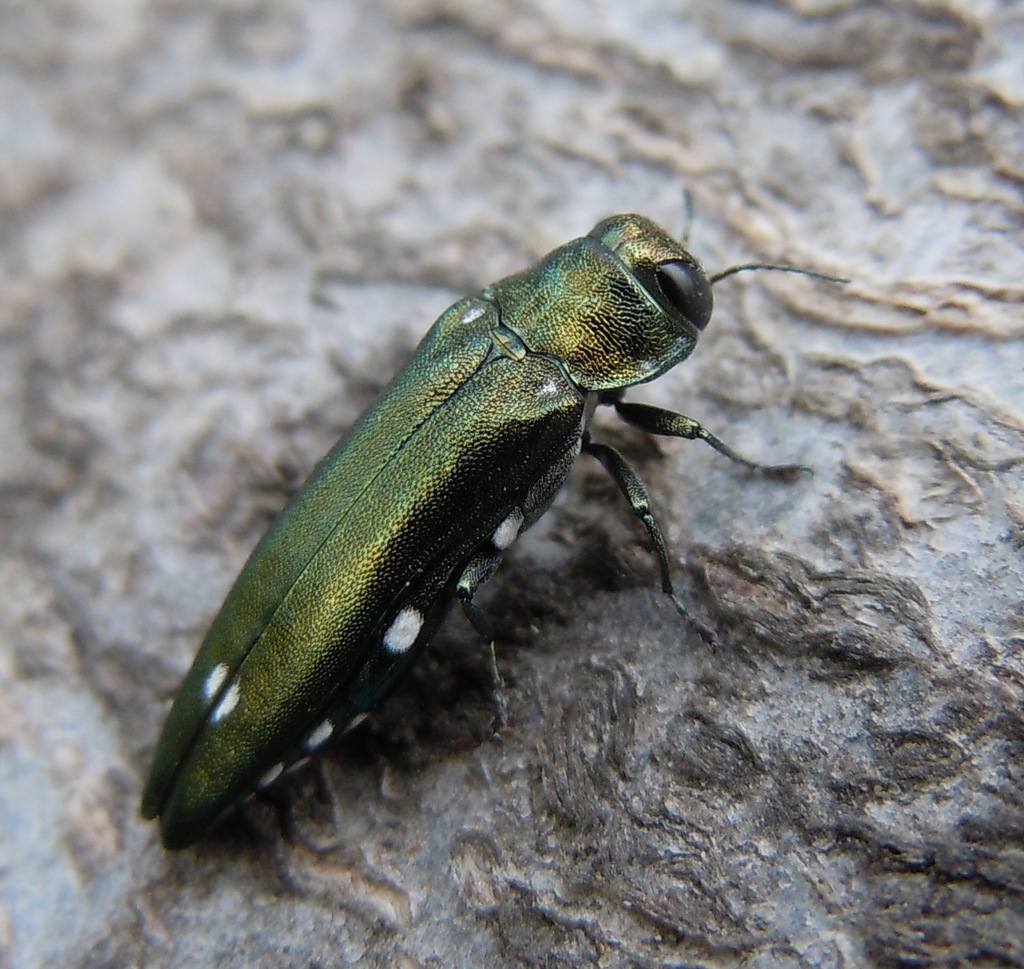
Oak Jewel-beetle
Agrilus biguttatus
Agrilus biguttatus is a species of beetle in the family Buprestidae, the jewel beetles. Common names include oak splendour beetle, oak buprestid beetle, and two-spotted oak borer. This beetle is known as a pest that causes damage to oak trees and is a major factor in oak decline.
The adult beetle is 8 to 13 millimeters long. It is metallic green in color with a black or yellow cast. There is a pair of white spots on the inner edges of the elytra. The larva is a creamy white color and measures up to 43 millimeters in length. The first thoracic segment is enlarged. The grub is legless and has a pair of horns on its last abdominal segment. The beetles have an average lifespan of 2 months, but some may live upwards of 5 months.
From the article Agrilus biguttatus on Wikipedia (CC BY-SA), quoted section by section
Range & habitat
Agrilus biguttatus is widespread throughout Europe, reaching the northern borders of southern Sweden and the UK. North Africa, and Northern Asia. Adults can fly several kilometres but the species distribution is restricted by cool temperatures. Until the 1970s, these beetles were considered rare in the UK. In the mid 1990s, A. biguttatus had begun expanding from its native range in Denmark and the Netherlands. Researchers had proposed that the expansion is largely due to global warming because it tends to live in more temperate areas. The beetle inhabits many environments, including deserts, xeric shrublands, Mediterranean scrub, mixed forests, and temperate coniferous forests. It can also be transported to new areas with shipments of wood. While Agrilus biguttatus is not currently found in the United States, its introduction could pose a significant risk to US natural environments. The main hosts of this insect are oak species, including English oak (Quercus robur), sessile oak (Q. petraea), downy oak (Q. pubescens), evergreen oak (Q. ilex), cork oak (Q. suber) and turkey oak (Q. cerris). The beetle can also be found on European beech (Fagus sylvatica) and chestnut (Castanea sativa). In Europe, species such as A. sulcicollis, A. angustulus, and A. biguttatus have been identified as significant contributors to oak decline due to their development pattern. …
Wikipedia: “Distribution and habitat”
What it does
Beetles have a considerable impact on the decline of oak trees across Europe, a phenomenon known as acute oak decline (AOD). One of the major symptoms of AOD is the presence of black fluid seeping from cracks in the bark, which often leads to the tree's death within a few years. If given enough time without further infestation, they are likely to recover. However, A. biguttatus, considered a secondary pest to oak, poses a serious threat by invading weakened trees before they can undergo the process of recovery. Symptomatic oak trees often exhibit distinctive D-shaped exit holes from emerging A. biguttatus adults. The decline of oak trees in Europe is believed to have been exacerbated by warmer climates and drought, as those conditions are optimal for A. biguttatus growth and host invasion. Documented evidence shows Agrilus pest incidence in Germany, France, Hungary, Poland, and England, contributing significantly to the increase in tree mortalities.
Wikipedia: “Interactions with humans and oak trees”
Listen
Looking for field recordings…
Where it lives
Recorded sightings
—
geo-referenced records in GBIF, from museums, herbaria and field observers.
Drag the globe to turn it. Dots are where records exist, not a range map; darker means more records.
In the stacks
Searching the stacks…
Every page naming Agrilus biguttatus in the Biodiversity Heritage Library →
This page is assembled live from iNaturalist, GBIF, Wikipedia, the Source Library and the Internet Archive. It is not yet part of the hand-edited codex. iNaturalist taxon 468237.