- Animals
- ›Arthropods
- ›Hexapods
- ›Insects
- ›Winged and Once-winged Insects
- ›True Bugs, Hoppers, Aphids, and allies
- ›Plant-parasitic Hemipterans
- ›Aphids and Allies
- ›Aphidoidea
- ›Aphids
- ›Aphidinae
- ›Macrosiphini
- ›Megoura
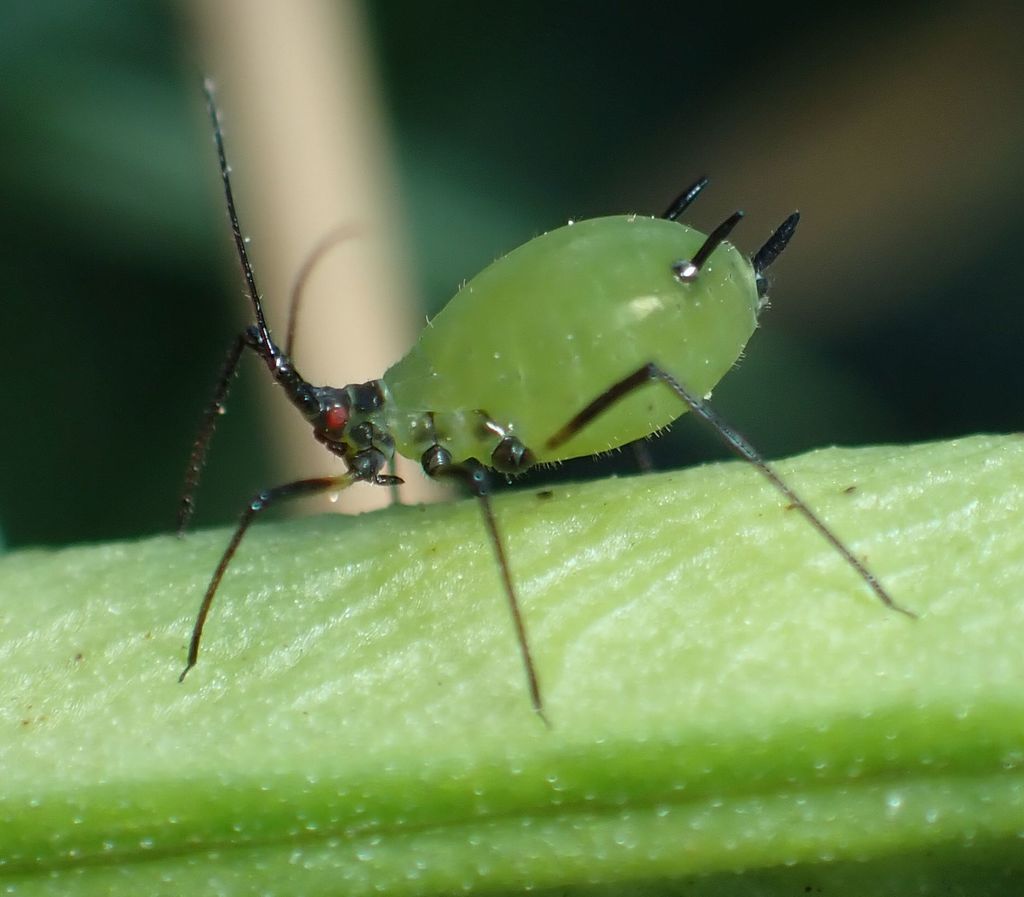
Vetch Aphid
Megoura viciae
Megoura viciae is a large, green aphid in the family Aphididae native to Europe that feeds on plants in the genus Vicia. They are commonly known as vetch aphids for this reason.
From the article Megoura viciae on Wikipedia (CC BY-SA), quoted section by section
Description
Megoura viciae has a large globular green abdomen with a smaller black prothorax, black cauda, black legs, black antennae and a black head. Towards the rear of the body are large crescent-shaped black sclerites which are in front of the siphunculi. The eyes are red in colour. Dependent on the stage in their lifecycle M. viciae may be winged or wingless.
Wikipedia: “Morphology”
Range & habitat
Megoura viciae is widely present in Europe, from latitudes 64–65° N across Scandinavia, into Denmark and the rest of Europe (including England) and south to the Mediterranean. It also occurs in Ethiopia and has been recorded from North America.
Wikipedia: “Distribution and habitat”
What it does
Megoura viciae does not move between primary and secondary plants, spending its life cycle on a leguminous host plant. Eggs are laid at the base of the host plant and these hatch in the spring. Winged forms are produced after three generations and these winged aphids then move on to other plants. In the autumn the aphids move on to the seed pods of the host plant. Like most aphids, M. viciae is viviparous.
Wikipedia: “Life cycle”
Listen
Looking for field recordings…
Where it lives
Recorded sightings
—
geo-referenced records in GBIF, from museums, herbaria and field observers.
Drag the globe to turn it. Dots are where records exist, not a range map; darker means more records.
In the stacks
Searching the stacks…
Every page naming Megoura viciae in the Biodiversity Heritage Library →
This page is assembled live from iNaturalist, GBIF, Wikipedia, the Source Library and the Internet Archive. It is not yet part of the hand-edited codex. iNaturalist taxon 467403.