- Animals
- ›Arthropods
- ›Hexapods
- ›Insects
- ›Winged and Once-winged Insects
- ›Butterflies and Moths
- ›Geometrid and Swallowtail Moths
- ›Geometer Moths
- ›Carpet Moths
- ›Perizomini
- ›Mesotype
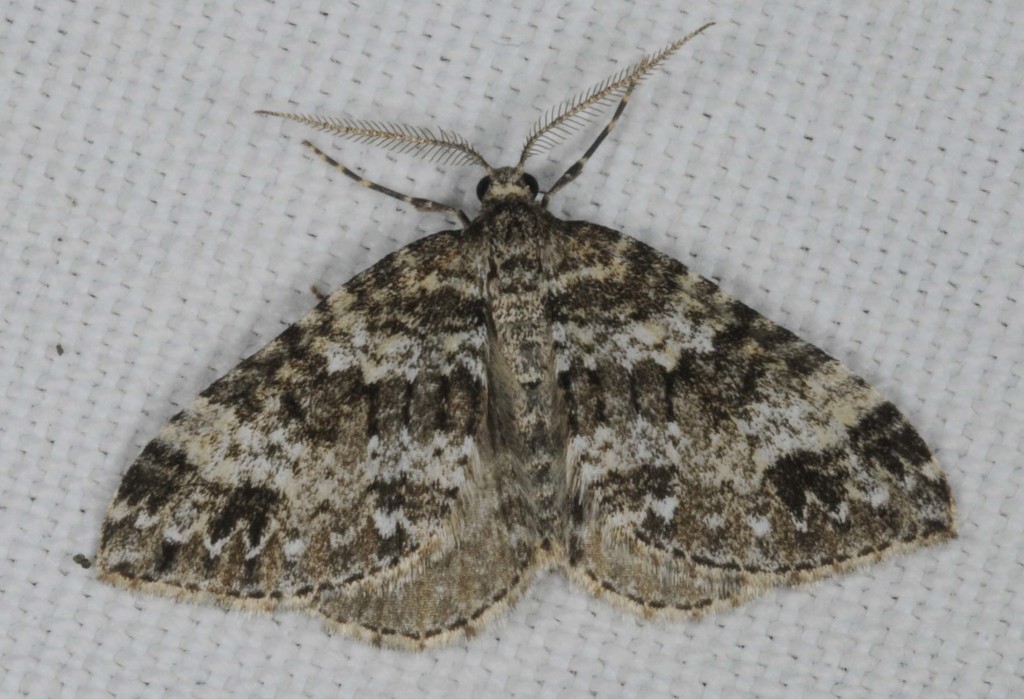
Twin-spot Carpet
Mesotype didymata
Mesotype didymata, the twin-spot carpet, is a moth of the family Geometridae. The species was first described by Carl Linnaeus in his 1758 10th edition of Systema Naturae. Its genus is sometimes included in Perizoma.
From the article Mesotype didymata on Wikipedia (CC BY-SA), quoted section by section
Description
The wingspan is 24–29 mm. The ground colour of the forewings is generally pale or dark grey. There are two dark stains near the apex and the costa of the forewing. The wavy crosslines delimit a darker mid field and a darker marginal field. It is very variable in colour, with the male considerably darker than the female; in some districts the sexual dimorphism is quite striking. This sex is also appreciably smaller and narrower-winged than the male and has a much stouter abdomen. - ab. ochroleucata Auriv. is unicolorous grey yellow or yellow brown without markings except the light subterminal line. - In ab. nigrofasciata Rbl. The ground colour is darkened and the median band narrow, almost black. - ab. nigra Prout has uniform blackish brown wings. In hethlandica Rbl. the male is more or less bright orange brown, the female lighter ochreous brown or fawn colour.
The larva is long and slender and differs so from most species of the genus Perizoma. It is grey-green in colour with short, dark brushes.
Range & habitat
It is found in northern and central Europe; further south and east it seems to be confined to the mountains Pyrenees, Alps, Urals.
Wikipedia: “Distribution”
Listen
Looking for field recordings…
Where it lives
Recorded sightings
—
geo-referenced records in GBIF, from museums, herbaria and field observers.
Drag the globe to turn it. Dots are where records exist, not a range map; darker means more records.
In the stacks
Searching the stacks…
Every page naming Mesotype didymata in the Biodiversity Heritage Library →
This page is assembled live from iNaturalist, GBIF, Wikipedia, the Source Library and the Internet Archive. It is not yet part of the hand-edited codex. iNaturalist taxon 466356.