- Plants
- ›Vascular Plants
- ›flowering plants
- ›monocots
- ›Agaves, Orchids, Irises, and Allies
- ›Orchids
- ›Lower Epidendroid Orchids
- ›Epidendreae
- ›Cattleya Alliance Orchids
- ›Epidendrum
- ›Epidendrum secundum
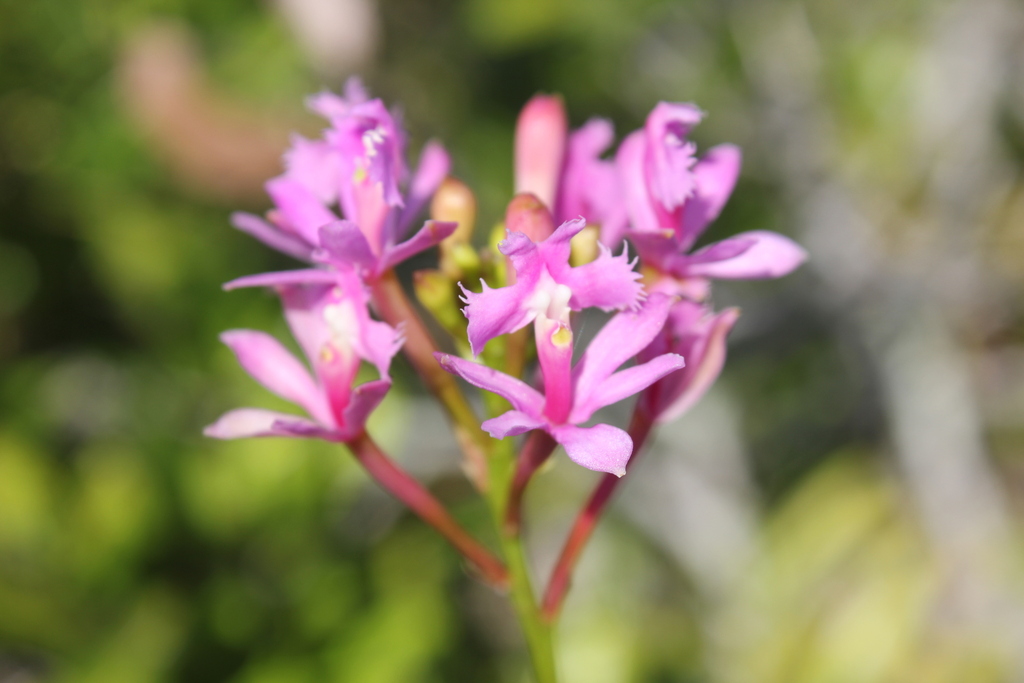
Epidendrum denticulatum
Epidendrum denticulatum, one of the crucifix orchids, is a reed stemmed species which, at least in herbarium specimens, is frequently confused with E. secundum Jacq.
Like E. secundum, the flowers of E. denticulatum are non-resupinate and are born in a congested raceme at the end of a long spike. Like all crucifix orchids, the lip is adnate to the column and bears three lobes, producing the effect of a cross.
From the article Epidendrum denticulatum on Wikipedia (CC BY-SA), quoted section by section
Description
This sympodial reed-stemmed Epidendrum displays a pseudomonopodial habit: an individual stem (to 4 mm in diameter) will grow continuously at the tip for some time, before producing a bloom spike. Nevertheless, the flowers come from the top of the stem (halting its upward growth), and new stems start from buds at the base of the old stems, thus making the plant sympodial, like the rest of the subtribe Laeliinae. Less than ideal lighting will encourage the formation of numerous keikis producing a tangled mass of shoots and roots high up the plant. However, full sunlight will cause most growths to start near the base of old growths, leading to a shorter and "tidier" plant. The long, thin (3 mm or less thick) roots of E. denticulatum are covered with spongy velamen, and extend through the air into the ground. The alternate, coriaceous leaves measure up to 9 cm long and 2 cm wide. The inflorescence is a terminal raceme, filling a globular space that can measure more than 30 cm and can include up to a hundred flowers, with some ten to thirty open simultaneously. A single inflorescence can remain in bloom for up to a year. The flowers may be white, cream, yellow, or orange, but are more commonly lavender. Each flower measures about 2 cm in diameter. …
Range & habitat
Epidendrum denticulatum is grows in tropical dry forests of the Serra do Mar in Brazil, extending from the coastal states of Rio Grande do Sul, to Pernambuco, as well as in the forests of Minas Gerais, at altitudes ranging from 0.5 to 1.4 km. The plant grows both terrestrially and epiphytically. It is most commonly found living among low bushes and at the edge of roads, occasionally forming large tussocks that can measure more than 5 m2. Although there are several references stating that E. denticulatum grows at low altitudes near the sea shore these may be the result of confusing E. denticulatum with other members of the Schistochila Carinata subsection of Epidendrum, such as E. cinnabarinum, E. fulgens, and E. puniceoluteum.
Wikipedia: “Distribution”
In human culture
E. denticulatum was described by John Barbosa Rodrigues in 1881 from a plant with lavender flowers and white and yellow calli found blooming in the month of March on a tree in the forest near Joinville, Santa Catarina.
Wikipedia: “History”
Where it lives
Recorded sightings
—
geo-referenced records in GBIF, from museums, herbaria and field observers.
Drag the globe to turn it. Dots are where records exist, not a range map; darker means more records.
In the stacks
Searching the stacks…
Every page naming Epidendrum denticulatum in the Biodiversity Heritage Library →
This page is assembled live from iNaturalist, GBIF, Wikipedia, the Source Library and the Internet Archive. It is not yet part of the hand-edited codex. iNaturalist taxon 465061.