- Animals
- ›Chordates
- ›Vertebrates
- ›Mammals
- ›Therians
- ›Placental Mammals
- ›Primates, Rodents, and Allies
- ›Rodents
- ›Squirrels, Dormice, and Mountain Beavers
- ›Squirrels
- ›Ground and African Tree Squirrels
- ›Holarctic Ground Squirrels
- ›Ammospermophilus
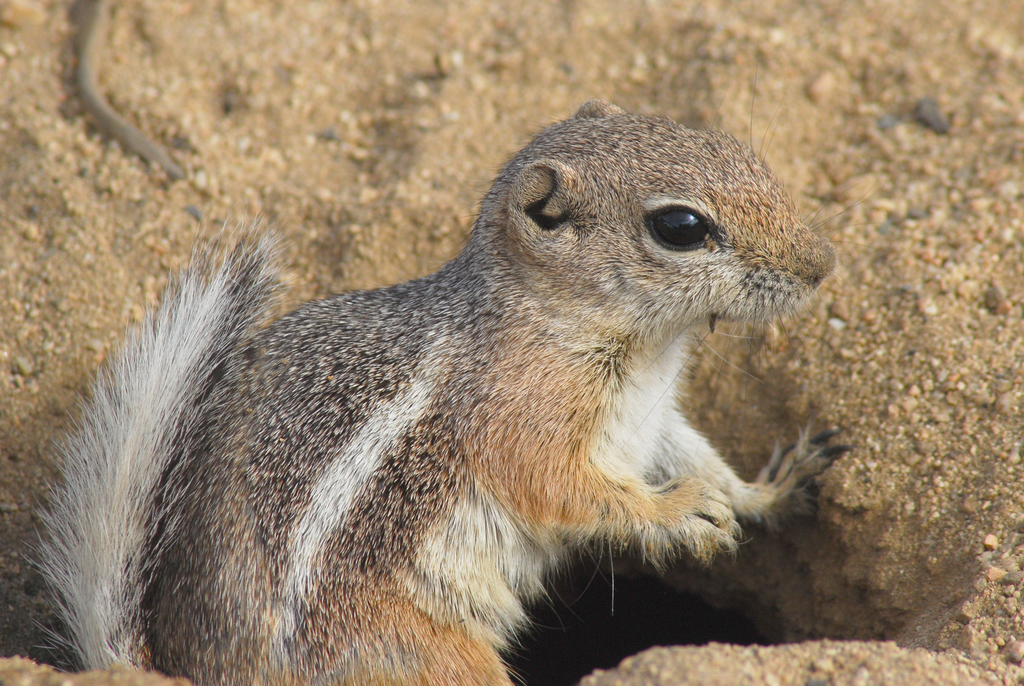
White-tailed Antelope Squirrel
Ammospermophilus leucurus
The white-tailed antelope squirrel (Ammospermophilus leucurus), is a diurnal species of ground squirrel, scientifically classified in the order Rodentia and family Sciuridae, found in arid regions of the southwestern United States and the Baja California Peninsula of northwestern Mexico.
From the article White-tailed antelope squirrel on Wikipedia (CC BY-SA), quoted section by section
Range & habitat
The white-tailed antelope squirrel's geographical range extends north to south from southwestern Oregon to New Mexico, and east to west from western Colorado to Baja California, Mexico.
Wikipedia: “Distribution”
What it does
The white-tailed antelope squirrel is commonly spotted in arid habitats throughout the southwestern United States. Throughout this range, A. leucurus is omnivorous, feeding primarily on foliage (10%-60% of its diet), seeds (20%-50%), arthropods, and to a lesser extent, vertebrates (mainly lizards and rodents; predatory behavior by ground squirrels has been noted). In conjunction with being a predator, the white-tailed antelope squirrel is also prey to many larger animals, including raptors, various canids, and snakes. These squirrels are not only preyed upon by large predators, but they also fall victim to many diverse ectoparasites. These include various ticks, fleas, mites, lice, and a couple species of parasitic larvae.
Wikipedia: “Ecology”
Listen
Looking for field recordings…
Where it lives
Recorded sightings
—
geo-referenced records in GBIF, from museums, herbaria and field observers.
Drag the globe to turn it. Dots are where records exist, not a range map; darker means more records.
In the stacks
Searching the stacks…
Every page naming Ammospermophilus leucurus in the Biodiversity Heritage Library →
This page is assembled live from iNaturalist, GBIF, Wikipedia, the Source Library and the Internet Archive. It is not yet part of the hand-edited codex. iNaturalist taxon 46255.