- Animals
- ›Arthropods
- ›Hexapods
- ›Insects
- ›Winged and Once-winged Insects
- ›Ants, Bees, Wasps, and Sawflies
- ›Narrow-waisted Wasps, Ants, and Bees
- ›Ants, Bees, and Stinging Wasps
- ›Vespoid Wasps
- ›Hornets, Paper Wasps, Potter Wasps, and Allies
- ›Paper Wasps
- ›Polistini
- ›Polistes
- ›Polistes
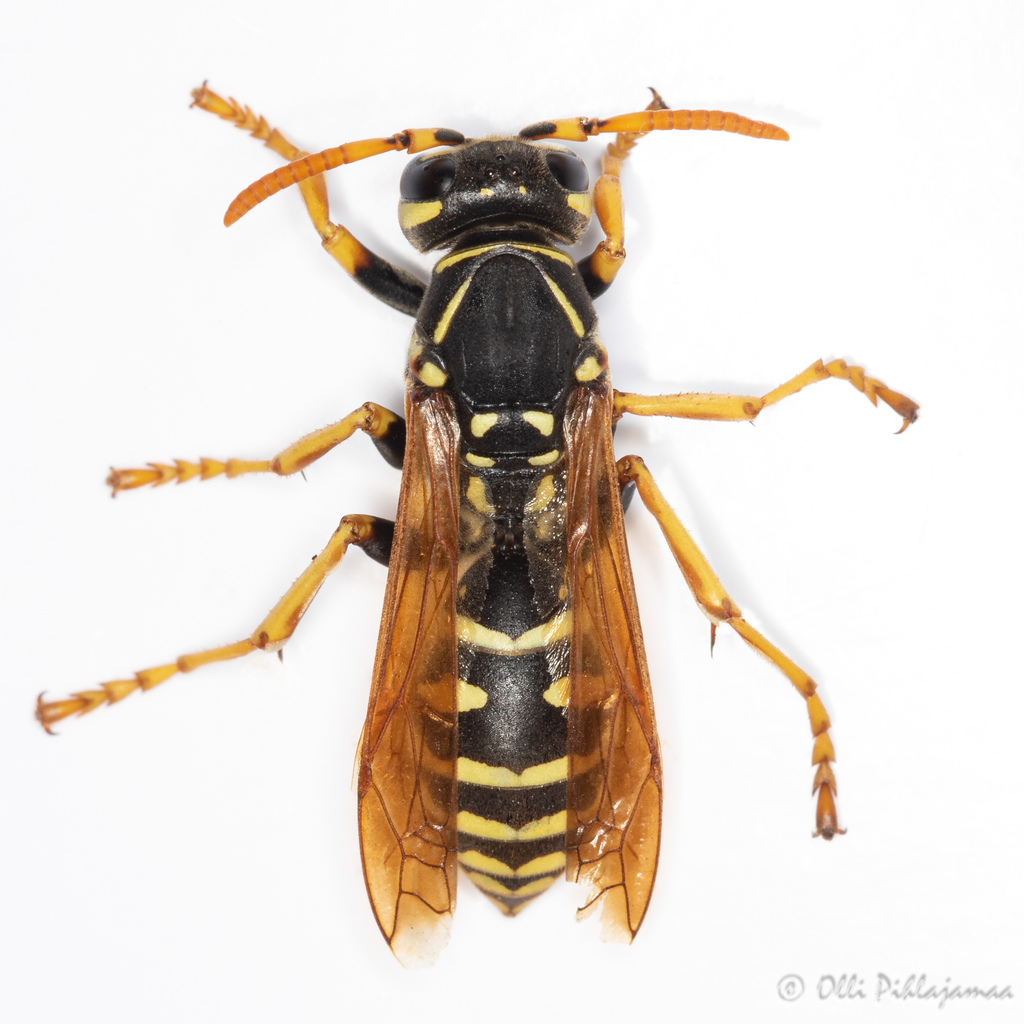
Polistes semenowi
Polistes semenowi is a species of paper wasp in the genus Polistes that is found in southeastern and southern central Europe, as well as central Asia, and was until 2017 erroneously known by the name Polistes sulcifer, while a different species was incorrectly believed to represent P. semenowi (this species has been named Polistes austroccidentalis since 2017). It is one of only four known Polistes obligate social parasites, sometimes referred to as "cuckoo paper wasps", and its host is the congeneric species Polistes dominula. As an obligate social parasite, this species has lost the ability to build nests, and relies on the host workers to raise its brood. P. semenowi females use brute force, followed by chemical mimicry in order to successfully usurp a host nest and take over as the queen.
From the article Polistes semenowi on Wikipedia (CC BY-SA), quoted section by section
Description
Polistes semenowi, like most other paper wasps, are typically 0.7–1.0 inches long. Because it is a social parasite, it is adapted for fighting off the host species, and has some morphological distinctions. P. semenowi is known to have larger mandibles and anterior legs than those of related species. It also has a more square-shaped head, which is hypothesized to have evolved from the need for robust muscles to power the larger mandibles. Additionally, there is often a black band in the lower half of the clypeus. This trait in particular distinguishes it from its host species P. dominula. P. semenowi males typically have a more complete coloration of the body than the females, with the colors ranging from yellow to almost white. A typical paper wasp nest resembles a papery material, and is made of saliva and fibers from wood and plants. P. semenowi, however, has lost the nest making ability. Instead, it relies on the nests of its host species Polistes dominula, whose nests are made of the typical paper material with many combs.
Range & habitat
P. semenowi is found in southeastern and south-central Europe, as well as central Asia.
Wikipedia: “Distribution”
What it does
P. semenowi larvae feed on what P. dominula feeds on, since it is the host workers who are collecting the food. It has been found that P. dominula food is from three insect orders. P. dominula, unlike many other social wasps, is known as a very generalist predator, and is both opportunistic and very flexible in selecting their prey. Adult P. semenowi wasps have been shown to eat the larvae of other insect species including Tenebrio molitor larvae (a beetle species) and fly maggots. It has also been shown that the parasitic P. semenowi female may use the host eggs as nutrition soon after usurpation occurs. Additionally, in P. semenowi, a peculiar phenomenon is observed during usurpation season. The female is known to feed on flowers in the early morning and in the late afternoon. This is thought to have evolved so the female could attempt to usurp in the middle of the day, when the host is out feeding.
== References ==
Wikipedia: “Diet”
Listen
Looking for field recordings…
Where it lives
Recorded sightings
—
geo-referenced records in GBIF, from museums, herbaria and field observers.
Drag the globe to turn it. Dots are where records exist, not a range map; darker means more records.
In the stacks
Searching the stacks…
Every page naming Polistes semenowi in the Biodiversity Heritage Library →
This page is assembled live from iNaturalist, GBIF, Wikipedia, the Source Library and the Internet Archive. It is not yet part of the hand-edited codex. iNaturalist taxon 462033.