- Animals
- ›Arthropods
- ›Hexapods
- ›Insects
- ›Winged and Once-winged Insects
- ›Ants, Bees, Wasps, and Sawflies
- ›Narrow-waisted Wasps, Ants, and Bees
- ›Ants, Bees, and Stinging Wasps
- ›Bees and Apoid Wasps
- ›Bees
- ›Honey Bees, Bumble Bees, and Allies
- ›Apine Bees
- ›Bombini
- ›Bombus
- ›Alpinobombus
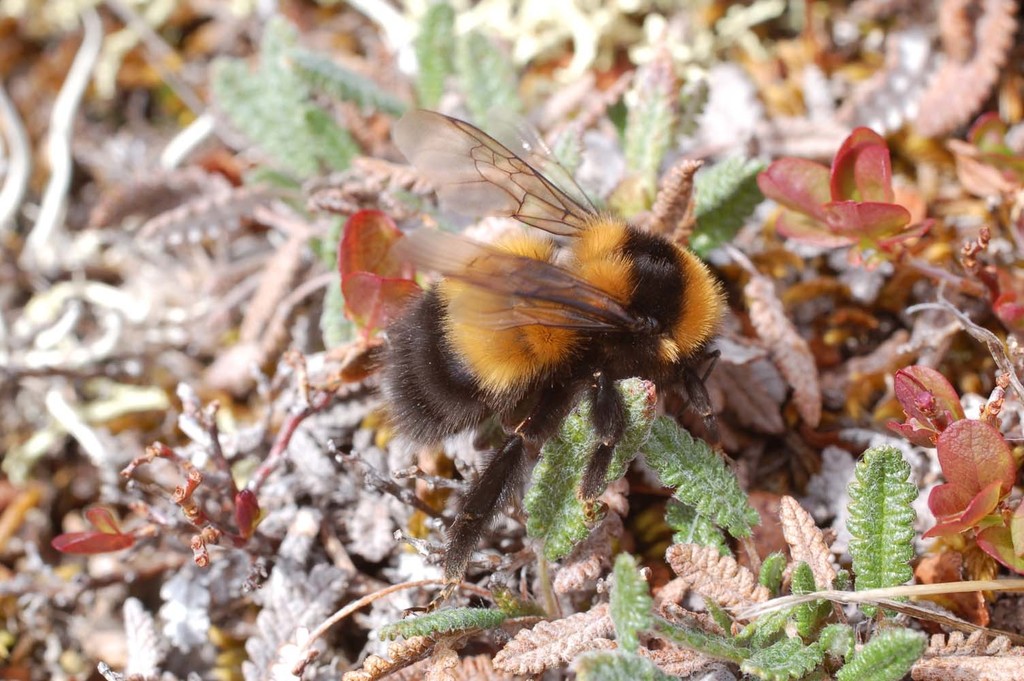
Tundra Bumble Bee
Bombus hyperboreus
Bombus hyperboreus is a species of Arctic bumblebee with a circumpolar distribution. The species is primarily found in the arctic areas of Canada, Greenland, northern Scandinavia, and Russia. In 2015, Bombus natvigi, from the Nearctic, was separated from this species, based on genetic analysis. Subsequent studies considered the genetic differentiation too weak for species status, but instead treat natvigi as a subspecies of hyperboreus. Accordingly, Bombus hyperboreus is now considered to have one subspecies (hyperboreus) limited to the Palaearctic, and the other (natvigi) occurring in North America and Greenland.
It is a brood parasite, and attacks and enslaves other bumblebee colonies in order to reproduce as they do not even have the ability to produce workers themselves. Most of its targets are colonies of species of the same subgenus, Alpinobombus.
From the article Bombus hyperboreus on Wikipedia (CC BY-SA), quoted section by section
Description
Due to its parasitic lifestyle, workers are rarely present. Queens and drones are similar, with the thorax and anterior part of the abdomen brownish-orange. The thorax has a black transversal band, while the last abdominal segments are black. Because the environment the species inhabits is cold and windy, it is suggested that their black bands act as a method to increase their body temperature through solar radiation, and their long, dense hair coat minimizes insulation loss. The mean length of the queen is relatively large at 18.4 millimetres (0.72 in) and is presumed to allow the species to counter the strong effects of the windy and cold environment.
Range & habitat
Members of the subgenus Alpinobombus, including B. hyperboreus, live in grasslands and shrub land in high Arctic and alpine areas, otherwise known as the Arctic tundra. They are distributed in the Arctic, Palearctic, and western Nearctic regions. The distribution of the species in terms of altitude varies depending on the season. During the summer, B. hyperboreus makes use of the entire altitudinal range (350–1,500 metres (1,150–4,920 ft)). However, they tend to inhabit and forage at basal altitudes in the spring and higher altitudes towards the end of the summer and beginning of autumn.
Wikipedia: “Distribution and habitat”
What it does
Bombus hyperboreus have a varied diet and mostly forage on medium to deep flowers. Some species that have been observed pollinating are of the genus Pedicularis, specifically Pedicularis hirsuta and Pedicularis lapponica. However, they are not limited to just those species. Near Lake Latnjajaure of northern Sweden, Bombus hyperboreus have been observed collecting pollen and nectar of Saxifraga oppositifolia and then switching to forage on Astragalus alpinus and Bartsia alpina once those come into flower. The flowers they forage on also vary depending on the season and altitude of their habitation. In Mt. Njulla of northern Sweden, for example, in the beginning of the summer, Rhododendron lapponicum and Salix species dominate their diet, but as the season goes on, their diet changes to consumption of Vaccinium species mid-summer and, finally, to consumption of Astragalus alpinus and Solidago virgaurea towards the beginning of August.
Wikipedia: “Diet”
Listen
Looking for field recordings…
Where it lives
Recorded sightings
—
geo-referenced records in GBIF, from museums, herbaria and field observers.
Drag the globe to turn it. Dots are where records exist, not a range map; darker means more records.
In the stacks
Searching the stacks…
Every page naming Bombus hyperboreus in the Biodiversity Heritage Library →
This page is assembled live from iNaturalist, GBIF, Wikipedia, the Source Library and the Internet Archive. It is not yet part of the hand-edited codex. iNaturalist taxon 452448.