- Animals
- ›Arthropods
- ›Hexapods
- ›Insects
- ›Winged and Once-winged Insects
- ›Ants, Bees, Wasps, and Sawflies
- ›Narrow-waisted Wasps, Ants, and Bees
- ›Ants, Bees, and Stinging Wasps
- ›Bees and Apoid Wasps
- ›Bees
- ›Honey Bees, Bumble Bees, and Allies
- ›Apine Bees
- ›Bombini
- ›Bombus
- ›Psithyrus
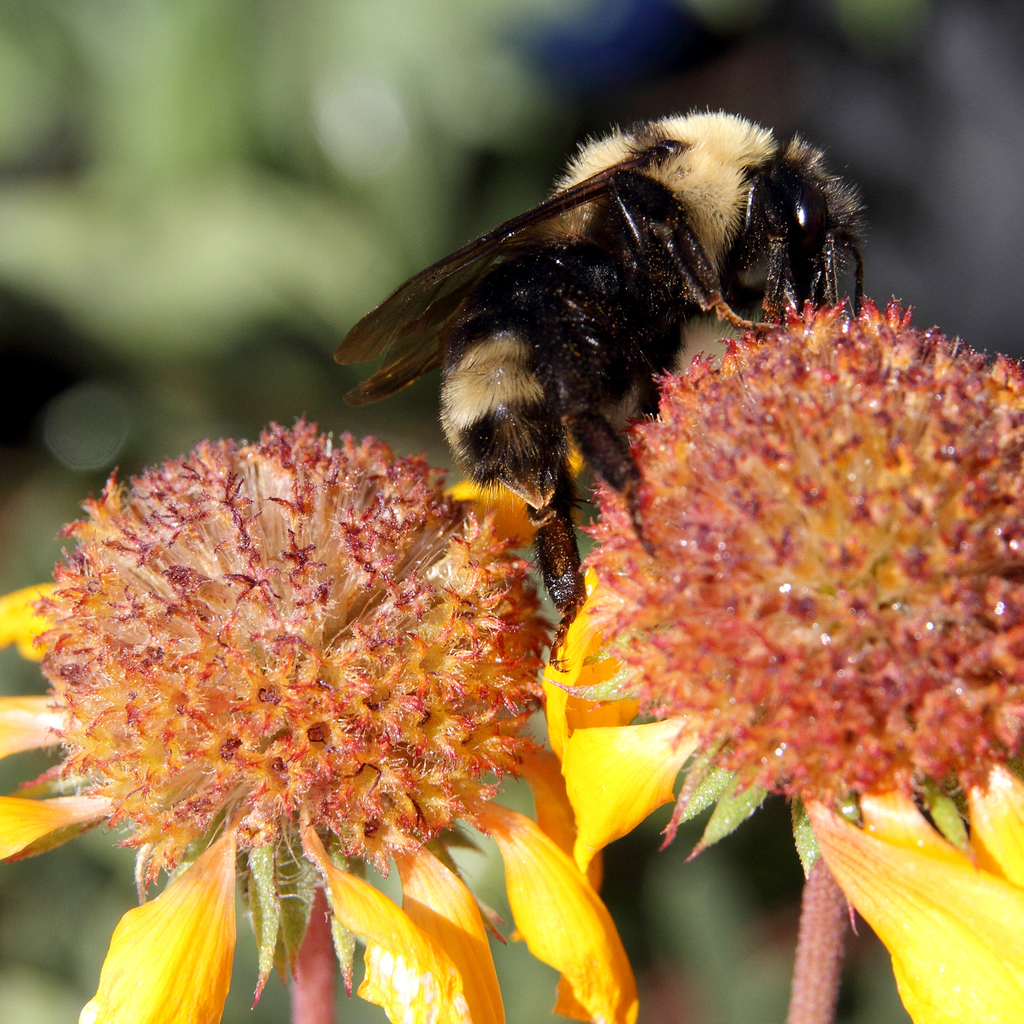
Suckley's Cuckoo Bumble Bee
Bombus suckleyi
Bombus suckleyi is a species of bumblebee known commonly as Suckley's cuckoo bumblebee, named after biologist George Suckley. Suckley's bumble bee is a generalist pollinator and represents a rare group of obligate, parasitic bumble bees (cuckoo bumble bees). Suckley's bumble bee is a social-parasite because it invades the nests of the host bumble bees, including the western bumble bee (Bombus occidentalis), and relies on host species workers to provision its larvae. It is native to northwestern North America, including Alaska and parts of western and central Canada and the western United States.
From the article Bombus suckleyi on Wikipedia (CC BY-SA), quoted section by section
Description
Suckley's bumble bee is a member of the subgenus Psithyrus which contains all cuckoo bumble bees. This subgenus differs morphologically from other Bombus subgenera primarily because its members do not have corbicula (pollen-carrying baskets) on the tibia of their hind legs. Cuckoo bees do not gather nectar or pollen for their own brood and have lost the ability to carry large amounts of pollen and nectar on their body. Suckley's bumble bee can be distinguished from other bees based on physical characteristics and coloration. It is most similar to the Ashton cuckoo bumble bee (Bombus bohemicus), the indiscriminate bumble bee (Bombus insularis), and the Fernald cuckoo bumble bee (Bombus flavidus). Suckley's bumble bee females are 0.72–0.92 in (18–23 mm) in length and covered in short hair of even length that is black, yellow, or white. The hind tibia has a round, convex shape with dense hairs and no pollen carrying basket. Suckley's bumble bee females have variable coloration with black faces and predominately yellow thorax. …
Wikipedia: “Description and identification”
Range & habitat
Suckley's bumble bee inhabits western meadows at a wide range of elevations. Like all bumble bees, Suckley's bumble bee requires suitable nesting sites for colonies, nectar and pollen resources during the colony period (spring, summer, and fall), and suitable overwintering sites for mated females. Suckley's bumble bee has historically been widespread across the western United States in a variety of meadow ecosystems. Historic observations have been most often made at higher elevations meadows within forest or subalpine zones. Meadows often exist within patchy meadow-complexes and bumble bees are able to exploit scattered resources because they are mobile compared to other insects. Quality and quantity of bumble bee habitat varies at a landscape scale and bumble bees routinely forage over relatively large distances of > 1.25 miles (> 2 km) and require approximately 815–2,500 acres (3.3–10 km2) of suitable habitat to sustain viable populations. The quantity and quality of floral resources within Suckley's range varies greatly, and floral-rich meadows are often interspersed within forests or exist in field margins and hedgerows within a matrix of flower-poor agricultural land. Suckley's bumble bee and its host species rely on flowers through the entire growing season to produce large colonies. …
Wikipedia: “Habitat”
What it does
Suckley's bumble bee is a cuckoo bumble bee or social parasite of other Bombus species. Its life cycle is directly linked to a host species for survival because they have lost the ability to collect sufficient pollen and nectar to produce colonies. All individual Suckley's bumble bees are able to reproduce and there is no sterile worker caste, differing from eusocial Bombus species. Suckley's bumble bee females emerge later in the season than host species and invade a host colony by killing or subduing the resident queen. A Suckley's bumble bee female is not strictly speaking a queen because she does not produce any worker bees of her own, and instead controls the host workers to continue collecting pollen and nectar to provision her offspring. Once developed, individuals leave the nest to mate; mated females feed on nectar and pollen prior to overwintering and males die after mating. Females emerge in the spring and forage until they find a suitable host colony to invade. Suckley's bumble bee has been documented breeding in colonies of B. occidentallis and has been recorded in colonies of B. terricola, B. rufocinctus, B. fervidus, and B. nevadensis, and B. appositus. Suckley's bumble bee females in California are active from late May to late October, with their greatest activity in June. …
Wikipedia: “Life cycle and behavior”
Listen
Looking for field recordings…
Where it lives
Recorded sightings
—
geo-referenced records in GBIF, from museums, herbaria and field observers.
Drag the globe to turn it. Dots are where records exist, not a range map; darker means more records.
In the stacks
Searching the stacks…
Every page naming Bombus suckleyi in the Biodiversity Heritage Library →
This page is assembled live from iNaturalist, GBIF, Wikipedia, the Source Library and the Internet Archive. It is not yet part of the hand-edited codex. iNaturalist taxon 452445.