- Plants
- ›Vascular Plants
- ›flowering plants
- ›Dicots
- ›pepper plants, birthworts, and allies
- ›lizard's tail family
- ›Saururus
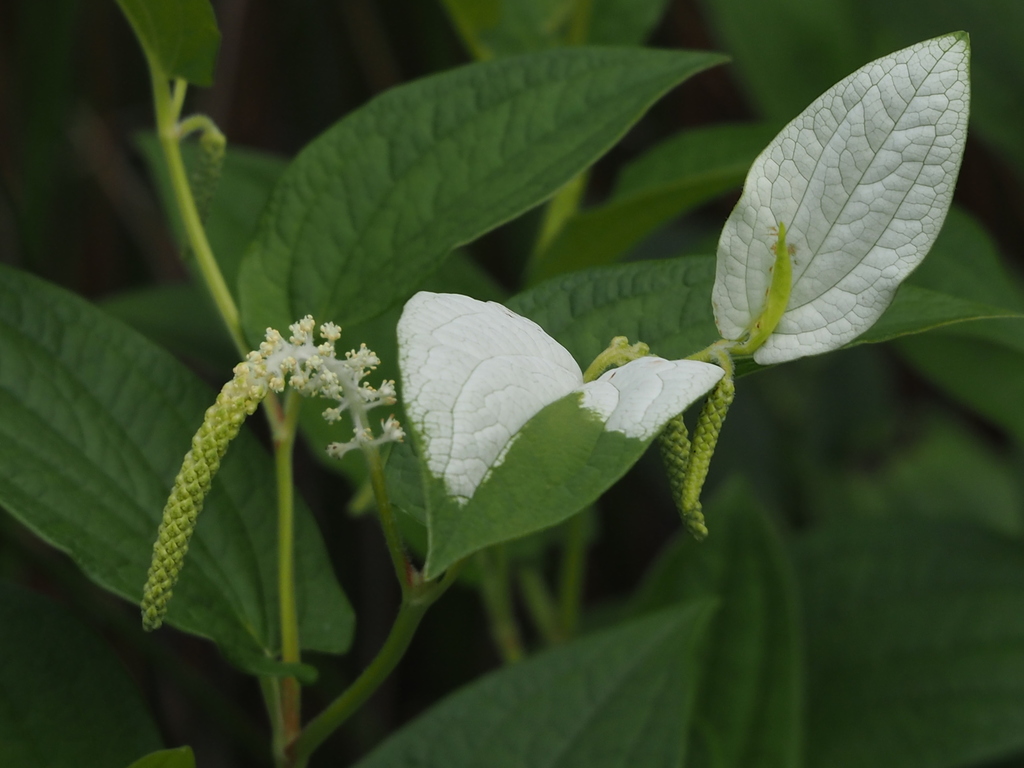
Asian Lizard's Tail
Saururus chinensis
Saururus chinensis, commonly known as Asian lizard's tail, is an herb that grows in low, damp places to more than 1 meter high, endemic to China, India, Japan (including the Ryukyu Islands), Korea, Philippines, and Vietnam. Its leaves are green, papery, ribbed, densely glandular, and ovate to ovate-lanceolate, and (4-)10-20 × (2-)5-10 cm in size. Each flower spike resembles a lizard's tail.
From the article Saururus chinensis on Wikipedia (CC BY-SA), quoted section by section
Description
It is an herb that grows in low, damp places to more than 1 meter high. Its leaves are green, papery, ribbed, densely glandular, and ovate to ovate-lanceolate, and (4-)10-20 × (2-)5-10 cm in size. Each flower spike resembles a lizard's tail.
Range & habitat
It is native to North-Central, South-Central and Southeast China, Hainan, Japan, Korea, the Philippines, Qinghai, the Ryukyu Islands, Taiwan, and Vietnam.
Wikipedia: “Distribution”
At the table
Saururus chinensis been used to treat inflammation in diverse conditions such as edema, gonorrhea, and asthma.
Wikipedia: “Traditional medical uses”
Where it lives
Recorded sightings
—
geo-referenced records in GBIF, from museums, herbaria and field observers.
Drag the globe to turn it. Dots are where records exist, not a range map; darker means more records.
In the old herbals & bestiaries


In the stacks
Searching the stacks…
Every page naming Saururus chinensis in the Biodiversity Heritage Library →
This page is assembled live from iNaturalist, GBIF, Wikipedia, the Source Library and the Internet Archive. It is not yet part of the hand-edited codex. iNaturalist taxon 452025.