- Plants
- ›Vascular Plants
- ›flowering plants
- ›Dicots
- ›Roses, Elms, Figs, and Allies
- ›elm family
- ›Ulmus
- ›Oreoptelea
- ›Blepharocarpus
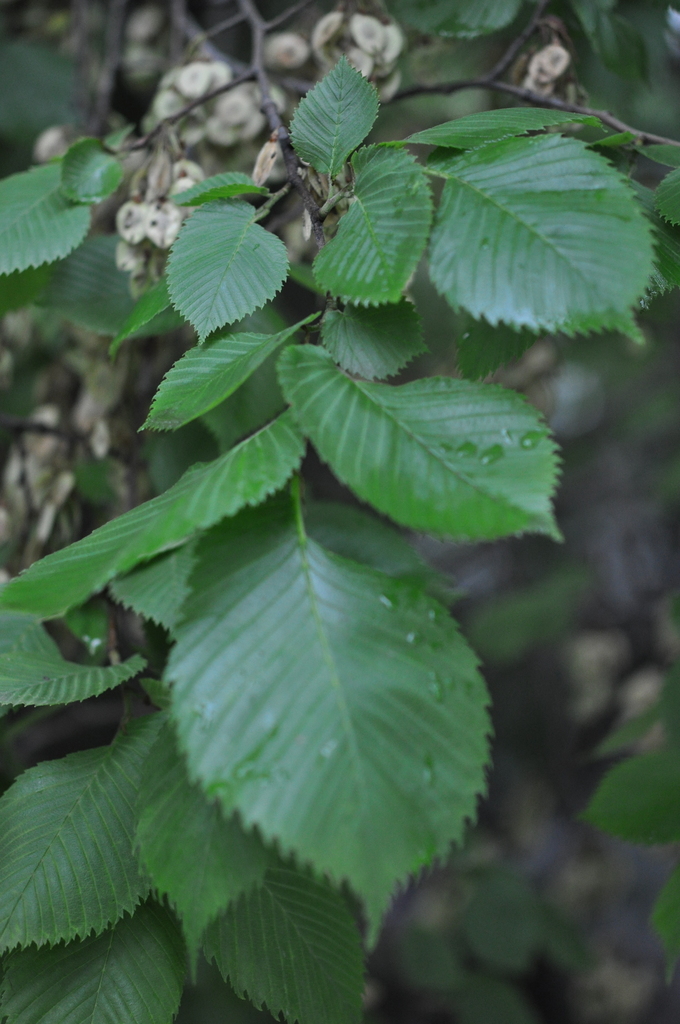
Fluttering Elm
Ulmus laevis
Ulmus laevis Pall., variously known as the European white elm, fluttering elm, spreading elm, stately elm and, in the United States, the Russian elm, is a large deciduous tree native to Europe, from France northeast to southern Finland, east beyond the Urals into Kyrgyzstan and Kazakhstan, and southeast to Bulgaria and the Crimea; there are also disjunct populations in the Caucasus and Spain, the latter now considered a relict population rather than an introduction by man, and possibly the origin of the European population. U. laevis is rare in the UK, although its random distribution, together with the absence of any record of its introduction, has led at least one British authority to consider it native. NB: The epithet 'white' elm commonly used by British foresters alluded to the timber of the wych elm.
The species was first identified, as Ulmus laevis, by Pallas, in his Flora Rossica published in 1784. The tree is allogamous and is most closely related to the American elm U. americana.
From the article Ulmus laevis on Wikipedia (CC BY-SA), quoted section by section
Description
Ulmus laevis is similar in stature to the wych elm, if rather less symmetric, with a looser, untidy, branch structure and less neatly rounded crown. The tree typically reaches a height and breadth of > 30 m, with a trunk < 2 m d.b.h. The extensive shallow root system ultimately forms distinctive high buttresses around the base of the trunk. The bark is smooth at first, then in early maturity breaks into thin grey scales, which separate with age into a network of grey-brown scales and reddish-brown underbark, and finally is deeply fissured in old age like other elms. The leaves are deciduous, alternate, simple ovate with a markedly asymmetric base, < 10 cm long and < 7 cm broad, comparatively thin, often almost papery in texture and very translucent, smooth above with a downy underside. Significantly, the leaf veins do not divide from the central vein to the leaf margin. The leaves are shed earlier in autumn than other species of European elm. The tree is most reliably distinguished from other European elms by its long flower stems, averaging 20 mm. Moreover, the apetalous wind-pollinated flowers are distinctively cream-coloured, appearing before the leaves in early spring in clusters of 15-30; they are 3–4 mm across. The fruit is a winged samara < 15 mm long by 10 mm broad with a ciliate margin, the single round 5 mm seed maturing in late spring. …
At the table
In Finland, young European white elm trees were traditionally grown for the raw material of shaft bows. It's leathery bark was also used in tough bindings. The density of the timber is significantly lower than that of other European elms. However, owing to its rapid growth, tolerance of soil compaction, air pollution and de-icing salts, the tree has long been used for amenity planting in towns and along roadsides.
Wikipedia: “Uses”
How it is grown
U. laevis is essentially a riparian tree, able to withstand over 100 days of continual flooding, although it is intolerant of saline conditions [11] Spanish trees were found to be calcifuge, preferring slightly acid, siliceous soils, and also drought-intolerant, their xylem vessels prone to drought-stress cavitation. In England, the tree failed to prosper in chalk stream valleys, where the soil was predominantly black peat, named 'Adventurers' for the Adventurers' Land SSSI in Cambridgeshire, owing to dehydration in summer. Trees planted in dry ground are notoriously short-lived. U. laevis is comparatively weak-wooded, much more so than field elm Ulmus minor, and thus an inappropriate choice for exposed locations. In trials in southern England by Butterfly Conservation, young trees of <5 m height were badly damaged by wind gusts of 40 knots (75 km/h) in midsummer storms. The species was never widely introduced to the United States, but is represented at several arboreta. Ulmus effusa, supplied by the Späth nursery of Berlin, was planted at the Dominion Arboretum, Ottawa, Canada, in 1896, as U. pedunculata. In the Far East, the tree has been planted in Xinjiang province and elsewhere in northern China; planting in Tongliao City is known to have been particularly successful. White elm is also known to have been introduced to Australia.
Introduction to the UK and Ireland. U. …
Wikipedia: “Cultivation”
Where it lives
Recorded sightings
—
geo-referenced records in GBIF, from museums, herbaria and field observers.
Drag the globe to turn it. Dots are where records exist, not a range map; darker means more records.
In the stacks
Searching the stacks…
Every page naming Ulmus laevis in the Biodiversity Heritage Library →
This page is assembled live from iNaturalist, GBIF, Wikipedia, the Source Library and the Internet Archive. It is not yet part of the hand-edited codex. iNaturalist taxon 450330.