- Plants
- ›Vascular Plants
- ›flowering plants
- ›Dicots
- ›Sunflowers, Bellflowers, Fanflowers, and Allies
- ›Sunflowers, Daisies, Asters, and Allies
- ›Asteroideae
- ›bonesets, blazingstars, and allies
- ›Eupatoriinae
- ›Eupatorium
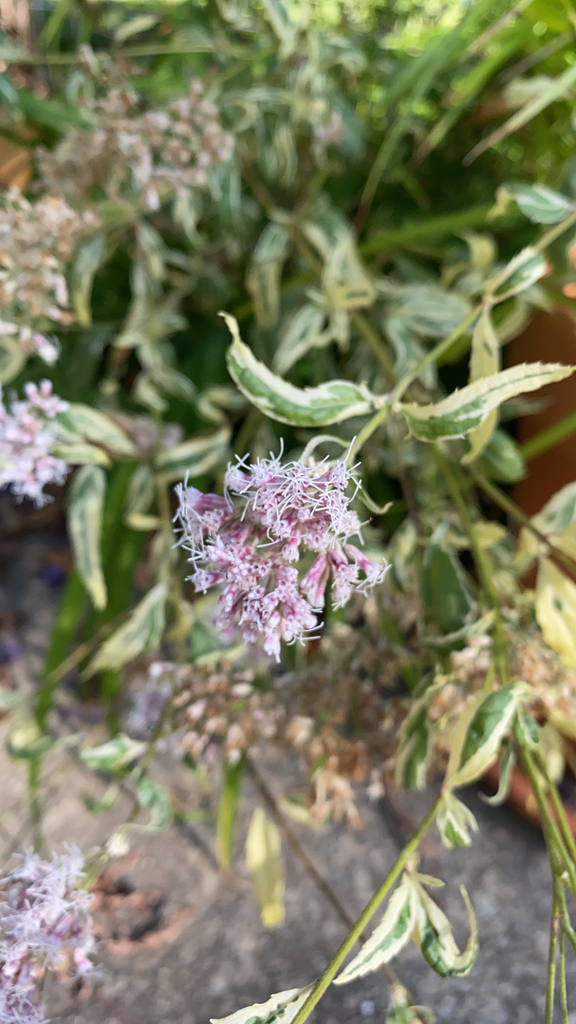
Eupatorium fortunei
Eupatorium fortunei, in Chinese called 佩兰 pei lan, is a plant species in Asteraceae native from Asia where it is rare in the wild but commonly cultivated. The white to reddish colored flowers and herbage smell like lavender when crushed. In China the plants are used to make fragrant oils.
From the article Eupatorium fortunei on Wikipedia (CC BY-SA), quoted section by section
Description
Eupatorium fortunei is a herbaceous perennial that grows 40 to 100 centimeters tall, growing from procumbent rhizomes. Plants are upright growing with green stems that are often tinted with reddish or purple dots. The stems have few branches and the inflorescence is apically branched. Cauline foliage is large with short petioles, the 5 to 10 cm long and 1.5 to 2.5 cm wide leaves are 3-sected or 3-partite and the terminal lobe of the leaves is large and narrowly elliptic to elliptic-lanceolate or oblanceolate shaped. The margins of the leaves are toothed, the largest leaves are produced mid stem and the leaves become smaller as they descend down the stems, the bottom leaves wither away by the time flowering begins. The flowers are in capitula, which are numerous and arranged in apical compound corymbs; inflorescence 3 to 10 cm across. The phyllaries are purple-red, they also lack hairs and glands. The florets are white to reddish in color, have 5 cm wide corolla that also lack glands. The elliptically shaped fruits are 5 angled achenes which are black-brown in color and 3–4 mm long. Pappus is white and about 5 mm long. …
At the table
The plant is used medicinally in both Japan and China. In Traditional Chinese Medicine it is indicated for poor appetite, nausea and vomiting due to 'dampness' obstructions or summer heat. Its modern usage includes stomach flus and acute gastritis, in conjunction with other herbs including Huo Xiang (Agastache rugosa).
Wikipedia: “Uses”
Toxicity
Eupatorium fortunei contains tumorigenic pyrrolizidine alkaloids.
== References ==
Where it lives
Recorded sightings
—
geo-referenced records in GBIF, from museums, herbaria and field observers.
Drag the globe to turn it. Dots are where records exist, not a range map; darker means more records.
In the old herbals & bestiaries

In the stacks
Searching the stacks…
Every page naming Eupatorium fortunei in the Biodiversity Heritage Library →
This page is assembled live from iNaturalist, GBIF, Wikipedia, the Source Library and the Internet Archive. It is not yet part of the hand-edited codex. iNaturalist taxon 447266.