- Animals
- ›Chordates
- ›Vertebrates
- ›Mammals
- ›Therians
- ›Placental Mammals
- ›Primates, Rodents, and Allies
- ›Rodents
- ›Mice, Rats, and Hamsters
- ›Muroids
- ›Old World Mice and Rats
- ›Murines
- ›Typical Old World Mice
- ›Mus
- ›Mus
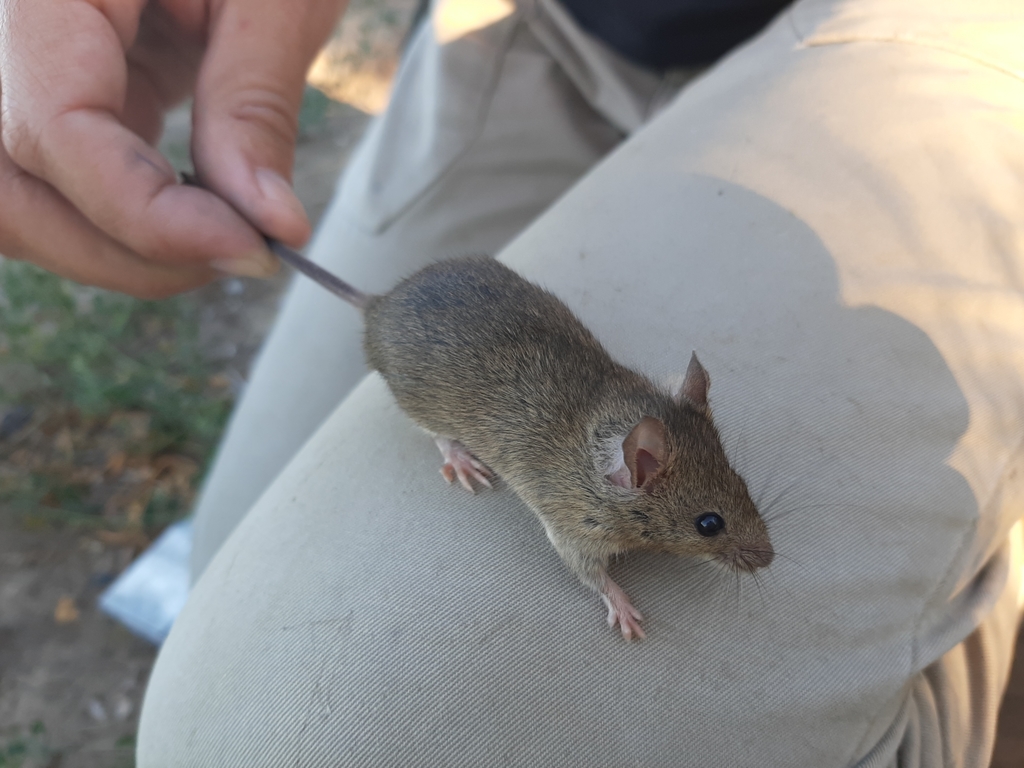
Mound-building Mouse
Mus spicilegus
The steppe mouse or mound-building mouse (Mus spicilegus) is a species of rodent in the family Muridae. It is found in grassland and other open areas in Austria, Bosnia and Herzegovina, Albania, Bulgaria, Croatia, Greece, Hungary, Moldova, Romania, Russia, Serbia, Montenegro, North Macedonia, Slovakia, and Ukraine.
From the article Steppe mouse on Wikipedia (CC BY-SA), quoted section by section
Description
The head-and-body length is between 70 and 80 mm (2.76 and 3.15 in) and the tail is between 55 and 65 mm (2.17 and 2.56 in) long. The colour is mostly a uniform grey with no hint of redness, but some populations are bicoloured and have paler underparts. The tail is more slender than that of other related species. This mouse is very similar in appearance to the common house mouse (Mus musculus), and the two are often confused. The most significant difference is the mound-building proclivities of Mus spicilegus, but these are only apparent at certain times of year.
What it does
This species is found in grassland, steppe, cultivated land, orchards, clearings and woodland borders. It is unique among mice in its habit of building mounds in the autumn. These are constructed by a number of mice and can be up to 4 m (13 ft) in diameter, although a more normal size is 1 to 2 m (3 to 7 ft). Some four to fourteen mice cooperate to build the mounds, and these have been shown to be closely related, probably through the mother's line. The mound is built over storage chambers which can hold up to 10 kg (22 lb) of seeds and grains, underneath which is a nesting chamber. Up to twenty mounds per hectare (eight per acre) is typical but there can be many more than this under particularly favourable conditions. Breeding is seasonal in this mouse, taking place between about March and October. Young females, six to eight months old which have spent the winter in the mound, breed in the spring and may have four or five litters of young during the year; in central Ukraine, the litter size averages 6.7 young. During the summer, most animals live in simple burrows, but some continue to inhabit the mound, and if it survives intact, it may be reused in the autumn for winter quarters. New mounds are constructed between about mid-August and mid-November, when cereal crops are maturing and other plants producing seeds. …
Wikipedia: “Ecology”
Listen
Looking for field recordings…
Where it lives
Recorded sightings
—
geo-referenced records in GBIF, from museums, herbaria and field observers.
Drag the globe to turn it. Dots are where records exist, not a range map; darker means more records.
In the stacks
Searching the stacks…
Every page naming Mus spicilegus in the Biodiversity Heritage Library →
This page is assembled live from iNaturalist, GBIF, Wikipedia, the Source Library and the Internet Archive. It is not yet part of the hand-edited codex. iNaturalist taxon 44702.