- Plants
- ›Vascular Plants
- ›flowering plants
- ›Dicots
- ›Mints, Plantains, Olives, and Allies
- ›figwort family
- ›Buddlejeae
- ›Buddleja
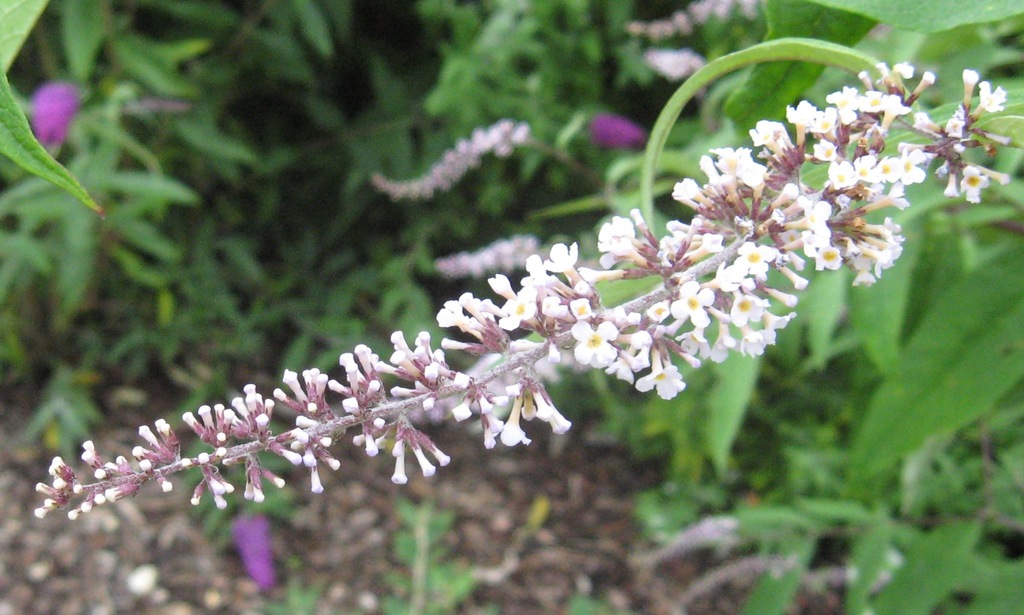
Buddleja albiflora
Buddleja albiflora is a deciduous shrub in the family Scrophulariaceae. It is native to the mountains of central China, where it grows on shrub-clad slopes at altitudes of between 1,000 and 2,000 m. Named rather carelessly by Hemsley, the species was discovered by Henry, and introduced to western cultivation by Wilson in 1900.
From the article Buddleja albiflora on Wikipedia (CC BY-SA), quoted section by section
Description
Buddleja albiflora grows to a height of 4 m in the wild, the branches erect and glabrous. The leaves are narrow lanceolate, with a long-tapered point and wedge-shaped base, 10–22 cm long by 1–6 cm wide, toothed and dark-green, glabrous above in maturity, but covered beneath with a fine silvery-grey felt. The shrub is similar to B. davidii, but has rounded stems, as opposed to the four-angled of the latter. Despite its specific name, the fragrant flowers are actually pale lilac with orange centres, borne as slender panicles 20–45 cm long by 5 cm wide at the base; they are considered inferior to those of B. davidii and thus the plant is comparatively rare in cultivation. B. albiflora is hexaploid: 2n = 114.
How it is grown
The shrub is fully hardy in the UK, and features in the NCCPG National Collection of Buddleja held by the Longstock Park Nursery, near Stockbridge. Hardiness: USDA zones 6–9.
Wikipedia: “Cultivation”
Where it lives
Recorded sightings
—
geo-referenced records in GBIF, from museums, herbaria and field observers.
Drag the globe to turn it. Dots are where records exist, not a range map; darker means more records.
In the stacks
Searching the stacks…
Every page naming Buddleja albiflora in the Biodiversity Heritage Library →
This page is assembled live from iNaturalist, GBIF, Wikipedia, the Source Library and the Internet Archive. It is not yet part of the hand-edited codex. iNaturalist taxon 446881.